2026-07-21
Home
Japanese

Omega Investment Co., Ltd.
Isetan Mitsukoshi Holdings (Price Discovery)
Buy below ¥3,500
Market capitalisation: ¥1,344.8bn
Share price and assumptions are as at 22 July 2026.
| Share price | Forecast EPS | Forecast PER | Actual BPS |
| ¥3,847 | ¥184.3 | 20.9x | ¥1,765 |
| Actual PBR | Forecast ROE | Forecast dividend | Forecast dividend yield |
| 2.18x | 9.9% | ¥80 | 2.08% |
Conclusion
Isetan Mitsukoshi Holdings has evolved into a company capable of sustainably delivering ROE of around 10% and a positive ROIC spread, not merely through an earnings recovery from the COVID-19 pandemic, but by improving its earnings structure through a shift to a “customer-centric business” focused on affluent and identified customers. Debt reduction, proactive shareholder returns and unrealised gains on prime urban properties also support shareholder value. However, at a share price of ¥3,847, a forecast PER of 20.9x and an actual PBR of 2.18x, much of this improvement is already priced in, and the expected return at the current level is not sufficiently attractive. If the share price falls below ¥3,500 without a deterioration in fundamentals that impairs corporate value, the upside to our fair value of ¥4,150 would be a little less than 20%, and we recommend buying actively.
Profile
Shifting to a “customer-centric business” that monetises long-term relationships with affluent customers, centred on department stores
Isetan Mitsukoshi Holdings is one of Japan’s largest department store groups, centred on Mitsukoshi and Isetan. Mitsukoshi traces its origins to Echigoya, founded in 1673, while Isetan was founded in 1886. The two companies integrated their management in 2008. The Group operates mainly domestic department stores, including the Isetan Shinjuku Main Store, Mitsukoshi Nihombashi Main Store and Ginza Mitsukoshi, as well as credit, finance, mutual-aid society and real estate businesses. In recent years, it has made the shift from the traditional store-centred “store business” to a “customer-centric business” a core management strategy, identifying customers through apps, credit cards and private client sales, and increasing purchase frequency and spending through ongoing relationships with individual customers. The company plans to expand its identified-customer base and broaden earnings opportunities by sharing its customer base across Group businesses, including department stores, finance and real estate.
Sales composition by business % (operating margin %): Department store business 82.4% (5.4%), Credit, finance and mutual-aid society business 6.5% (16.6%), Real estate business 5.0% (17.2%), Other 6.1% (12.0%) (FY3/2026)
Stock Hunter’s View
Shift to a “customer-centric business” is paying off; efforts to lock in overseas customers are also being strengthened.
Isetan Mitsukoshi Holdings traces its origins to the kimono shop Echigoya, founded by Takatoshi Mitsui, a merchant in the Edo period. It pioneered innovation in retail business practices through its “cash sales at fixed prices” policy, and that spirit has been carried forward to the present day.
Since the start of the 2020s, the company has shifted towards an affluent-customer business. It has also moved away from the conventional “store-centred retail business” and, in recent years, embarked on a path to renewed growth through a “customer individualisation” strategy centred on customer relationships. Specifically, it identifies store visitors on an individual ID basis through apps and credit cards. These are referred to as “identified customers”, and the business model is designed to offer value personalised to each customer.
Identified customers are less susceptible to the external environment, and continued contact increases both visit frequency and average spending per customer. Annual spending per customer increases progressively from unidentified customers to app members, card members, app-and-card members and then private client customers, with spending per customer doubling across these categories; among overseas customers, conversion to private client customers increases spending per customer to more than five times the original level.
Most recently, sales to Group customers purchasing ¥3mn or more annually have also continued to grow steadily. In FY3/2027, in addition to further progress in customer identification through its premium card strategy, the company will establish CRM (customer relationship management) for overseas customers in the same way as for domestic customers. Operating profit is expected to reach a record high for the fourth consecutive year.
Investor’s View
The transformation of the earnings structure is highly rated, but much of its success is already priced into the current share price.
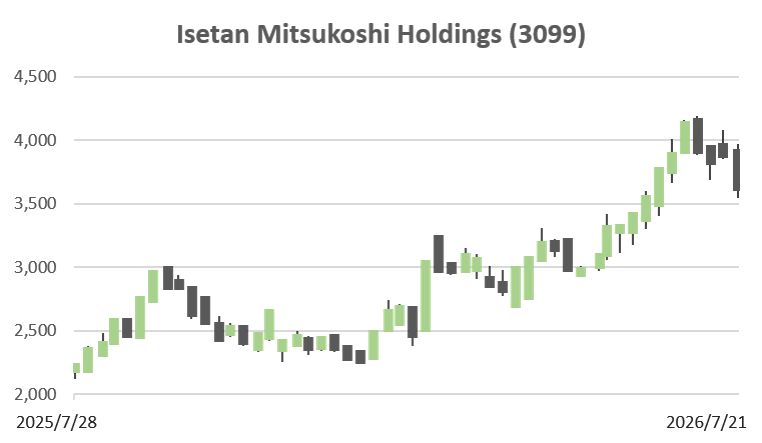
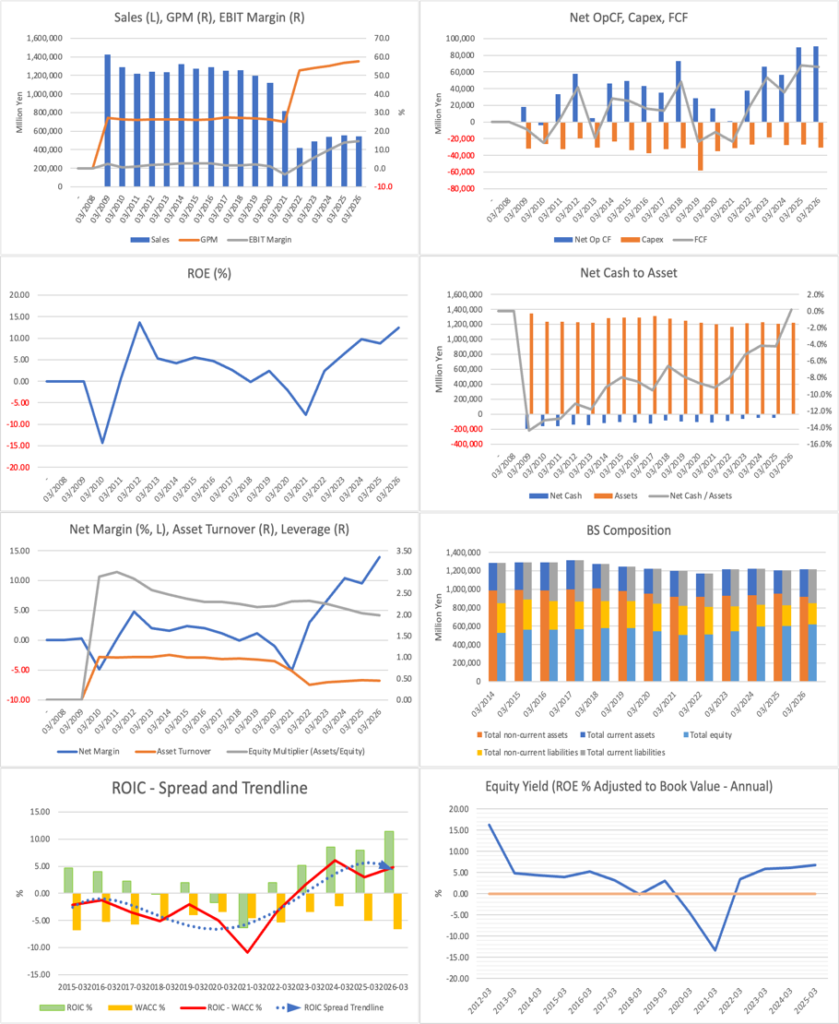
Viewing the change in earnings since FY3/2021 as merely a recovery from the COVID-19 pandemic would understate Isetan Mitsukoshi’s corporate value. In FY3/2021, sales fell sharply because of store closures, shorter opening hours and the disappearance of inbound demand, before recovering from a trough in FY3/2022. However, the recovery in profit far exceeded the normalisation in sales. The pandemic prompted a review of unprofitable businesses and fixed costs, and during the recovery phase the company concentrated management resources on high-priced products, affluent customers, private client sales and identified customers, resulting in a greater improvement in profit margins than in sales. Operating profit improved to ¥80.0bn and ROE to the 12% range in FY3/2026, and the company plans operating profit of ¥81.5bn in FY3/2027, which would mark a record high for the fourth consecutive year.
Particularly noteworthy is that the improvement in ROE has been achieved through higher profit margins rather than financial leverage. Alongside the improvement in earnings power, interest-bearing debt has been reduced, and net interest-bearing debt has effectively turned into net cash. ROIC has also improved to a level above the cost of capital, and the company has changed from a traditional asset-heavy department store operator into a company capable of continuously creating economic value on shareholders’ equity. Forecast ROE of 9.9% in FY3/2027 is close to the normalised level excluding the exceptional factors in FY3/2026, and whether the company can sustain ROE of around 10% will be central to its future valuation.
It is reasonable that this change has been reflected in the share price more through a rise in PBR than through a rise in PER. The share price has risen sharply over the past five years, with PBR increasing from a level once below liquidation value to more than 2x, while the rise in PER has been relatively modest because EPS has also surged. The market has recognised not only a simple earnings recovery, but also the structural transformation into a company capable of sustaining ROE of around 10%. At a share price of ¥3,847, forecast PER is 20.9x, and actual PBR is 2.18x; assuming a payout ratio of around 43% and a cost of equity of 8%, the long-term EPS growth expectation implied by the share price is approximately 5.9%. Going forward, the share price will depend on whether the company can deliver sustainable EPS growth of around 5–6% through deeper penetration among identified customers, collaboration between the finance and real estate businesses, and share buybacks.
The company’s property holdings still contain substantial unrealised value, but the full amount should not be added to equity value. The book value of land on the consolidated balance sheet is approximately ¥540bn and includes prime Tokyo sites such as the Isetan Shinjuku Main Store, Mitsukoshi Nihombashi Main Store and Ginza Mitsukoshi. Assuming a market value for the land of 1.8–2.2x book value, unrealised gains before tax would be approximately ¥430–650bn, or approximately ¥300–450bn after tax, equivalent to approximately ¥860–1,300 per share. However, the land occupied by the flagship stores is itself central to the competitiveness of the department store business. It is not an asset whose value can be realised through a wholesale disposal. Taking redevelopment costs and the time required for value realisation into account, it is realistic to recognise approximately 20–40% of after-tax unrealised gains as shareholder value, equivalent to approximately ¥170–520 per share, with a midpoint of around ¥350 of additional value.
A premium valuation is justified for a department store share, but we do not believe that this premium can expand without limit. Compared with Takashimaya and J. Front Retailing, among others, Isetan Mitsukoshi has clear advantages in its strength in high-value consumption and affluent customers centred on the Isetan Shinjuku Main Store, its ability to identify customers through private client sales, apps and cards, and the asset value of its flagship stores in central urban locations. In addition, because it can secure profits through domestic customers and SG&A control even when sales to overseas customers fluctuate, it is not solely dependent on inbound demand. This high quality justifies a higher valuation than peers, but the current PBR of more than 2x already incorporates a commensurate premium.
Shareholder returns have clearly become more proactive and, given the current financial headroom, should provide an additional driver of shareholder value. In FY3/2026, the total payout ratio, including dividends and share buybacks, rose into the 70% range, and the company intends to continue combining progressive dividends with flexible share buybacks while raising DOE in stages. The shareholder distribution provides high liquidity, and there is no excessive concentration in any particular shareholder. However, a considerable proportion of the holdings of major asset managers is held through index strategies, so the shareholder structure itself does not exert strong pressure on management to improve capital efficiency. In this sense, the current proactive shareholder returns and improvements in capital efficiency must become established as management’s own capital policy.
In conclusion, Isetan Mitsukoshi is worth holding, but it is a share for which the purchase price matters. The central fair value derived from the PBR, DCF and ROIC approaches is approximately ¥4,150, leaving upside of only 7.9% from ¥3,847. By contrast, at ¥3,500 there would be 18.6% upside to fair value, with an even higher expected return if part of the unrealised value of the land is recognised. We regard a share price of ¥3,500 or below, while business fundamentals remain intact, as a level at which investors should buy actively to exploit the gap between corporate value and the share price.
Financials and Valuations
Based on a share price of ¥3,847, forecast EPS of ¥184.3, actual BPS of ¥1,765, forecast ROE of 9.9% and a forecast dividend of ¥80, forecast PER is 20.9x, actual PBR is 2.18x, forecast dividend yield is 2.08%. The forecast payout ratio is 43.4%. We estimate the long-term EPS growth rate priced into the share price at approximately 5.9%.
| Valuation method | Assumptions | Fair value |
| PBR approach | Sustainable ROE 9.5–10.5%, fair PBR 1.9–2.2x | ¥3,350–3,880 Median ¥3,530 |
| DCF approach | Normalised FCF, WACC 6.0–7.0%, terminal growth rate 0.5–1.0% | ¥3,700–4,500 Median ¥4,150 |
| ROIC approach | ROIC 8–11%, WACC 5–7%, continuation of a positive ROIC spread | ¥4,000–4,700 Median ¥4,400 |
We set the fair value range derived from the three approaches at ¥3,500–4,500, with a median of ¥4,150. The current share price of ¥3,847 is within the fair value range and does not represent a substantial discount. By contrast, at ¥3,500 the upside to the median would be 18.6%, and at ¥3,300 it would be 25.8%; we therefore set ¥3,500 or below as a clear buying level.
Shareholder Distribution
FactSet data identify ownership of approximately 54%, while the free-float ratio is approximately 80%, indicating ample liquidity. Domestic and overseas institutional investors such as Nomura Asset Management, Sumitomo Mitsui Trust Asset Management, Amova Asset Management and Vanguard rank among the largest shareholders. At the same time, there is no excessive concentration in any particular shareholder. High liquidity and broad institutional ownership facilitate market price formation and large-scale share buybacks. However, a considerable proportion of the holdings of major asset managers is held through TOPIX- and Nikkei-linked index funds, so the shareholder structure itself does not exert strong pressure on management to improve capital efficiency. The key to enhancing shareholder value is whether the current capital policy, including progressive dividends, a higher DOE and share buybacks, becomes embedded as a discipline exercised by management itself.
Key Charts
Price

PBR (LTM)

PER (LTM)

ROE (LTM)

EPS (LTM)

BPS (LTM)
