2026-10-23
Home
Japanese

Omega Investment Co., Ltd.
Arent (Price Discovery)
Buy
Market Capitalisation: 29.8 billion yen
Share Price: 4,290 yen, based on assumptions as at 21 August 2026.
| Share Price | Forecast EPS | Forecast PER | Actual BPS |
| 4,290 yen | 229.4 yen | 18.7x | 1,063.36 yen |
| Actual PBR | Forecast ROE | Forecast Dividend | Forecast Dividend Yield |
| 4.03x | 21.6% | 0 yen | 0.00% |
Conclusion
BUY. Arent is a small player benefiting from the structurally growing construction DX market, but the DX Business’s high margin of 39.9%, the rising conversion rate from PoC to full-scale development, and the increasing scale and duration of projects indicate that growth is supported not only by industry tailwinds but also by the Company’s own technological capabilities, operational know-how and ability to co-create with clients. The share-price decline in CY2025 reflected a de-rating driven by concerns over the impairment of PlantStream, M&A and slowing DX growth. Meanwhile, the CY2026 rebound reflects easing concerns and a reassessment of business fundamentals. At 4,290 yen, the shares trade at a forecast PER of 18.7x and actual PBR of 4.03x. Although the Company pays no dividend and uncertainty remains over the profitability of the Product Business following M&A and its medium- to long-term competitive market share, the valuation does not appear overheated given forecast ROE of 21.6% and renewed acceleration in growth in the DX Business. We estimate a fair-value range of 4,200-6,000 yen using three methodologies, with a median of 5,000 yen, and judge the risk-reward to favour BUY.
Profile
A high-margin niche player built around tacit knowledge in construction and 3D technology, expanding DX co-creation and products
Arent provides DX consulting, system development and software sales, primarily to the construction industry. The DX Business identifies operational issues at major construction and building-services companies and provides end-to-end support from consulting through PoC, full-scale development and business launch. The Product Business sells software developed in-house and acquired through M&A. Its strengths are 3D/CAD-based technological capabilities, knowledge of construction operations, and the ability to build businesses jointly with clients through to launch, with a principal focus on niche operations where BIM/SaaS adoption has lagged. In FY6/2026, the DX Business maintained high profitability while the product portfolio expanded through M&A. Going forward, growth will focus on increasing the scale of DX projects, improving profitability in the Product Business, and improving development and sales productivity through AI.
Revenue mix by business (operating margin): DX Business 65.4% (39.9%), Product Business 34.6% (0.1%) (FY6/2026)
Note: Segment profit is on an operating-profit-before-goodwill-amortisation basis, with goodwill amortisation added back to operating profit.
Stock Hunter’s View
Growth driven by DX consulting for the construction industry. Earnings expansion accelerates as projects increase in scale and conversion to full-scale development rises.
Arent (5254) has two core businesses: the DX Business, which provides DX consulting services specialised in the construction industry through system development, and the Product Business, which sells in-house products on a subscription basis. The construction industry comprises a collection of niche areas where many inefficient processes remain without BIM or SaaS adoption, and the Company develops products jointly with client companies.
BIM is a method in which computers automatically generate 3D drawings of buildings and centralise and utilise all information from design through construction and maintenance. Unlike CAD, which is limited to digitising drawings, BIM can centrally manage not only drawings but also object-based information such as quantities, part numbers, dimensions and materials. To improve productivity in the construction industry, Japan’s Ministry of Land, Infrastructure, Transport and Tourism made the use in public works the general rule from 2023, and BIM has become a foundation for DX in the construction industry.
FY6/2027 guidance calls for revenue of 8.465 billion yen (+45.2% YoY) and operating profit of 1.706 billion yen (+84.9% YoY). In the DX Business, large orders and the transition of new projects to full-scale development progressed in the previous fiscal year. The pipeline has shifted “from quantity to quality”, with a growing stock of high-quality leads. This fiscal year, further revenue growth is expected from progress on existing projects as well as contributions from projects that slipped from the previous period.
Meanwhile, in the Product Business, the appointment of Tsuyoshi Kimura, a former director of KEYENCE Corporation, has improved sales efficiency through a KEYENCE-style consultative sales approach. Cost optimisation has also contributed, and the earnings structure is becoming more stable.
Investor’s View
A phase of reassessing the growth capacity of the core DX Business following the CY2025 de-rating
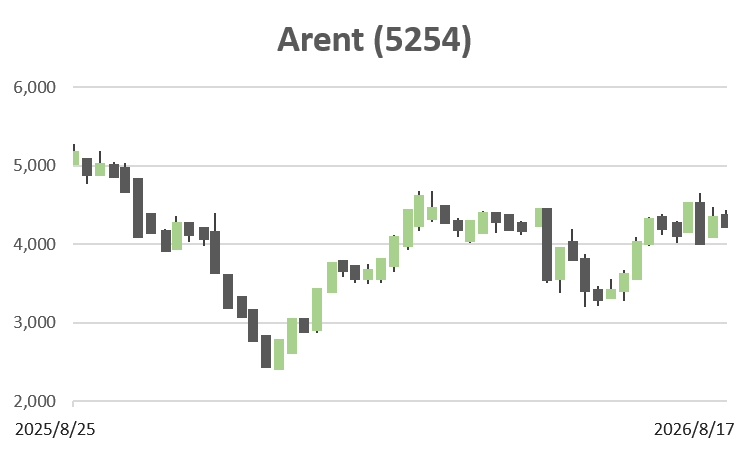
The sharp decline in CY2025 and rebound in CY2026 can be explained more by changes in the market’s assessment of Arent-specific execution risk than by the construction DX market itself. In CY2025, the impairment of PlantStream, uncertainty over the performance of companies acquired through M&A, and concerns over slowing growth in the DX Business combined to strip away the premium attached to Arent as a high-growth DX company. The share price is up approximately 46% year to date in CY2026, but much of this reflects a reversal of the concerns priced in during the previous year, supported by a share buyback of up to 700 million yen and 202,000 shares, the increasing scale of DX projects, a high conversion rate to full-scale development, and profit contributions from subsidiaries acquired through M&A. The share-price chart and trends in PBR and PER also suggest that the valuation remains in the process of normalising rather than having returned to the extreme growth premium seen immediately after listing.
Strong earnings reflect not only industry tailwinds but also clear contributions from the DX Business’s own competitive strengths. Consolidated revenue increased 44.7% YoY to 5.83 billion yen in FY6/2026, while the DX Business generated 3.97 billion yen of revenue, up 17.1%, and maintained a segment profit margin of 39.9%. The conversion rate from PoC to full-scale development rose to 75.5%, while the duration of full-scale development extended to 29 months, indicating that projects are deepening within clients. For FY6/2027, the Company plans revenue of 8.465 billion yen and operating profit of 1.706 billion yen, but consolidated growth also includes the full-year contribution of subsidiaries acquired through M&A; the headline growth of 45% should therefore not be regarded as purely organic. The key question is whether the core DX Business can reaccelerate through larger and longer-duration projects, while improved development efficiency through AI represents potential upside.
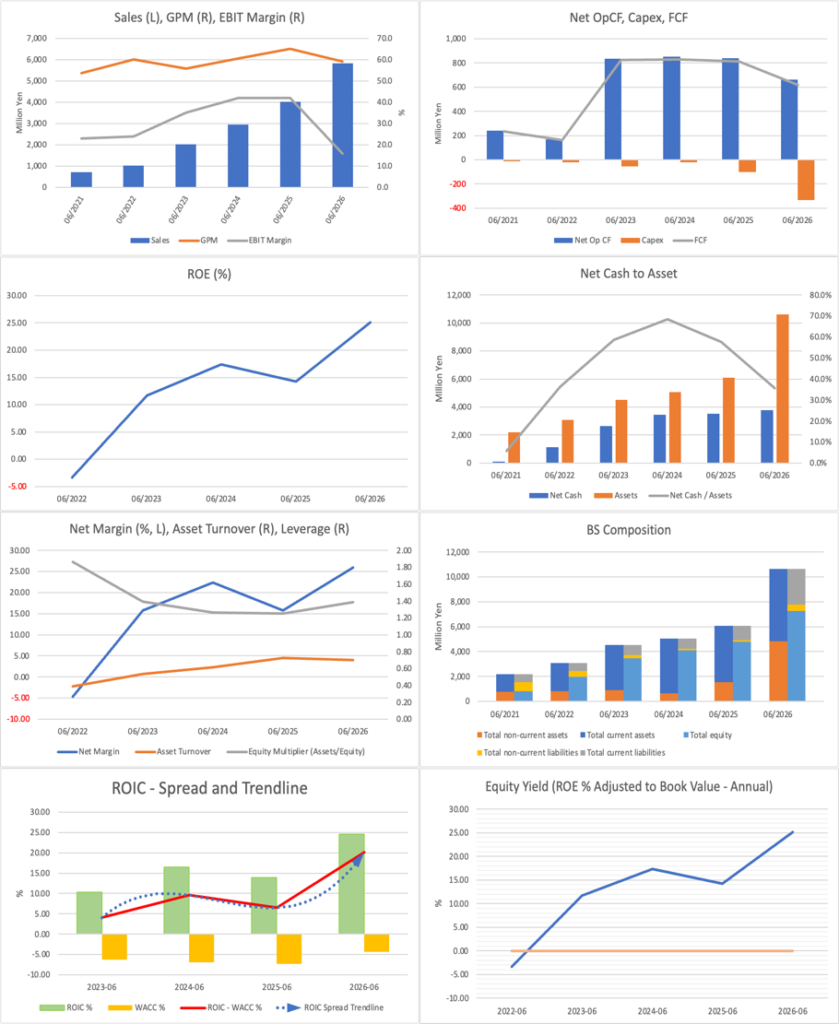
While the improvement in ROE and ROIC is positive from a financial perspective, the change in asset quality resulting from M&A should not be overlooked. ROE has risen markedly, and the ROIC-WACC spread has widened, but total assets increased from 6.08 billion yen in FY6/2025 to 10.62 billion yen in FY6/2026, with goodwill reaching 2.54 billion yen. Operating cash flow and FCF after capex remain positive, although Net Cash to Assets has declined from its previous peak. The DX Business is an asset-light, high-ROIC model, but shareholder value will depend on whether capital efficiency can be maintained after adding product assets through M&A. The Product Business expanded to 2.02 billion yen in FY6/2026, while its segment profit margin was near zero; the next point of assessment is therefore profitability rather than revenue scale.
The biggest medium- to long-term issue is that the Company remains small relative to the enormous DX market, making its future competitive market share difficult to assess with high confidence. The Company estimates construction IT investment at approximately 1 trillion yen, IT investment by major construction companies at approximately 550 billion yen, and the market it can address at approximately 55 billion yen; FY6/2026 revenue of 5.83 billion yen is small relative to the market as a whole. Competitors span major systems integrators, BIM/CAD vendors, construction SaaS providers and clients’ in-house development. At the same time, generative AI may raise Arent’s productivity but also lower barriers to entry in development. However, the Company is not seeking to compete head-on in the general-purpose BIM market; instead, it enters operational areas where BIM/SaaS adoption has lagged, co-creates with major clients and develops these relationships into long-term projects. We therefore do not view the Company as unable to survive because of its small size, but it is not yet at a stage where a high multiple should be assigned on the assumption of medium- to long-term market-share expansion.
The valuation is not Deep Value, but it is also difficult to regard it as overheated if growth reaccelerates. At a share price of 4,290 yen, the shares trade at a forecast PER of 18.7x and actual PBR of 4.03x, with forecast ROE of 21.6%; the earnings yield implied by ROE divided by PBR is approximately 5.36%. With no dividend, shareholder returns depend heavily on earnings growth and share-price appreciation, but the current PER is acceptable if the DX Business can sustain growth of around 20% or more together with high margins. Conversely, if profitability in the Product Business is delayed and the scale-up of DX projects runs its course, a PBR of 4x leaves room for downward adjustment. Our median fair value of 5,000 yen is approximately 17% above the current share price. The margin of safety is not large, but given the starting point following the CY2025 de-rating and current earnings momentum, our investment view is BUY.
Valuation
Even after discounting the sustainability of high ROE, the median of the three methodologies is above the current share price
| Valuation Method | Key Assumptions | Fair Value Range | Median |
| PBR Method | Normalised ROE 19-22%, cost of equity 8.5-10.0%, long-term growth 3-4%, normalised PBR 4.0-5.0x |
4,250-5,300 yen | 4,800 yen |
| DCF Method | Revenue CAGR 18-22% over the next five years, normalised operating margin 20-23%, WACC 9-10%, terminal growth 3-4% |
4,500-6,000 yen | 5,250 yen |
| ROIC Method | Normalised ROIC 18-22%, WACC 9-10%, continued high ROIC in the DX Business and normalisation of profitability of M&A assets |
4,200-5,700 yen | 4,950 yen |
| Overall | Equal weighting to all three methodologies | 4,200-6,000 yen | 5,000 yen |
Market expectations: forecast PER 18.7x, actual PBR 4.03x and forecast dividend yield 0.00%. The combined range from the three methodologies is 4,200-6,000 yen, with a median of 5,000 yen, placing the 4,290 yen share price about 17% below the median. Upside is sufficient but not excessive, and the BUY view is conditional on maintaining high profitability in the DX Business and achieving profitability in the Product Business.
Ownership
High ownership by the founders and management supports a long-term orientation, while liquidity remains constrained
Among the latest major shareholders, Hiroki Kamobayashi, CEO, President and Representative Director, holds 34.24%, Fumitaka Sakai, Vice President and Representative Director, holds 5.20%, and SBI4&5 Investment Limited Partnership holds 4.51%. High ownership by the founders and management aligns with long-term corporate value growth, but it also limits free float and creates a trading-liquidity constraint for institutional investors. The Company is conducting a share buyback of up to 700 million yen and 202,000 shares to improve capital efficiency and shareholder returns. In contrast, the buyback raises EPS and reduces shares available for trading in the market. Alongside growth in market capitalisation, a broader shareholder base and improved liquidity will be conditions for a medium-term re-rating.
Financials and Valuations
High profitability in the DX Business is the core of value creation; next focus is asset turnover on M&A assets and Product Business profitability.
Source: Company disclosures, FactSet and share-price data; prepared by us. Unless otherwise stated, figures are based on the specified assumptions as at 21 August 2026.
Based on a share price of 4,290 yen, forecast EPS of 229.4 yen, actual BPS of 1,063.36 yen, forecast ROE of 21.6% and forecast dividend of 0 yen, the forecast PER is 18.7x, actual PBR is 4.03x and forecast dividend yield is 0.00%. Using 6,954,295 shares outstanding at the end of FY6/2026, the market capitalisation is approximately 29.8 billion yen. The earnings yield implied by ROE divided by PBR is 5.36%. At the same time, the valuation incorporates a certain level of earnings power as a growth stock; it has normalised substantially from the extreme premium immediately after listing.
Revenue, ROE, ROIC, EPS and BPS have risen over the long term, while the consolidated EBIT margin declined in FY6/2026 due to M&A-related expenses and changes in business mix. This needs to be distinguished from the DX Business margin of 39.9%. BS Composition and Net Cash to Assets also show that M&A has materially increased total assets and goodwill, shifting the Company towards a more asset-intensive corporate structure. Further re-rating will require not only continued growth in the DX Business but also improved margins in the Product Business and maintenance of ROIC including acquired assets.
Price

PBR (LTM)

PER (LTM)

ROE (LTM)

EPS (LTM)

BPS (LTM)
