2026-08-24
Home
Japanese

Omega Investment Co., Ltd.
NIPPON DENSETSU KOGYO (Price Discovery)
Buy
| Share price | Forecast EPS | Forecast PER | Latest BPS |
| 4,085 yen | 316.9 yen | 12.9 x | 3,577.1 yen |
| Latest PBR | Forecast ROE | Forecast DPS | Forecast Yield |
| 1.14 x | 8.9 % | 127 yen | 3.1 % |
Conclusion
BUY. The current valuation still does not fully reflect the structural improvement in profitability.
In addition to stable earnings from Railway Electrical Works, Nippon Densetsu Kogyo raised ROE from 3.0% in FY3/2022 to 8.8% in FY3/2026 through higher margins in General Electrical Works, which are capturing redevelopment, data-centre and renewal investment. Forecast ROE for FY3/2027 is 8.9%, above the company’s recognised cost of capital of 7-8%, while at JPY4,085 the shares trade on a forecast P/E of 12.9x, P/B of 1.14x and dividend yield of 3.1%, which do not price in excessive expectations even after the CY2025 re-rating. The decline in the net cash ratio was mainly due to the working-capital burden associated with large, long-duration projects, and it recovered in Q1. High sales dependence on East Japan Railway and governance independence warrant a valuation discount; however, given the JPY249.9bn order backlog, expanding orders in General Electrical Works and stronger shareholder returns, there remains substantial scope for the market to recognise that the recent ROE improvement is structural rather than temporary. As margin sustainability and capital efficiency become clearer, we see further re-rating potential in both P/B and P/E and rate the shares BUY.
Profile
From the leading railway electrical contractor to a comprehensive infrastructure facilities contractor capturing redevelopment and data-centre demand
Established in 1942 as a railway electrical works contractor, the company handles power, signalling and communications work for JR companies, led by East Japan Railway, as well as public and private railways. At the same time, it is expanding into General Electrical Works, Information and Communications, and Environmental and Energy, aiming to become a “comprehensive infrastructure facilities contractor”. FY3/2026 sales were JPY229.21bn, of which 48.1% was to East Japan Railway. Growth areas are station-area redevelopment and data centres in General Electrical Works, infrastructure sharing in Information and Communications, and ZEB and energy-saving refurbishment in Environmental and Energy. Data-centre orders in General Electrical Works surged to JPY11.67bn in FY3/2026, accounting for 13.2% of the segment. Sales mix by business (operating margin): Railway Electrical Works 52.4% (8.3%), General Electrical Works 28.2% (14.1%), Information and Communications 13.6% (8.3%), Environmental and Energy 2.6% (4.1%), Related Businesses, etc. 3.2% (22.5%).
Stock Hunter’s View
A long-established infrastructure contractor. Orders are strong for data centres, redevelopment projects and other areas.
Nippon Densetsu Kogyo is the largest railway electrical works contractor, with East Japan Railway as its principal customer. Its history is long, beginning in 1942, during the Pacific War, when it was established under the leadership of the then Ministry of Railways as “Railway Electrical Industry Co., Ltd.”, specialising in railway electrical works for Japanese National Railways to strengthen and maintain railway transport capacity under the wartime regime.
While a large proportion of its work is related to East Japan Railway, it also undertakes a broad range of work for public railways and private railways (public/private railways), subways, trams and monorails. In recent years, it has also aimed to become a “comprehensive infrastructure facilities contractor” by expanding construction businesses other than railway electrical works. In General Electrical Works, it has won multiple large projects worth JPY2.0bn or more, centred on station-front redevelopment and data centres; in Information and Communications, it is expanding its infrastructure-sharing business (joint connections for mobile communications carriers and leasing optical-fibre cores along railway lines); and in Environmental and Energy works, orders are expanding for new-build and refurbished ZEBs (net-zero energy buildings).
Against a backdrop of order backlog and orders received remaining at record-high levels, the company expects sales of JPY242.31bn (+5.7% YoY) and operating profit of JPY23.89bn (+1.4%) in FY3/2027, both marking record highs for a third consecutive year. With favorable order conditions supported by national resilience and the renewal of aging infrastructure, the company expects quality order growth through selective order intake to continue for the time being.
Investor’s View
ROE improvement is high quality and margin-led. The decline in net cash does not indicate structural deterioration, leaving re-rating potential at 12.9x P/E
The most important change is the structural uplift in construction gross margin and operating margin, rather than sales growth.
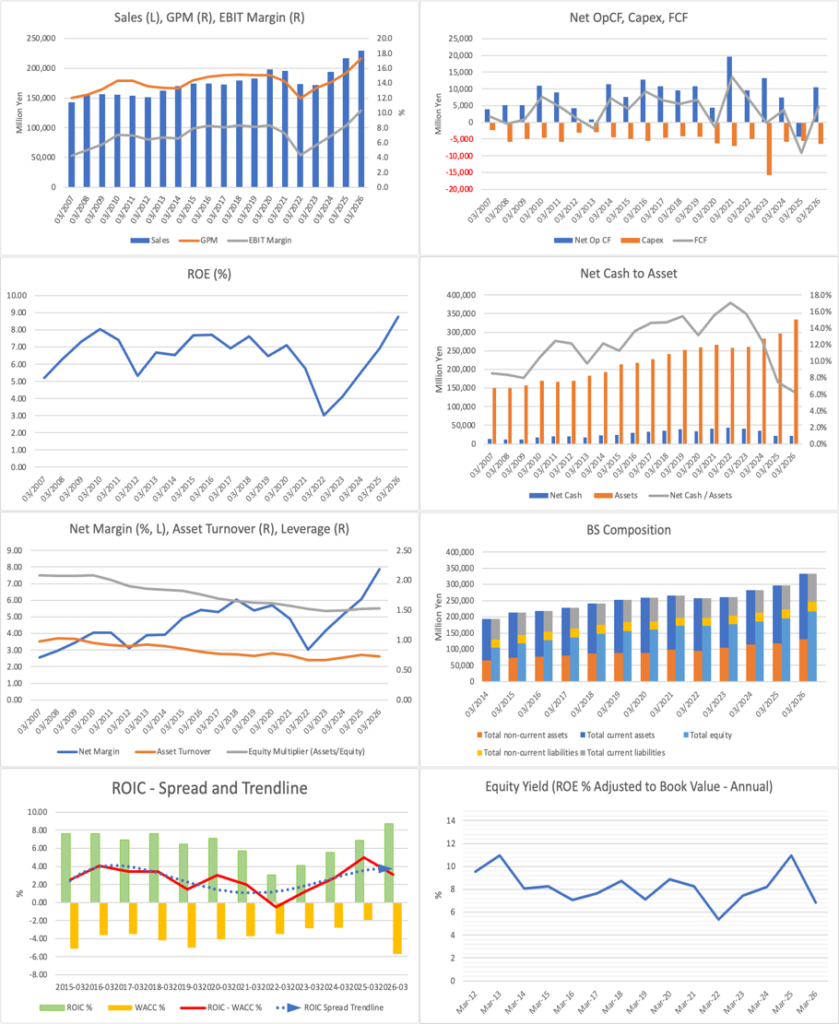
After earnings bottomed in FY3/2022, margins and returns on capital improved simultaneously, in FY3/2026, sales rose to JPY229.21bn, gross margin to 17.9%, operating margin to 10.3%, net margin to 7.9% and ROE to 8.8%. In the company’s operating-profit bridge, an increase in completed construction contributed JPY5.90bn and improved project profitability by JPY1.94bn, showing that earnings growth was driven not only by volume but also by selective order intake, cost reductions and passing on inflation through pricing. In particular, the operating margin in General Electrical Works rose from 7.1% in FY3/2025 to 14.1% in FY3/2026, and the improved mix lifted group ROE. The company’s FY3/2027 plan calls for sales growth of 5.7% versus operating-profit growth of 1.4% and an operating margin of 9.9%, while our simplified ROE remains at 8.9%. The key issue therefore shifts from further ROE expansion to whether the company can sustain ROE in the 8-9% range. Sustainability is high as long as railway renewal and data-center demand and selective order intake continue; however, given labor costs, expenses related to the new head office, and profitability volatility on large projects, we do not regard an operating margin above 10% in FY3/2026 as a permanent level.
The sharp fall in net cash/total assets was driven mainly by the larger scale and longer duration of the construction cash cycle, rather than by management deliberately running down cash.
Net cash/total assets fell to around 6.6% in FY3/2026, and the company itself explained that construction-related cash advances increased due to “larger and longer-duration construction projects, an increase in work on hand, and shorter payment terms”. In fact, notes and accounts receivable from completed construction, etc. were JPY150.18bn and short-term borrowings were JPY12.20bn at the end of FY3/2026. In contrast, by end-June 2026 the former had declined to JPY88.52bn through receivables collection and short-term borrowings had been repaid to JPY0.10bn. Net cash/total assets, calculated as cash and securities less short-term borrowings, recovered to around 11.9%, leading us to judge that much of the year-end decline reflected working-capital seasonality and collection timing. Management nevertheless accepts to some extent the impact of shorter payment terms and plans to reduce cross-shareholdings by 70% by FY3/2030 versus FY3/2024, while pursuing growth investment and flexible share repurchases. The main cause of the decline was therefore business operations, although there is also a secondary element of deliberate management direction towards avoiding excess capital.
Demand conditions are strong, but investors should focus not on market growth rates but on the company’s ability to choose high-margin projects amid supply constraints.
The Ministry of Land, Infrastructure, Transport and Tourism’s FY2026 construction investment outlook calls for total investment of JPY81.47tn (+2.9%), private non-residential construction of JPY22.26tn (+6.6%), including private non-residential building construction of JPY12.32tn (+8.6%), indicating that the markets in which the company’s General Electrical Works and renewal work operate are expanding. IDC Japan forecasts IT load at domestic operator data centres to increase at a CAGR of 13.7% from 2,365.8MVA at end-2024 to 4,499.6MVA at end-2029, and expects construction investment to exceed JPY1tn in 2028. On the railway side, East Japan Railway plans capital expenditure of approximately JPY3.9tn over FY3/2024-FY3/2028 and aims to install platform doors on 758 tracks at 330 stations by FY3/2032. Nippon Densetsu Kogyo is the leading company, with FY3/2026 Railway Electrical Works sales of JPY120.13bn, although public statistics do not allow us to calculate its precise share of the overall railway electrical works market. In practical terms, we consider the main competitors to be Nippon Rietec and Shinsen Technos, among others, in railway electrical works; Kandenko and Kinden, among others, in general electrical works and data centres; and EXEO Group and Nippon COMSYS, among others, in information and communications. Its competitive advantages are railway safety and construction know-how, its workforce and site network, and long-term customer relationships, together with the ability to execute large projects spanning railway, general electrical, communications and environmental fields. FY3/2027 Q1 orders received of JPY60.1bn (+42.1%) and order backlog of JPY249.9bn (+28%) show that this ability to select orders has not yet weakened.
The roughly 19.5% capital relationship with East Japan Railway is currently a competitive advantage, but remains a governance issue for minority shareholders.
Sales to East Japan Railway accounted for 48.1% of FY3/2026 sales, and President Kazunari Yasuda is also a former executive officer in East Japan Railway’s electrical network division. Safety regulations, night-time work, and a deep understanding of existing assets create barriers to entry in railway facilities, giving this relationship economic value through project access, demand visibility, and the accumulation of human resources and technology. Meanwhile, East Japan Railway is an “other affiliated company” with 19.6% of voting rights. Although the company describes the relationship as an ordinary business relationship, investors should continue to confirm whether transaction pricing, director appointments, and capital allocation prioritize the interests of all shareholders over East Japan Railway’s preferences. The latest Corporate Governance Report shows that five of the ten directors are outside directors, four are independent directors and only one director concurrently serves at East Japan Railway; however, there is no special committee to ensure independence. I do not view this as an immediate SELL factor, but believe that the governance discount required by minority shareholders could narrow if customer diversification progresses through a higher proportion of General Electrical Works and Information and Communications, the independent director bench is further strengthened, and disclosure on related-party transactions improves.
The 66.1% rise in the share price in CY2025 was a re-rating driven not only by the data-centre and railway-renewal themes, but also by simultaneous improvements in margins and visibility on capital policy.
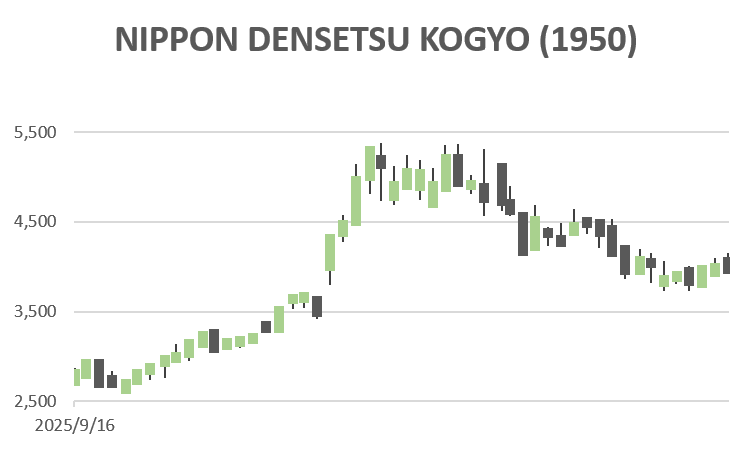
The share price rose from JPY1,993 at end-2024 to JPY3,310 at end-2025, and the company itself cited improved performance, higher dividends, share repurchases and strength in the overall equity market as factors behind the rise in its FY3/2026 financial-results materials. One turning point was the introduction of a 40% payout ratio on 30 April 2025 and the increase in the FY3/2025 dividend to JPY90, after which the share price rose 13.1% on 1 May. Record-high orders and margin improvement were subsequently confirmed, and P/B rose from 0.63x at end-FY3/2025 to 1.29x at end-FY3/2026. The current share price is JPY4,085, implying a P/B of 1.14x on the latest BPS, a forecast P/E of 12.9x, a dividend yield of 3.1%, and a forecast ROE of 8.9%. ROE is only slightly above the company’s estimated cost of capital of 7-8%, and further share-price upside depends less on mechanical P/B expansion than on whether the company can widen its ROE spread by sustaining operating margins around 9-10%, improving total-asset turnover through working-capital collection, reducing cross-shareholdings and enhancing shareholder returns. In August 2026, the company repurchased JPY4.848bn of its own shares and cancelled 2,000,000 shares, making capital allocation focused on shareholder value clearer than before.
FINANCIALS AND VALUATIONS
Record highs continue, while FY3/2027 is a pause in margin expansion – valuation returns to fundamentals
| FY3/2023 | FY3/2024 | FY3/2025 | FY3/2026 | FY3/2027E | |
| Sales (JPYbn) | 172.10 | 194.03 | 216.92 | 229.21 | 242.31 |
| Operating profit (JPYbn) | 9.66 | 13.45 | 17.93 | 23.56 | 23.89 |
| Operating margin | 5.6% | 6.9% | 8.3% | 10.3% | 9.9% |
| Net margin | 4.2% | 5.2% | 6.1% | 7.9% | 7.6% |
| ROE | 4.1% | 5.5% | 6.9% | 8.8% | 8.9%* |
Current valuation snapshot
| Metric | Value | Investor interpretation |
| Share price | JPY4,085 | After the substantial CY2025 re-rating, the shares have corrected from their 2026 high |
| Forecast P/E | 12.9x | Not valued materially above the TSE Prime average |
| P/B | 1.14x | At ROE of 8.9%, substantial P/B expansion requires further ROE improvement |
| Forecast dividend yield | 3.1% | Supported by the 40% payout-ratio policy |
| Forecast ROE | 8.9% | A modestly positive spread over the company-estimated cost of capital of 7-8% |
MANAGEMENT AND BOARD
Turning the relationship with East Japan Railway into a competitive advantage, while capital efficiency becomes clearly more shareholder-oriented
President Kazunari Yasuda comes from East Japan Railway’s electrical network division, and his understanding of railway operations and customer access is a strength. At the same time, precisely because the company’s top management has close personnel ties with its largest shareholder and customer, transparency on transaction terms and capital allocation is important for minority shareholders. The company explains that for construction contracts with East Japan Railway, it submits quotations and contracts at appropriate price,s taking market prices and other factors into account. As of FY3/2026, the board comprised ten directors, including five outside and four independent directors, with one director concurrently serving at East Japan Railway. This provides a degree of independence, although the company has no special committee to ensure it.
Capital policy has clearly changed since 2025. The company targets a payout ratio of 40%, and cumulative dividends under the Three-Year Management Plan 2024 are expected to total approximately JPY20.4bn, substantially above the initial plan. It plans to reduce cross-shareholdings by 70% by FY3/2030 versus FY3/2024, and in August 2026 repurchased 1,200,000 shares for JPY4.848bn and cancelled 2,000,000 shares at month-end. It is positive that ROE improvement is broadening beyond margins to include asset reduction, shareholder returns and use of leverage where appropriate. Areas for improvement are a further increase in the proportion of independent directors, greater visibility of independent outside directors’ involvement in material transactions with East Japan Railway, and clear rules for allocating proceeds from cross-shareholding sales between growth investment and shareholder returns.
SHAREHOLDER DISTRIBUTION
A deep base of stable shareholders centred on East Japan Railway at 19.5%, while a 48.3% free float leaves room for institutional investors to contribute to price discovery
In the FactSet snapshot as of 10 September 2026, shares outstanding were 59,537,219, the free-float ratio was 48.3%, and institutional ownership was 20.89%. East Japan Railway was the largest shareholder with 11.598m shares, or 19.48%, alongside a deep base of stable shareholders including the Nippon Densetsu Kogyo Mutual Aid Association, Nippon Concrete Industries and the NDK Group Employee Shareholding Association. Even after the cancellation of treasury shares in August 2026, East Japan Railway retains significant economic influence, and from the perspective of minority shareholder,s the investability of the shares combines a “stable base of closely aligned shareholders” with “roughly half the shares in free float”. Domestic and overseas institutional investor,s including Schroders, Morant Wright, Vanguard, Dimensional and Fidelity, are also present, and continued improvement in profitability and capital efficiency could allow the institutional ownership ratio to rise.
| Shareholder | Holding | Shares (000) |
| East Japan Railway | 19.48% | 11,598 |
| Nippon Densetsu Kogyo Mutual Aid Association | 5.16% | 3,073 |
| Nippon Concrete Industries | 4.59% | 2,730 |
| NDK Group Employee Shareholding Association | 3.81% | 2,270 |
| Schroder Investment Management | 3.74% | 2,226 |
| Nippon Densetsu Kogyo (treasury shares) | 2.73% | 1,624 |
| Nippon Densetsu Kogyo Stock Benefit Trust (J-ESOP) | 2.52% | 1,499 |
| Morant Wright Management | 2.18% | 1,296 |
KEY INVESTMENT ISSUES
| Issue | Positive factors | Monitor |
| ROE sustainability | Selective order intake, pricing pass-through, General Electrical Works mix, railway renewal demand | Whether the FY3/2027 operating-margin plan of 9.9% is undershot |
| Working capital | Receivables collection and repayment of short-term borrowings in Q1; recovery in the net cash ratio | Whether cash advances expand again as large projects become longer-duration |
| Market demand | Data centres, redevelopment, ageing-infrastructure renewal and JR safety investment continuing for multiple years | Whether labour shortages and project delays postpone revenue recognition |
| East Japan Railway relationship | Project access, technical and safety know-how, demand visibility | Transaction terms, independent-director ratio, customer concentration |
| Capital allocation | 40% payout ratio, reduction of cross-shareholdings, share repurchases and cancellation | Whether disposal proceeds are directed to low-return investment |
Charts for Price Discovery
The charts show sales and margins, cash flow, ROE, net cash/total assets, DuPont decomposition, balance-sheet composition, ROIC spread, Equity Yield, and long-term share price. The rise in ROE since FY3/2023 is mainly due to improved net margin rather than leverage, while working-capital burdens are evident in total-asset turnover and the net cash ratio.
Operating, Balance-sheet and Return Profile
Valuation and Per-share Fundamentals
Price

PBR (LTM)

PER (LTM)

ROE (LTM)

EPS (LTM)

BPS (LTM)
