2026-10-23
Home
Japanese

Omega Investment Co., Ltd.
Caulis (Price Discovery)
HOLD
Market Capitalization: ¥7.83 billion
Based on a share price of ¥1,199 and assumptions as of July 30, 2026. Market capitalization is calculated using 6.528 million shares outstanding.
| Share Price | Forecast EPS | Forecast PER | Trailing BPS |
| ¥1,199 | ¥47.7 | 25.1x | ¥253.8 |
| Trailing PBR | Forecast ROE | Forecast Dividend | Forecast Dividend Yield |
| 4.72x | 19.3% | ¥5.75 | 0.48% |
Conclusion
HOLD. Caulis is a high-quality RegTech company centered on Fraud Alert, its unauthorized-access detection service for financial institutions, with strengths including a low churn rate, expansion of service coverage among existing customers, and collaboration with regulators and financial institutions. Revenue and profit increased in 1Q FY12/2026, while the new Grid Data KYC business broadens the company’s future growth opportunities. However, at ¥1,199, the shares trade at 25.1x forecast PER and 4.72x trailing PBR, already above the approximately ¥1,170 median fair value derived from the PBR, DCF, and ROIC methods. The post-IPO decline in ROE primarily reflects normalization of the capital structure, but the company has yet to demonstrate that it can reinvest its abundant capital at high returns, and Grid Data KYC has not yet been monetized. We recognize the quality of the business, but the expected return is currently insufficient; therefore, we believe continued ownership is appropriate.
Profile
A cloud-based RegTech company supporting financial institutions’ counter-fraud measures
Caulis is a RegTech company whose principal business is Fraud Alert, a cloud-based unauthorized-access detection service for financial institutions. It monitors user actions such as account openings, logins, and remittances. It detects risks including money laundering, impersonation, and fraudulent transfers using data on devices and access patterns associated with fraud accumulated across financial institutions. Revenue comprises the number of contracted customers, revenue per customer, and consulting revenue; expansion in the monitored pages, devices, accounts, and user actions leads to higher unit revenue. In September 2025, the company launched Grid Data KYC, which verifies actual residency using electricity contract information and actual power usage, building a platform for identity verification and ongoing customer due diligence alongside Fraud Alert.
Sales Composition by Business (%) (Operating Margin (%)): Fraud Detection Services 100.0% (29.1%) (FY12/2025)
Stock Hunter’s View
Adoption of anti-money-laundering measures is expanding. 2Q results are due shortly.
Caulis, which provides Fraud Alert, a fraud-detection tool for financial institutions’ anti-money-laundering measures, is also a rare Japanese RegTech company that actively makes policy proposals, including the formulation of guidelines and legal amendments, and works to change regulations by deepening public-private cooperation.
Revenue consists of the number of contracted customers multiplied by ARPU (revenue per customer), plus the number of contracted customers multiplied by consulting revenue. The business model raises unit revenue by expanding the installed scope, including the number of accounts and user actions, such as logins, account openings, and remittances, as well as the monitoring scope, including browsers, smartphone applications, and account-opening, login, and remittance pages. Expansion of monitored pages has recently progressed, supporting expectations for the company’s 2Q FY12/2026 results for January–June, scheduled to be announced on August 14.
Progress in Grid Data KYC, a know-your-customer service using electricity contract information that was launched as a new business in September 2025, also warrants attention. This fiscal year is a phase-in in which the company is focusing on acquiring pioneers in each industry—its initial customers—and in 1Q it began a proof-of-concept trial with Iida Shinkin Bank.
The service determines whether a person continues to reside at an address or has moved out by comparing information held by electricity transmission and distribution operators with actual electricity usage. It covers all of Japan, from Hokkaido Electric Power Network, a subsidiary of Hokkaido Electric Power (9509; P), in the north to Okinawa Electric Power (9511) in the south, enabling uniform, highly accurate fraud detection without regional disparities.
Investor’s View
HOLD: The high-quality business platform merits recognition, but the current share price already factors in a meaningful reacceleration in earnings growth
The core of Caulis’s investment value lies in converting irreversible regulatory demand for financial-crime prevention into recurring software revenue. Fraud Alert combines unauthorized-access information accumulated across financial institutions, integration into customer workflows, and regulatory expertise, making it less susceptible to churn than a straightforward security product. In addition to increasing the number of contracted customers, the company can raise ARPU by expanding monitored pages, accounts, devices, and user actions among existing customers, giving it a growth structure that does not depend solely on customer acquisition.
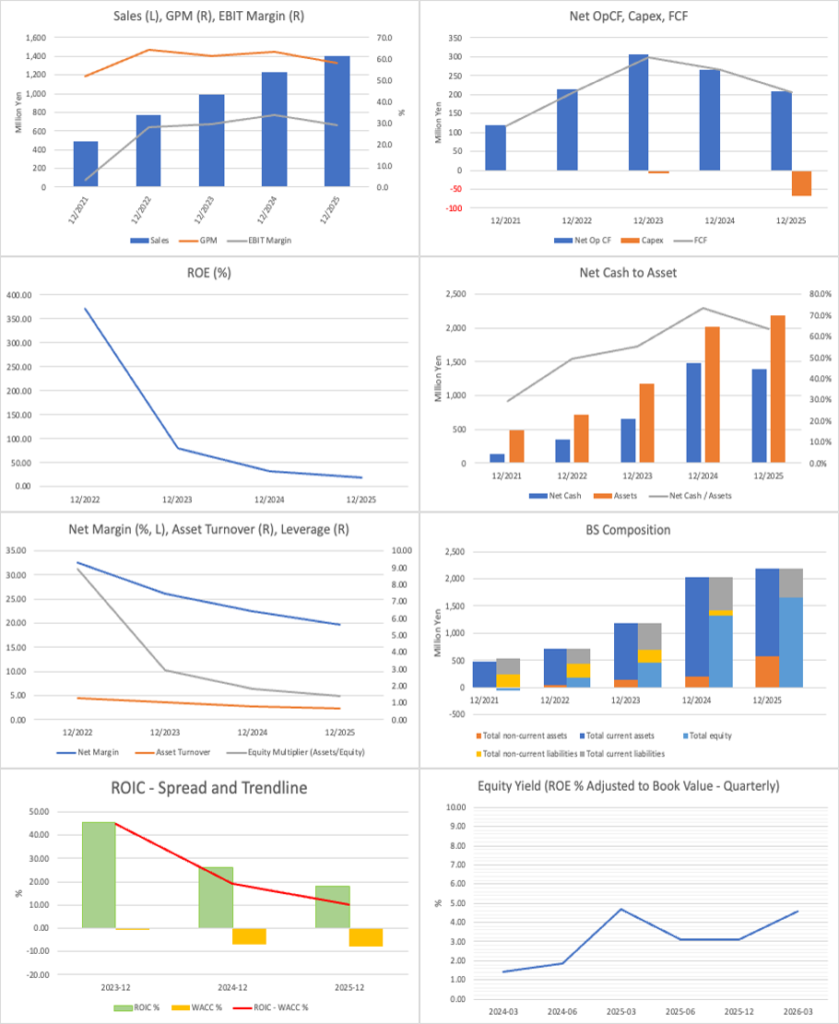
The company has combined rapid revenue growth with a high operating margin, but converting those gains into shareholder value has been uneven. Revenue expanded substantially from FY12/2021 through FY12/2025, and the operating margin remained at 29.1% in FY12/2025, while the free-cash-flow margin declined to 14.7% and ROIC to 18.0%. These levels remain above the cost of capital, but the pace at which IPO proceeds and retained earnings are translating into revenue and profit growth has slowed. Unless growth investments, including Grid Data KYC, generate high incremental returns, the accumulation of cash will strengthen financial resilience while restraining capital efficiency and the share-price valuation.
The principal reason for the rapid decline in ROE after the IPO is normalization of the capital structure, rather than deterioration in the competitiveness of the core business. ROE of 372% in FY12/2022 was an exceptional level based on an extremely thin pre-IPO equity base and high financial leverage. Equity subsequently increased sharply through the IPO capital raise and retained earnings, while the equity multiplier fell from 8.94x in FY12/2022 to 1.42x in FY12/2025. Total asset turnover also declined from 1.28x to 0.67x, as the cash raised has not yet been converted immediately into revenue-generating assets. Forecast ROE of 19.3% remains high, but future valuation will depend not on comparisons with anomalous historical levels, but on whether Caulis can sustain ROE of approximately 20% on a normalized balance sheet that includes surplus capital.
The decline in net margin cannot be explained solely by deterioration in the operating margin. In FY12/2022, the net margin was 32.5% versus a pretax margin of 28.6%, largely because income taxes became a net benefit—for example, through tax effects related to tax-loss carryforwards—temporarily producing a negative effective tax rate. The tax burden subsequently normalized, and in FY12/2025 the net margin was 19.7% versus a pretax margin of 29.3%. Accordingly, the decline in net margin from FY12/2022 does not directly indicate weaker profitability in the core business; the principal factor was the expiration of a one-time tax benefit. Nevertheless, FY12/2025 also showed a lower gross margin and increased capital expenditures, making it necessary to assess operating profit, pretax profit, and free cash flow separately.
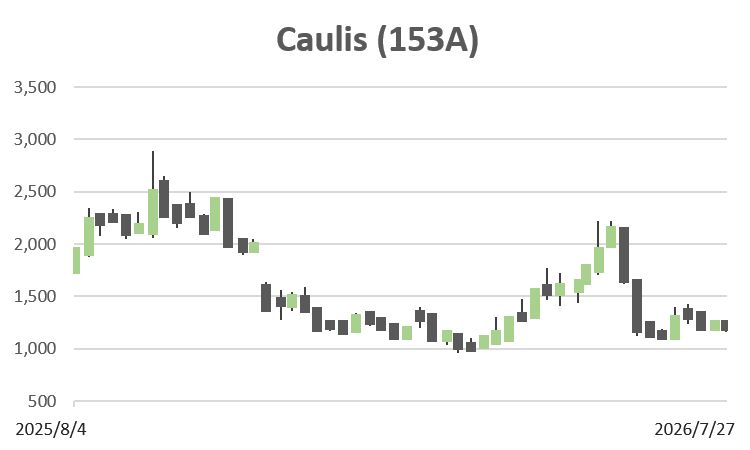
The weak share-price performance since the IPO reflects the correction of excessive expectations immediately after listing rather than deteriorating operating performance. Against the March 2024 offering price of ¥1,530, the shares rose to the ¥3,900 range shortly after listing amid scarcity value as a growth company and expectations for RegTech, taking PER and PBR to unsustainable levels. Revenue subsequently increased, but EPS remained broadly flat from FY12/2022, while declines in ROE, ROIC, and free cash flow became clear, compressing valuation multiples. The market currently recognizes the quality of Fraud Alert but is cautiously assessing how quickly broader service usage converts into EPS growth, the timing of Grid Data KYC monetization, and the use of surplus capital.
Grid Data KYC is the company’s largest option for revaluing shareholder value. By comparing electricity contract information with actual usage to verify the existence of an address and continued residency, the system has potential applications not only in identity verification when opening an account, but also in ongoing customer due diligence, detection of fraudulent accounts, lending, telecommunications, and insurance. A data platform covering electricity transmission and distribution operators nationwide is not easy to replicate. However, the business remains at the proof-of-concept and initial customer acquisition stage, and contract pricing, implementation periods, recurring revenue, and required additional investment are not yet clear. Investors should focus not on the number of proof-of-concept trials, but on conversion to commercial contracts, annual contract value, ARPU, and contribution to operating profit.
At a share price of ¥1,199, the shares trade at a forecast PER of 25.1x based on forecast EPS of ¥47.7 and a trailing PBR of 4.72x based on trailing BPS of ¥253.8. Assuming an 8% cost of equity, the market is factoring in long-term EPS growth of approximately 5% per year. This is substantially below the apparent EPS CAGR from FY12/2021 through FY12/2025, but, excluding the base effect from the low starting point, it is higher than the record of broadly flat EPS since FY12/2022. The current share price requires not only earnings growth this fiscal year, but also continued growth thereafter.
The shareholder distribution supports long-term management but weakens liquidity and external discipline. President Atsuyoshi Shimazu owns 53.01%, followed by GMO Internet Group, directors, and strategic corporate shareholders, making the economic interests of management and shareholders more likely to be aligned and allowing the company to pursue regulation-building and new businesses over the long term. Conversely, institutional ownership is limited, and major asset managers have reduced their holdings. Founder control, a limited free float, and share repurchases can destabilize price discovery, making capital policy and board independence important considerations for minority shareholders.
We rate the shares HOLD. Fraud Alert’s competitive advantage, low churn rate, revenue and profit growth in 1Q FY12/2026, and the potential value of Grid Data KYC merit recognition. However, the median fair value under the PBR, DCF, and ROIC methods is approximately ¥1,170, and the current share price of ¥1,199 is 2.5% above that level. Further share-price appreciation requires upselling to existing customers to translate into double-digit EPS growth, Grid Data KYC to progress from proof-of-concept trials to commercial contracts, and surplus capital to be reinvested at a high ROIC. At present, business quality and valuation are balanced, and there is no sufficient margin of safety to justify an aggressive allocation of new capital.
Financials and Valuations
Based on a share price of ¥1,199, forecast EPS of ¥47.7, trailing BPS of ¥253.8, forecast ROE of 19.3%, and a forecast dividend of ¥5.75, forecast PER is 25.1x, trailing PBR is 4.72x, the forecast dividend yield is 0.48%, and the forecast payout ratio is 12.1%. Market capitalization based on 6.528 million shares outstanding is approximately ¥7.83 billion.
| Valuation Method | Key Assumptions | Fair Value |
| PBR Method | Sustainable ROE of 17–20%; cost of equity of 8–9%; long-term growth of 4–5%; normalized PBR of 4.0–5.2x | ¥1,020–1,320 Median: ¥1,170 |
| DCF Method | EPS growth of 10–15% over the next five years; cost of equity of 8.5%; terminal growth of 2% | ¥950–1,300 Median: ¥1,120 |
| ROIC Method | Normalized ROIC of 16–20%; WACC of 8–9%; net cash of approximately ¥1.0–1.1 billion | ¥1,180–1,500 Median: ¥1,330 |
The combined fair-value range under the three methods is ¥950–1,500, with a median of approximately ¥1,170. The current share price of ¥1,199 is approximately 2.5% above the median and within the fair-value range. The ROIC method produces the highest value because it recognizes net cash and high returns on capital; however, as ROIC has been declining, realizing the upper end requires monetization of Grid Data KYC and improved capital efficiency.
Shareholder Distribution
Shareholders identified by FactSet account for 73.50% of shares, with President Atsuyoshi Shimazu holding 53.01%. Other major holders include GMO Internet Group at 4.36%, Hironori Zoda at 3.06%, treasury shares held by Caulis at 2.88%, Phillip Capital Management at 2.30%, and Kansai Electric Power at 1.65%. The founder’s majority ownership aligns management and shareholder interests and allows the company to build its business platform without being driven by short-term market pressure. On the other hand, the free float is limited, making it difficult for domestic and international institutional investors to establish meaningful positions. Amova Asset Management and Asset Management One have recently reduced their holdings, and the institutional shareholder base is not yet sufficiently broad. Share repurchases support per-share value but may further reduce liquidity. For minority shareholders, capital allocation, board independence, and the shareholder-return policy under founder control are important matters for ongoing review.
Price

PBR (LTM)

PER (LTM)

ROE (LTM)

EPS (LTM)

BPS (LTM)
