2026-08-03
Home
Japanese

Omega Investment Co., Ltd.
Organo (Price Discovery)
Sell on Strength
Market Capitalisation: 696.3 billion yen
ased on a share price of 15,020 yen and assumptions as of 6 August 2026.
| Share Price | Forecast EPS | Forecast PER | Historical BPS |
| 15,020 yen | 652.4 yen | 23.0x | 3,109 yen |
| Historical PBR | Forecast ROE | Forecast Dividend | Forecast Dividend Yield |
| 4.83x | 21.0% | 220 yen | 1.46% |
Conclusion
Sell on Strength. Organo has significantly increased sales, profit margins, ROE and ROIC, supported by its strong competitive position in ultrapure water systems for semiconductor applications, the expansion of AI and advanced semiconductor investment, large-scale projects centred on Taiwan, and growth in its solutions business. Orders remained strong in Q1 FY3/2027, and the quality of the business fundamentals remains high. However, the rise in the share price since 2021 has been driven not only by EPS growth, but also by a substantial rerating that has priced in improvements in profit margins and capital efficiency. With the operating profit margin and ROE now at around 20%, which is a significantly high level in the cycle, we believe the market is beginning to price in the possibility that these metrics may peak relatively soon, rather than continue to rise or remain at current levels. At 15,020 yen, the shares trade on a forecast PER of 23.0x and a historical PBR of 4.83x, 16% above the median fair value of 12,950 yen derived from the PBR, DCF and ROIC approaches and at the upper end of the overall range of 9,300-15,100 yen. Even after a correction of more than 25% from the May high, the margin of safety remains limited, and there is significant risk in chasing shares in the current pullback on the assumption that it marks the start of a renewed medium- to long-term uptrend. While recognising the quality of earnings, investors should prioritise taking profits on share price strength.
Profile
A comprehensive water treatment engineering company centred on ultrapure water for advanced semiconductors, with plant operations and high-margin solutions
Organo is a comprehensive water treatment engineering company engaged in pure and ultrapure water production, water and wastewater treatment, wastewater recycling and recovery of valuable materials, using ion-exchange resins, separation membranes, activated carbon and other technologies. Its core water treatment engineering business comprises the Plant business, which designs and constructs large-scale facilities for semiconductor plants and other customers, and the Solutions business, which provides equipment maintenance, operations management, modification work and asset-owning services. The Performance Products business provides water treatment chemicals, standardised pure-water systems, filters and separation/purification materials, as well as food ingredients and additives. In ultrapure water systems, which are essential for semiconductor manufacturing, the ability to handle differing raw-water characteristics by region, extremely stringent water-quality control and long-term operating know-how constitute barriers to entry, while expanding investment in AI and advanced semiconductors is driving demand. In FY3/2026, in addition to sales growth in the Water Treatment Engineering business, the relatively higher-margin Solutions business drove profit growth.
Sales composition by business, % (operating profit margin, %): Water Treatment Engineering 85.5% (22.6%), Performance Products 14.5% (12.9%) (FY3/2026)
Stock Hunter’s View
Expansion of the AI and semiconductor markets provides a tailwind. Recurring-revenue businesses are also performing well.
Organo is a comprehensive water treatment engineering company with a high share of ultrapure water systems required for semiconductor manufacturing. The company is benefiting from TSMC’s investment expansion in Taiwan and the growth of the AI market. It celebrated its 80th anniversary this May.
The top four companies, including Organo, account for 90% of the global market for ultrapure water production systems for semiconductor applications, an area in which the company has strengths. The other three are Kurita Water Industries (6370), Nomura Micro Science (6254) and Germany’s Christ. The market is considered difficult for new entrants because it requires expertise in analysing the constituents of raw water, which differ by region, as well as maintaining water quality.
Q1 FY3/2027 results (April-June), announced on 3 August, showed sales of 42.183 billion yen, up 10.7% YoY, and operating profit of 6.612 billion yen, down 4.9%. In the electronics industry segment, large semiconductor-related projects drove a substantial increase in orders. In addition to winning multiple large-scale projects in Taiwan, the company secured major orders in the US, Japan and China.
The decline in operating profit was mainly due to the reaction to highly profitable plant projects for which sales were recognised in the same period of the previous year. Meanwhile, solutions projects (recurring-revenue businesses), which generate stable earnings from asset-owning services, various types of maintenance and other activities, continued to perform well.
Investor’s View
The quality of the business is high, but this is not the time to chase a share price that is beginning to reflect concerns over peak profit margins and ROE
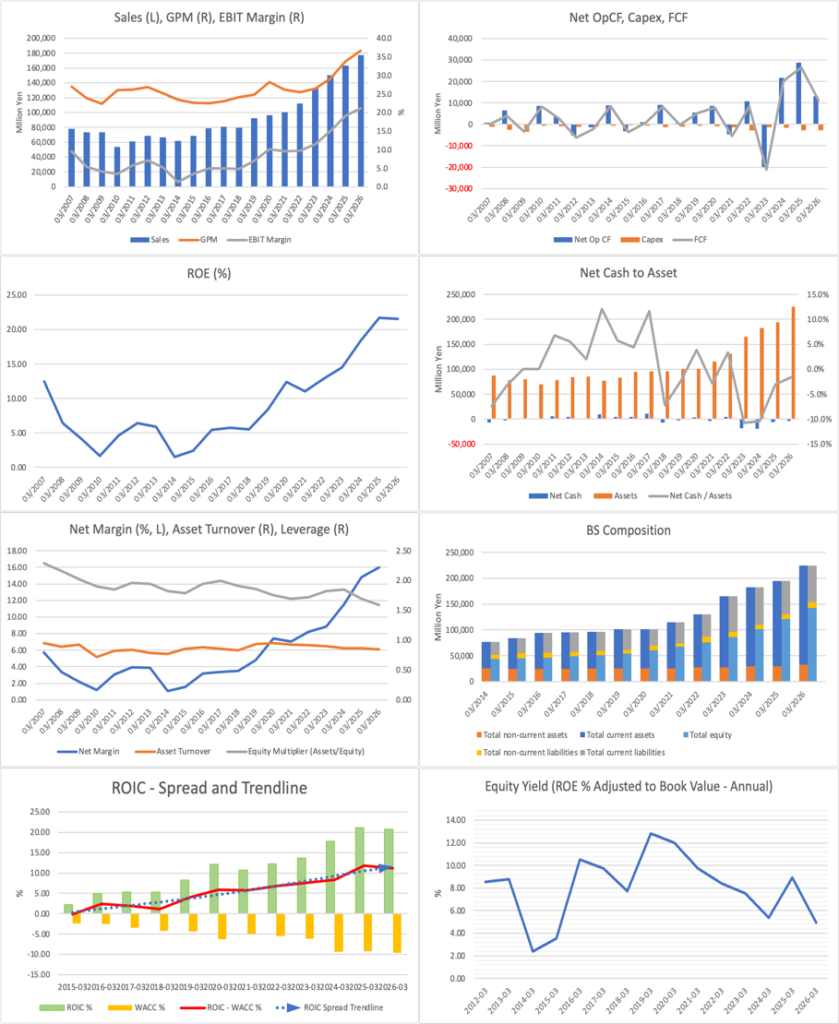
The rise in the share price since 2021 has resulted from simultaneous EPS growth, improving profit margins, rising ROE and ROIC, and valuation expansion, beginning with the increase in semiconductor capital expenditure. The share price rose more than eightfold from the end of 2020 to the end of 2025, with expectations for investment in advanced semiconductors and generative AI accelerating particularly from 2023. The charts below show that gross profit margin and EBIT margin rose substantially alongside sales growth, while ROE moved into the 20% range. The market came to value Organo not as a mature water treatment company, but as a high-value-added bottleneck company serving advanced semiconductor capital expenditure.
The quality of earnings is high, but profitability and capital efficiency are now at elevated levels in the cycle. In FY3/2026, the operating profit margin reached 21.2%, ROE moved into the 21% range, and ROIC also rose to around 20%, substantially widening the spread over WACC. The principal driver of the improvement in ROE has been higher net profit margin rather than leverage, indicating high-quality value creation. However, with highly profitable plant projects, semiconductor capital expenditure and a rising mix of the Solutions business all contributing, there is limited scope for the current profit margin to continue rising further. Although the company aims to maintain a high ROE, we believe the equity market is already beginning to focus not on a further rise in profit margins or ROE, but on the possibility that they may peak relatively soon and move towards normalisation.
In Q1 FY3/2027, the fact that operating profit declined despite strength in the top line and orders could become a catalyst for heightened concern over peak margins. Sales increased by 10.7% YoY, while operating profit declined by 4.9%. The main reason was the reaction to highly profitable plant projects recognised in the same period of the previous year, rather than deterioration in the order environment. The company won multiple large-scale projects in Taiwan, while orders also expanded in the US, Japan and China, and the recurring-revenue Solutions business remained strong. Even so, when a share price has been formed on the assumption of high profit margins, the fact that margins decline despite sales growth can itself become a trigger for multiple compression.
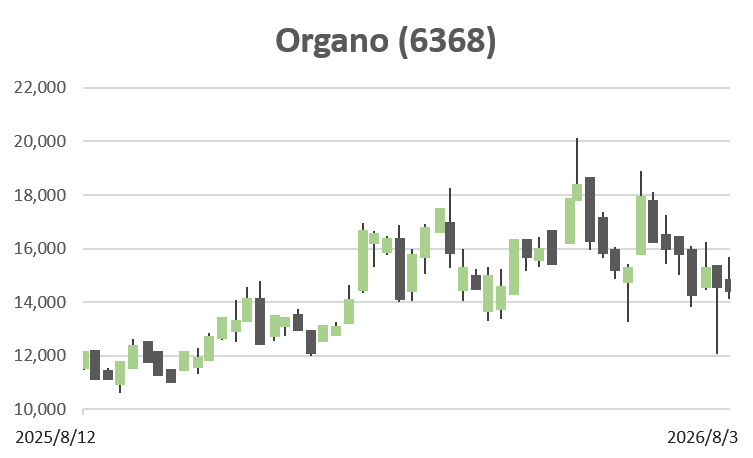
We view the correction of more than 25% from the May high as a normalisation of a valuation built on exceptional earnings growth, rather than a deterioration in earnings. The share price in 2026 remains above the end-2025 level, but has fallen sharply from the May high of 20,145 yen to 15,020 yen. While EPS CAGR over the past five years was exceptionally high, in the 30% range, the long-term EPS growth rate implied by the current share price is estimated at around 6.5-8.5%, assuming a cost of equity of 8-10%. The market is not assuming that high growth will continue indefinitely, but a valuation of 4.83x PBR nevertheless requires high ROE and profit margins to persist over the long term. The recent decline therefore should not simply be viewed as making the shares cheap.
The three valuation approaches indicate that the current share price offers little margin of safety. The PBR approach gives an estimated fair value range of 9,300-12,400 yen, based on assumptions including normalised ROE of 19-21%; the DCF approach gives 10,800-15,100 yen, based on assumptions including EPS growth of 10-15% over the next five years; and the ROIC approach gives 11,500-14,500 yen, based on assumptions including normalised ROIC of 18-21%. The combined range from the three approaches is 9,300-15,100 yen, with a median of 12,950 yen; the current share price of 15,020 yen is 16% above the median and close to the upper end of the range. The ROIC approach produces a relatively high value because it reflects the company’s high technological barriers to entry and recurring earnings from the Solutions business, but even after fully incorporating these strengths, upside from the current price is limited.
The shareholder distribution offers stability, but Tosoh’s high shareholding constrains liquidity and external discipline. Tosoh holds 43.96%, institutional ownership is 24.83%, and the effective free float is 54.2%. The presence among the leading shareholders of KBC, Vanguard, Norges Bank and BlackRock, as well as specialist funds focused on water and environmental themes, indicates recognition of the company’s technological competitiveness and long-term growth themes. On the other hand, the presence of a controlling shareholder limits the shares available for trading in the market. At the same time, supply-demand dynamics can push the share price higher in an uptrend; they may amplify price movements during a valuation correction. Minority shareholders need to continue monitoring capital policy, related-party transactions and board independence.
Our investment view is Sell on Strength. Organo’s business competitiveness, semiconductor-related demand, expansion of the Solutions business and high ROIC merit recognition, and the situation does not justify immediately concluding that earnings have peaked. However, current profit margins and ROE are already at fairly high levels in the cycle, and the market is beginning to reflect the risk of normalisation rather than continued maintenance of these levels. At 15,020 yen, the share price is at the upper end of the combined range from the three valuation approaches and, even after the decline from the May high, does not offer a sufficient margin of safety. Rather than chasing a renewed medium- to long-term rise from the current price weakness, investors should prioritise taking profits on share price strength.
Valuation
Even allowing for high ROIC, the median of the three valuation approaches is below the current share price
| Valuation Method | Key Assumptions | Fair Value Range | Median |
| PBR approach | Normalised ROE 19-21%, cost of equity 8.5-9.5%, long-term growth rate 3-4%, normalised PBR 3.0-4.0x |
9,300-12,400 yen | 10,850 yen |
| DCF approach | EPS growth of 10-15% over the next five years, cost of equity 8.5-9.5%, perpetual growth rate 3%, normalised FCF |
10,800-15,100 yen | 12,950 yen |
| ROIC approach | Normalised ROIC 18-21%, WACC 8-9%, continuation of a positive ROIC-WACC spread, taking net cash into account | 11,500-14,500 yen | 13,000 yen |
| Combined | Equal reference to the three approaches | 9,300-15,100 yen | 12,950 yen |
Market expectations: forecast PER of 23.0x and forecast dividend yield of 1.46%. Assuming a cost of equity of 8-10%, the long-term EPS growth rate implied by the share price is around 6.5-8.5%. This is substantially below the EPS CAGR in the 30% range over the past five years, but it does not mean that the current share price is inexpensive. Past growth was accompanied by substantial improvements in profit margins and capital efficiency, and the pace of their peak-out and normalisation will determine the share price from here.
Shareholder Distribution
Tosoh’s stable holding and a high-quality institutional shareholder base are strengths, but liquidity and external discipline remain constrained
Tosoh holds 43.96%, institutional ownership identified by FactSet is 24.83%, and the effective free float is 54.2%. In addition to KBC Asset Management, Vanguard, Norges Bank and BlackRock, specialist funds with long-term water and environmental themes, including KBC ECO Fund, Regnan Sustainable Water and Waste Fund and Fidelity Water & Waste Fund, rank among the leading shareholders. The coexistence of stable shareholders and long-term-oriented institutional investors supports long-term investment and continuity of business strategy. On the other hand, Tosoh’s high shareholding limits the shares available for trading in the market, making supply-demand dynamics more likely to amplify share price volatility. For minority shareholders, capital policy, conflicts of interest with the controlling shareholder and board independence remain ongoing areas for assessment.
Financials and Valuations
Source: Prepared by Omega Investment based on company disclosures, FactSet and Charts for Price Discovery. Figures are as of 6 August 2026 unless otherwise stated.
Based on a share price of 15,020 yen, forecast EPS of 652.4 yen, historical BPS of 3,109 yen, forecast ROE of 21.0% and forecast dividend of 220 yen, forecast PER is 23.0x, historical PBR is 4.83x and forecast dividend yield is 1.46%. Based on 46,359,700 shares outstanding, market capitalisation is 696.3 billion yen. Equity yield, calculated as ROE divided by PBR, is 4.35%. At the same time, the business’s earnings power is high, but the price at which investors acquire that value does not offer a sufficient margin of safety. The Charts show that sales, profit margins, ROE, ROIC, EPS, and BPS have all improved over the long term. However, PBR has also risen substantially at the same time, indicating that the current share price already reflects a considerable portion of the improvement in profitability.
Price

PBR (LTM)

PER (LTM)

ROE (LTM)

EPS (LTM)

BPS (LTM)
