2026-11-09
Home
Japanese

Omega Investment Co., Ltd.
Kyodo Printing (Price Discovery)
BUY
| Share Price | Forecast EPS | Forecast PER | Actual BPS |
| 1,647 yen | 184.34 yen | 8.93 x | 2,590.23 yen |
| Actual PBR | Forecast ROE | Forecast Dividend | Dividend Yield |
| 0.64 x | 7.12 % | 80 yen | 4.86 % |
The share price is the closing price on 12 November 2026. BPS is calculated by dividing equity attributable to owners of the parent of JPY 71.717bn at end-September 2026 by 27,687,502 shares outstanding at the period-end, excluding treasury shares. Forecast ROE = company-forecast EPS ÷ the same BPS. PER, PBR and yield are calculated from the figures above.
Conclusion
BUY : Recognising improving earnings quality and scope for capital efficiency reform
Improving profitability in Lifestyle and Industrial Materials and Information Security is advancing the shift away from dependence on declining paper-based media. At JPY 1,647, the shares trade on an 8.93x company-forecast PER, 0.64x PBR and a forecast dividend yield of 4.86%, insufficiently reflecting the benefits of continued price pass-through and business restructuring. However, FY3/2027 net profit of JPY 5.1bn includes gains on the sale of investment securities, and the forecast ROE of 7.12% overstates underlying recurring earnings power. The investment case rests not on extraordinary gains but on downsizing and restructuring low-margin printing operations, improving margins in packaging materials and BPO, reducing cross-shareholdings, and shareholder returns.
Profile
Shifting the business mix from a long-established printer towards information services and functional packaging
Kyodo Printing originated in publishing and commercial printing and now derives its principal earnings from cards and security printing, BPO for local authorities and healthcare, and laminate tubes, flexible packaging and industrial materials. In response to the structural decline in demand for paper-based media, it is restructuring its Information Communication business and prioritising investment in higher-margin information services and packaging-related products. In the first half of FY3/2027, the sales mix by segment (operating margin) was Information Communication 29.9% (-4.1%), Information Security 31.0% (6.2%), Lifestyle and Industrial Materials 37.1% (6.8%), and Others 2.1% (-21.4%). The percentages are calculated using the sum of segment sales of JPY 48.178bn as the denominator.
Stock Hunter’s View
Transforming the image of a printing company through expansion in growth areas and improved profitability
Kyodo Printing is known as a long-established publishing and general commercial printer, but Information Security and Lifestyle and Industrial Materials are now its main sources of earnings. It is currently pursuing a portfolio transformation from information-related businesses towards Lifestyle and Industrial Materials. Profitability is improving through continued price pass-through and an expanded range of high-value-added products, among other measures.
The company recently revised its full-year earnings forecast for the current March year-end. While it lowered its sales forecast by JPY 2.0bn, it raised its operating profit forecast from JPY 2.5bn to JPY 2.7bn (up 26.5% year on year). In Information Security, transport IC cards declined, but BPO for local authorities and information-service BPO for the healthcare sector increased. In Information Communication, original content generated higher sales, but the operating loss did not narrow, while existing paper-based media continue to decline in publishing, printing and general commercial printing.
Against this backdrop, it has begun measures to revitalise the publishing printing business. The company will reorganise the sales, prepress, printing and bookbinding/finishing functions into an independent operating company with vertical integration. Going forward, it plans to establish a hybrid production structure combining digital printing technology with its strengths in advanced prepress technology and data-management infrastructure, while actively expanding into content businesses adjacent to publishing printing, including rights businesses and merchandise development.
Investor’s View
Sustained operating margin improvement, rather than asset-disposal gains, is central to the re-rating
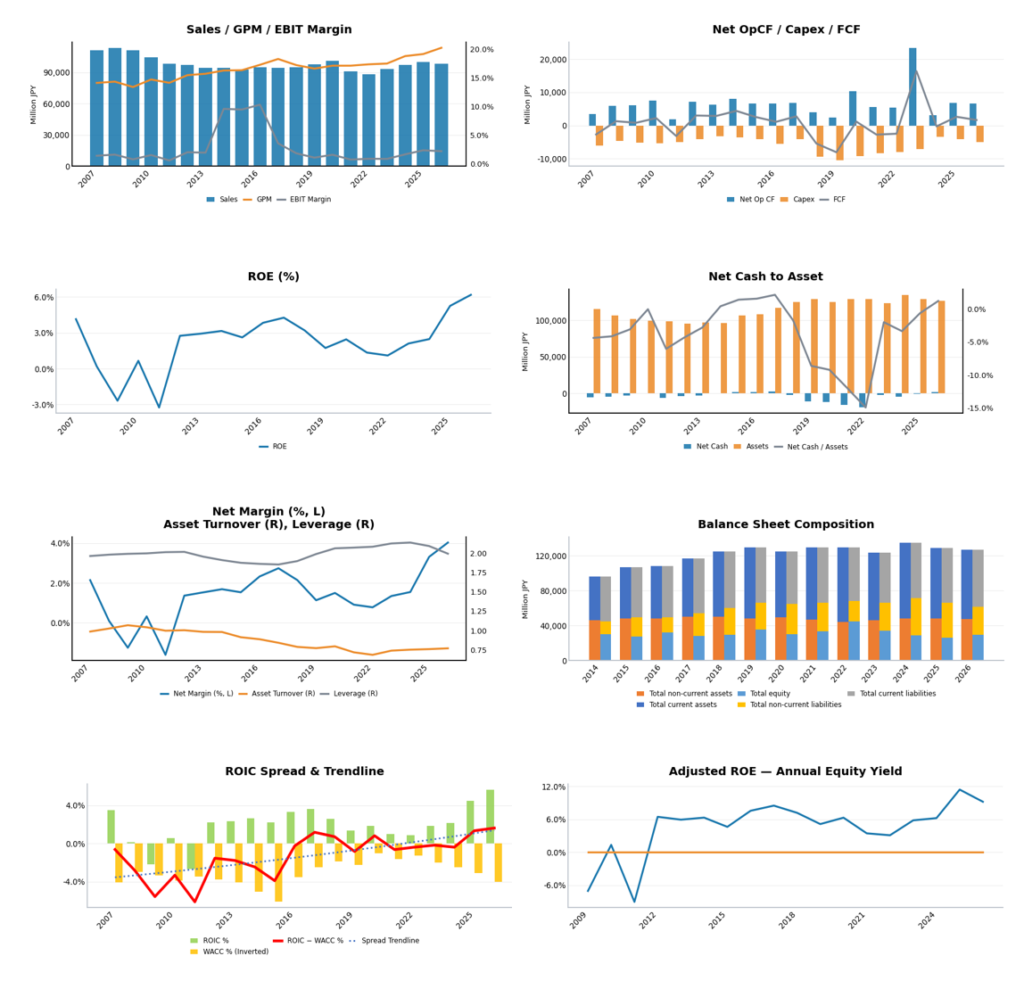
There is substantial scope to transform margins and capital efficiency despite sluggish sales growth. Sales have remained broadly flat over the long term, with growth in packaging materials and BPO offsetting declining printing demand. In FY3/2026, sales were JPY 98.205bn, operating profit JPY 2.134bn, and the operating margin was only 2.17%. The company forecasts FY3/2027 sales of JPY 99.0bn, operating profit of JPY 2.7bn and an operating margin of 2.73%. The company is not yet highly profitable, but rationalising fixed costs and low-margin contracts in traditional printing would allow margin improvement to outpace sales growth.
Recent profit improvement has principally reflected price pass-through and a shift towards higher-value-added products, and should be distinguished from growth in net profit. In the first half of FY3/2027, operating profit was JPY 1.331bn (JPY 0.612bn a year earlier), and the operating margin was 2.76% (1.29% a year earlier). In the company’s operating-profit bridge, price pass-through contributed JPY 1.856bn, offset by lower sales of JPY 0.510bn, electricity costs of JPY 0.110bn and general administrative expenses of JPY 0.515bn. First-half net profit of JPY 2.869bn included JPY 2.818bn in gains on sales of investment securities, so the increases in net margin and ROE cannot simply be interpreted as improved profitability in the core business.
The earnings contribution from growth segments is clear, but losses in Information Communication erode enterprise value. In the first half of FY3/2027, Lifestyle and Industrial Materials generated operating profit of JPY 1.219bn and Information Security JPY 0.924bn, whereas Information Communication recorded an operating loss of JPY 0.595bn. In the former, demand for packaging materials, pass-through of raw-material costs and a better product mix contributed; in the latter, BPO offset fluctuations in the card market. The plan to reorganise publishing printing into a subsidiary integrating sales and manufacturing in October 2027 is sensible, but the company should disclose numerical targets and an implementation timetable for narrowing losses.
Cash generation is recovering, but the priorities between investment and shareholder returns remain in question. Operating cash flow and capital expenditure fluctuate in this business, so a single year of free cash flow alone cannot establish capital-allocation capability. In the first half of FY3/2027, operating cash flow was JPY 1.765bn and investing cash flow was an inflow of JPY 1.244bn; the effects of asset disposals and other factors also warrant attention. Securing the capital expenditure required to increase the value added of packaging materials, while reducing low-return assets and cross-shareholdings and directing surplus capital towards dividends and share buybacks, is a prerequisite for PBR improvement.
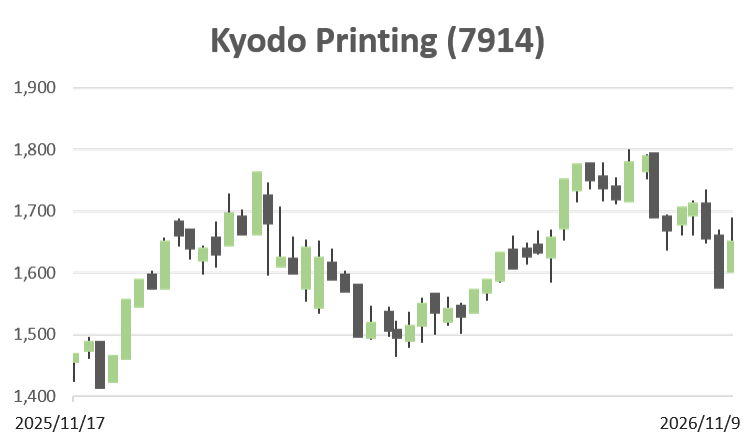
The share-price rise in CY2025 and retreat from the 2026 high reflect expectations moving ahead of results and scrutiny of earnings quality. We believe expectations of improved capital efficiency, sales of cross-shareholdings and higher dividends, together with a recovery in profit levels, supported the valuation in CY2025. However, these factors cannot be quantitatively attributed to individual share-price movements. In 2026, the shares fell 8.50% from the year-to-date high of JPY 1,800 on 18 September to the closing price of JPY 1,647 on 12 November, but remained above the year-to-date low of JPY 1,464. We therefore do not conclude that the absolute year-to-date return in 2026 has been poor, but view this as a correction from the recent high. The sustainability of profit improvement will determine the re-rating.
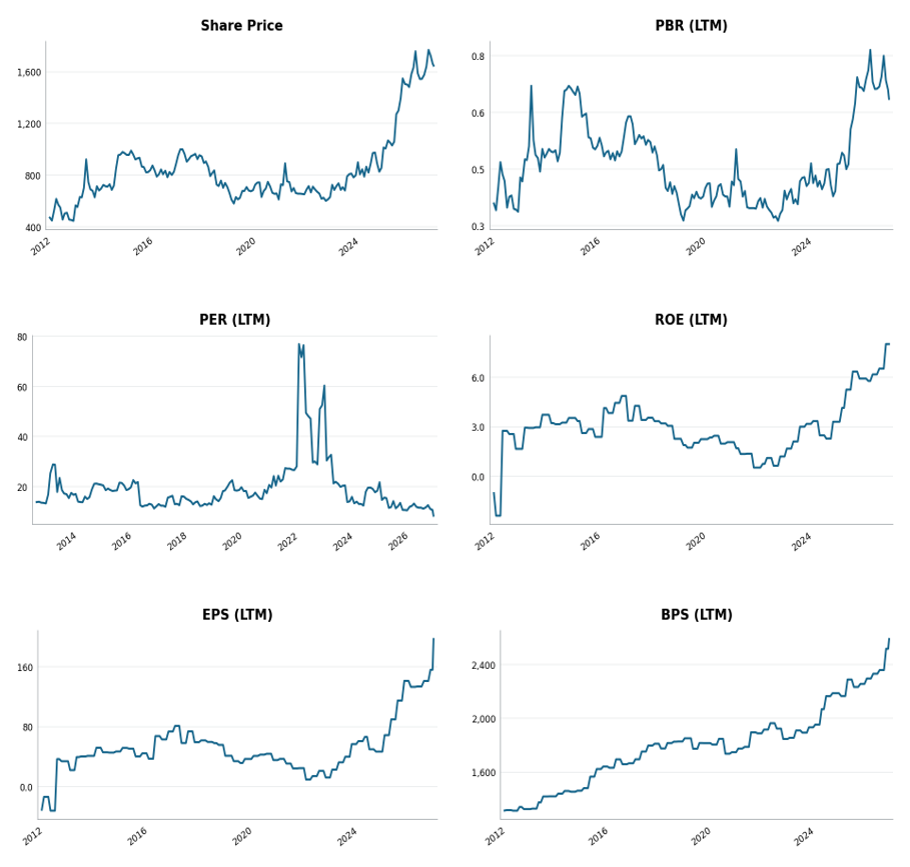
The opposing movements in PER and PBR around 2023 can be explained by differences like earnings and book value, which form their respective denominators. When EPS falls sharply, PER rises mechanically even if the share price barely moves; when EPS recovers in subsequent years, PER declines sharply. By contrast, BPS rises relatively smoothly as retained earnings accumulate, so PBR remains low unless the share price catches up with BPS. It would be mistaken to interpret the high PER around 2023 as a sign of growth expectations; rather, we interpret it as an anomalous reading caused by a low earnings denominator. Expectations of profit improvement have also contributed to the recent increase in PBR, but we would want to test its consistency with sustainable ROE.
The most important KPIs for closing the valuation discount are operating margin, adjusted ROE and the ROIC spread, rather than sales. The company’s FY3/2028 operating profit target of JPY 4.5bn requires an increase of JPY 1.8bn from the FY3/2027 forecast of JPY 2.7bn. Given the substantial step-up required, we avoid valuing the shares on the assumption that the target will be achieved. Nevertheless, reducing Information Communication losses, improving profitability in Lifestyle and Industrial Materials and returning idle capital could raise both valuation multiples and value per share. Conversely, the end of price pass-through benefits, deteriorating profitability of BPO contracts, and upfront costs associated with overseas investment are key risks.
Financials and Valuations
The company forecasts FY3/2027 sales of JPY 99.0bn, operating profit of JPY 2.7bn, ordinary profit of JPY 3.150bn and profit attributable to owners of the parent of JPY 5.1bn. PER is 8.93x based on forecast EPS of JPY 184.34, and PBR is 0.64x based on actual BPS of JPY 2,590.23. We emphasise the sustainability of earnings, excluding gains on the sale of cross-shareholdings.
Financial & Valuation Overview
Share Price and Valuation History