2026-11-16
Home
Japanese

Omega Investment Co., Ltd.
FFRI Security, Inc. (3692:Price Discovery)
Sell
| Share Price | Forecast EPS | Forecast PER | Actual BPS |
| 7,990 yen | 143.25 yen | 55.8 x | 475 yen |
| Actual PBR | Forecast ROE | Forecast Dividend | Dividend Yield |
| 16.8 x | 30.2 % | 18 yen | 0.23 % |
Conclusion
Significant growth potential from national policy, but valuation excessively discounts future profit growth
We rate the shares SELL. The scarcity value of domestic security technology, expanding demand from government agencies and defence-related customers, and the FY3/2026 operating margin of 31.4% are positive. However, the share price of JPY7,990 equates to a 55.8x company-forecast PER and approximately 16.8x PBR, indicating that substantial growth expectations are priced in relative to the company-forecast operating profit growth of 6.5% for FY3/2027. It will take time, and uncertainty remains, before commissioned R&D projects such as the K Program translate into highly profitable recurring revenues. At the same time, product competition with major overseas vendors continues. The potential of an excellent business should be distinguished from the attractiveness of prospective shareholder returns at the current valuation.
Profile
Technology company combining domestically developed endpoint protection with security-related R&D
FFRI Security develops fundamental cybersecurity technologies in Japan. It provides the domestically developed endpoint protection product “FFRI yarai”, investigation, research, analysis and training for government agencies and defence-related customers, corporate security services, and software development and testing. Domestic development and support offer differentiation for customers seeking to reduce dependence on overseas technologies. The FY3/2026 revenue breakdown by business was Security Products 40.4%, National Security Services 36.3%, Other Security Services 15.1%, and Software Development and Testing 8.3% (operating margin: 6.7%). The Cyber Security business, comprising the first three businesses, had an overall operating margin of 35.9% (operating margins for the individual constituent businesses are not disclosed).
Stock Hunter’s View
Focus on cybersecurity for national security with “Japanese-origin” and “fully domestic” technology
FFRI Security conducts R&D into core security technologies in Japan and focuses on the national security field, where its strengths can be most fully demonstrated. Its principal product, “FFRI yarai”, is almost the only entirely domestically developed product among the NGAV (next-generation antivirus)/EDR (endpoint detection and response) products that are now mainstream. President and Representative Director Yuji Ukai is also an internationally recognised security expert who serves as a judge at Black Hat, the world’s largest information-security conference.
In 1Q FY3/2027 (April–June), projects under the Key and Advanced Technology R&D through Cross Community Collaboration Program (K Programme) increased within National Security Services. Some R&D projects that meet government requirements are subject to profit exclusion (meaning that almost only costs can be charged), but the research results may be used as the company’s own copyrighted works. The company therefore aims ultimately to contribute to profits by offering these results as products and services to the government, public agencies and private-sector companies.
Although 1Q operating profit fell 30% year on year, reflecting higher costs from increased personnel and stepped-up recruitment at subsidiaries, the company forecasts full-year operating profit of JPY1.452bn (up 6.5% year on year), maintaining profit growth. The 2Q results are scheduled for release on 12 November.
Investor’s View
The improvement in profitability is genuine, but the share price already discounts success beyond it
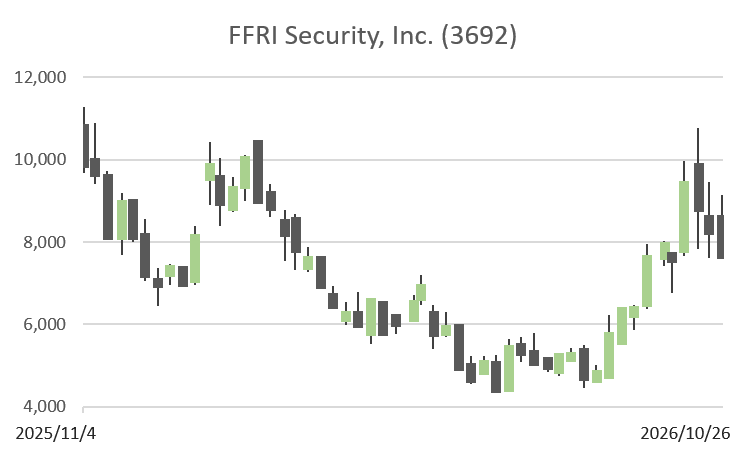
We believe both improved earnings and expectations surrounding national policy have driven the share-price re-rating since 2023. The prolonged weakness through 2022 reflected the heavy R&D burden, unstable profits and a lack of visibility over growth. Profitability recovered from 2023, and in 2025, policy-related demand for cybersecurity in national security raised investors’ growth expectations. However, the share-price movements cannot be attributed solely to increased demand.
Simultaneous improvements in revenue growth and margins reflect robust fundamentals. FY3/2026 revenue increased 43.1% year on year to JPY4.349bn, while operating profit rose 67.0% to JPY1.364bn and the operating margin increased to 31.4%. The high-gross-margin product business and highly utilised specialist services supported growth. By contrast, the company forecasts FY3/2027 revenue of JPY5.135bn and operating profit of JPY1.452bn, with profit growth slowing relative to revenue growth.
Rising ROE and substantial net cash are financial strengths, but capital efficiency warrants careful assessment. ROE and ROIC have improved alongside the earnings recovery, and cash generation has also strengthened. A balance sheet with virtually no debt provides capacity for R&D and recruitment, although accumulating cash and deposits could reduce future capital efficiency. More specific disclosure on returns on investment, capital allocation and shareholder-return policy will be key to enhancing shareholder value.
The surge in demand for online security is a tailwind, but market growth does not automatically translate into higher market share for FFRI. Concerns about targeted attacks, ransomware and supply-chain security support the market as a whole. FFRI’s advantages lie in fully domestic technology and its ability to meet the requirements of Japanese customers, particularly those in government and critical infrastructure. For general corporate customers, however, Microsoft, CrowdStrike and SentinelOne, among others, are strong in integrated operations, detection data and distribution networks. Sustaining competitiveness will require ongoing verification of product performance and implementation records.
Commercialisation of national-policy R&D is both the largest upside driver and the largest valuation risk. Some K Programme projects require profit exclusion, so growth in commissioned-project revenue alone does not guarantee higher profitability. The key is whether the company can reuse research-generated intellectual property, turn it into products, and sell them repeatedly to private-sector customers as well. In 1Q FY3/2027, revenue rose only 1.2% to JPY907m and operating profit fell 30.0% to JPY185m. We want to assess whether an improved order mix can absorb the upfront recruitment and personnel costs.
The mismatch between share-price appreciation and earnings growth is decisive for our SELL rating. The increase in EPS and accumulation of BPS in FY3/2026 underpin the rise in the share price, but the company-forecast PER of 55.8x assumes continued high growth from the next fiscal year onwards. Even if national-policy projects continue to increase, there is substantial scope for valuation compression unless product licence sales increase and margins improve.