2026-11-16
Home
Japanese

Omega Investment Co., Ltd.
Nihon Dengi (Price Discovery : 1723)
NEUTRAL
| Share Price | Forecast EPS | Forecast PER | Actual BPS |
| 1,610 yen | 136.49 yen | 11.80 x | 767.57 yen |
| Actual PBR | Forecast ROE | Forecast dividend | Dividend Yield |
| 2.10 x | 17.78 % | 56.00 yen | 3.48 % |
Conclusion
NEUTRAL : Maintain existing holdings; no new purchases recommended
Our investment rating is NEUTRAL. Nihon Dengi has strengthened its earnings power through profitability-focused order intake and improved construction management. In contrast, a substantial order backlog, a robust balance sheet and enhanced shareholder returns support corporate value. However, the company’s FY3/2027 forecast indicates a decline in the operating margin, and it is not yet clear whether the current high ROE represents a normal medium-term level. At a share price of ¥1,610, a forecast PER of 11.8x and a forecast earnings yield of 8.48%, the valuation reflects some of the improvement in profitability, but the shares cannot be judged definitively undervalued or overvalued without establishing fair value after margin normalisation. We recommend that existing shareholders maintain their holdings and that non-holders refrain from new purchases. We will reassess this view in light of FY3/2027 full-year results and the next company forecast, examining project profitability and the sustainability of the operating margin and ROE.
Profile
A highly profitable engineering company capturing new-build and renewal demand through HVAC automatic controls
A leading instrumentation contractor providing integrated design, installation and maintenance of HVAC automatic control systems for buildings and factories. Demand is supported by redevelopment in the Tokyo metropolitan area, factories, research facilities and data centres, as well as the renewal of existing facilities driven by energy-saving and labour-saving requirements. In the six months to September 2026, the revenue composition by business (segment profit margin) was 88.08% (37.49%) for the HVAC Control Systems Business and 11.91% (18.39%) for the Industrial Systems Business. The revenue shares use consolidated revenue as the denominator and are subject to rounding differences. The figures in parentheses are calculated by dividing disclosed segment profit by segment revenue and therefore differ in definition from the consolidated operating margin.
Stock Hunter’s View
Strong orders amid robust construction demand; exposure to data centres
Nihon Dengi, a major contractor in building HVAC control systems, provides an integrated service spanning the design, installation and maintenance of automatic HVAC control systems for factories and buildings. Following the strengthening of its investor relations (IR) activities, it was selected for inclusion in the major TOPIX reconstitution this October.
Recently, large-scale projects, including redevelopment in the Tokyo metropolitan area, factories and data centres, have been performing strongly. Business opportunities are expanding amid the transition to a decarbonised society and demand for factory labour-saving measures in response to labour shortages. Although the company accepts orders with due regard to its available construction capacity, orders are increasing in both the HVAC Control Systems Business and the Industrial Systems Business, and the order backlog (work carried forward) at the end of September this year remained high, up 30% year on year.
In the core HVAC Control Systems Business, new installation work for research facilities and factories has increased, as has work on existing installations at factories and accommodation facilities. For FY3/2027, the company forecasts revenue of ¥51.5 billion (up 11.1% year on year) and operating profit of ¥12.5 billion (up 5.7%), expecting both to set new record highs for another consecutive year.
By contrast, the recently announced second-quarter results (April–September) showed revenue of ¥19.758 billion (up 5.8% year on year) and operating profit of ¥4.549 billion (up 9.9%), with operating profit reaching a record high for the first half.
Investor’s View
Corporate value has genuinely improved, but maintaining existing holdings and refraining from new purchases is appropriate for now
In assessing Nihon Dengi as an investment, I would distinguish the quality of the business from the investment returns available at the current share price. The rise in margins since 2024 reflects profitability-focused order intake and improved construction management, while the growing order backlog and robust balance sheet are also positive. However, the operating margin in the company’s FY3/2027 forecast is below the previous year’s level, and it remains uncertain how much of the high profitability can be sustained. A forecast PER of 11.8x alone does not establish undervaluation, while there is likewise insufficient evidence of overvaluation to recommend selling. I therefore adopt NEUTRAL: existing shareholders should maintain their positions, while non-holders should make no new purchases. The next evidence on which to base a decision will be the profitability of major projects, the operating margin, ROE and the quality of the order backlog in the FY3/2027 full-year results and FY3/2028 company forecast.
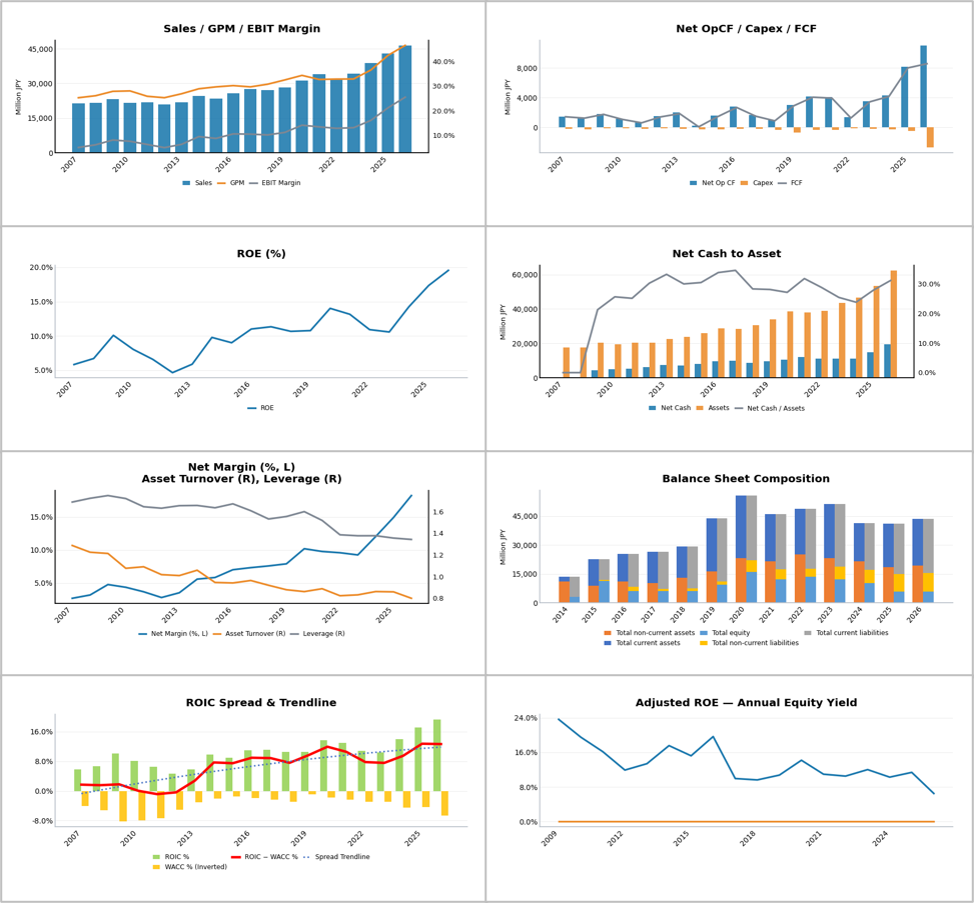
The rapid expansion in EPS since 2024 has been supported more by improvements in profitability than by revenue growth, and it would be inappropriate to extrapolate all of those gains into the future. The simultaneous rise in gross and operating margins reflects an improved mix of work on existing facilities and large projects, profitability-focused order intake and higher construction efficiency. In FY3/2026, revenue reached ¥46.371 billion and operating profit ¥11.821 billion, representing an operating margin of 25.49%. By contrast, the FY3/2027 company forecast is for revenue of ¥51.5 billion, operating profit of ¥12.5 billion and an operating margin of 24.27%, implying a decline in the margin, not in profit. While the improvement in business competitiveness is evident, I would not treat the margin gains of recent years as a permanently sustainable structural level.
The expanding order backlog increases the visibility of growth but does not imply that high profitability will be sustained. At the end of September 2026, the HVAC Control Systems Business had work carried forward of ¥42.707 billion and the Industrial Systems Business ¥4.314 billion, increases of 33.6% and 31.4% year on year, respectively. Given the seasonality of construction completions, which are concentrated in the fourth quarter, the first-half revenue progress rate of 38.4% alone cannot establish whether the full-year plan will be met. The more important question is whether the company can control construction capacity, subcontracting costs, labour costs and the profitability of long-term projects as work volumes rise.
The source of the high ROE is profitability rather than financial leverage, which is positive, but I would not assume that ROE of around 20% is a stable baseline. The improvement has not depended heavily on higher asset turnover or leverage, and the equity ratio remained high at 81.3% at the end of September 2026. Forecast EPS of ¥136.49 divided by the latest BPS of ¥767.57 gives a simplified forecast ROE of 17.7%, while operating profit growth for FY3/2027 is also expected to slow to 5.7%. The improvement in capital efficiency is real, but the focus now is less on peak ROE than on the sustainable level after profitability normalises.
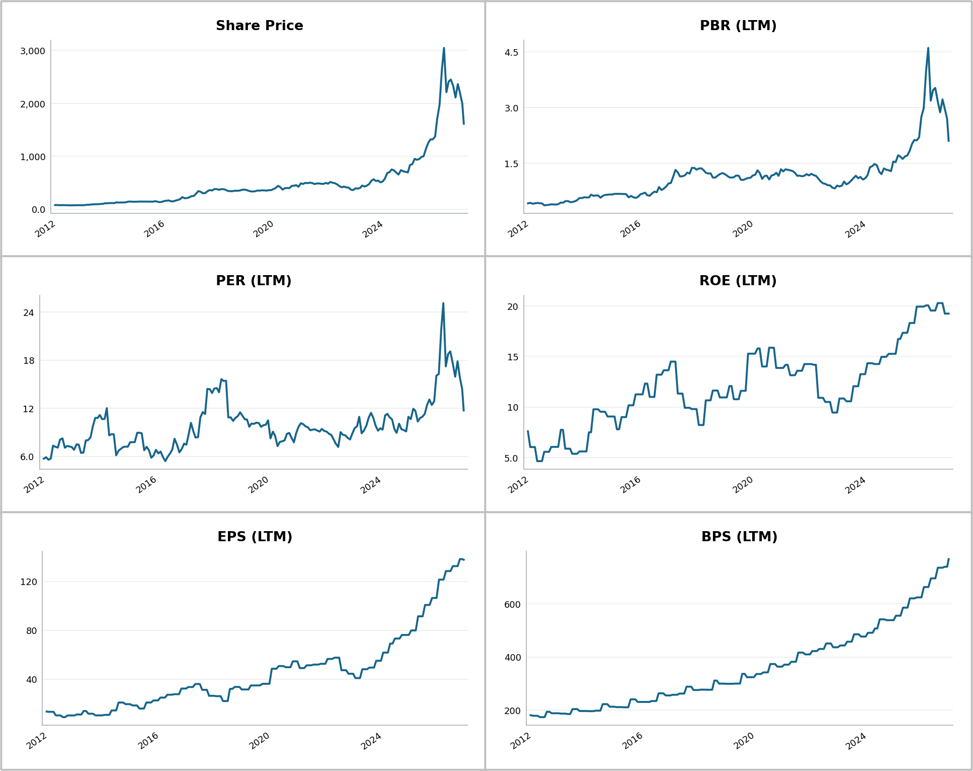
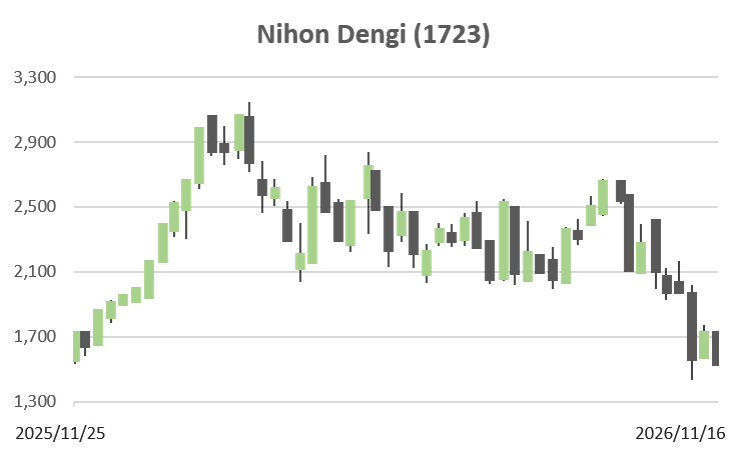
I believe the sharp rise in the share price in 2025 and its reversal in 2026 reflect a substantial change in investor expectations as well as earnings performance. Alongside higher profitability, expectations surrounding data-centre and redevelopment-related demand and shareholder returns drove PER and PBR expansion. Conversely, the decline from the 2026 high may reflect a reversal in valuation multiples, supply-and-demand concerns associated with the September share sale, and slower profit growth indicated by the company forecast. The demand-side support provided by TOPIX inclusion in October should be distinguished from the market’s assessment of medium- to long-term corporate value.
The earnings yield declined despite growth in EPS, BPS, and cash flow because the share price rose faster than earnings. In particular, during the expansion in valuation multiples in 2025, share prices anticipated earnings growth, reducing the appeal of the earnings yield. The forecast earnings yield of 8.48% as at 19 November has improved from its level at the share-price peak, but, if future margins are estimated conservatively, this figure does not directly indicate the medium-term equity return. For example, if EPS were ¥109.19, 20% below the company forecast of ¥136.49, PER at a share price of ¥1,610 would rise to 14.7x. This is not a forecast but a sensitivity analysis of earnings sustainability; it does not establish whether the current share price is undervalued or overvalued.
The higher dividend suggests a stronger commitment to shareholder returns alongside earnings growth, although dividend increases at the same pace cannot be assumed. The FY3/2027 annual dividend forecast was raised to ¥56 per share after the share split, above the previous forecast of ¥40. The FY3/2026 dividend of ¥160 was quoted before the split, equivalent to ¥40 on a post-split basis. Looking ahead, beyond sustainable profitability and cash generation, an important question is how clearly management articulates its dividend payout ratio and policy for deploying surplus capital.
The next stage of shareholder value creation requires capital allocation that improves both earnings repeatability and capital efficiency, rather than simply accumulating abundant cash. Growth in operating cash flow and net cash provides the capacity to combine investment in staff development and construction capability with shareholder returns. However, higher dividends and ample cash alone may not offset the effects of earnings normalisation. As an investor, I would assess the company while monitoring project profitability and the continuity of its dividend policy. In the shareholder distribution, insiders hold 40.78% and institutional investors 28.78%; liquidity and capital policy are therefore also factors in the share valuation.
Financials and Valuations