2026-07-06
Home
Japanese

Omega Investment Co., Ltd.
Kandenko Co., Ltd. (Price Discovery)
Take Profit and Reassess
Market capitalisation: ¥1,255.1bn
Share price and assumptions are as at 17 July 2026. Market capitalisation is calculated using 205,288,338 shares outstanding.
| Share price | Forecast EPS | Forecast PER | Actual BPS |
| 6,114yen | 326.6yen | 18.7x | 1,961x |
| Actual PBR | Forecast ROE | Forecast dividend | Forecast dividend yield |
| 3.12x | 17.2% | 132.5yen | 2.82.175% |
Conclusion
Take Profit and Reassess. Kandenko has transformed from a low-profit electrical engineering contractor into a comprehensive facilities engineering company generating high returns on capital, as orders and margins have improved simultaneously, supported by data centres, semiconductor plants, large-scale redevelopment projects and the expansion of power transmission and distribution networks. However, the current share price already reflects, to a considerable extent, not only increases in EPS, ROE, and ROIC, but also expectations for AI-related capital expenditure and a valuation re-rating. The median fair value derived from the PBR, DCF and ROIC approaches is ¥6,000, broadly in line with the current share price, and we recommend that existing shareholders take profits. The investment case should now be reassessed after confirming the sustainability of high project margins, further upward revisions to earnings forecasts, and stronger share buybacks and shareholder returns under the next medium-term management plan.
Profile
A comprehensive facilities engineering company capturing demand from AI and semiconductor investment and power-grid renewal through the twin pillars of building facilities and social infrastructure
Kandenko is a comprehensive facilities engineering company whose principal shareholder is the TEPCO Group. It operates a Building Facilities business, covering electrical, air-conditioning, and sanitation systems for offices, factories, data centres, and semiconductor plants, and a Social Infrastructure business, covering power distribution, power transmission, information and communications, renewable energy-related construction, and other work. In its core indoor electrical and environmental facilities construction operations, the company has a track record in data centres and semiconductor-related facilities that require advanced capabilities in power supply, air conditioning, and construction management, as well as in large-scale redevelopment projects in the Tokyo metropolitan area. In FY3/2026, completed construction revenue was ¥742.0bn and operating profit was ¥83.1bn, with the operating margin rising to 11.2%. For FY3/2027, Kandenko plans to complete construction revenue of ¥780.0bn and operating profit of ¥90.0bn, and expects a fourth consecutive record profit, supported by robust private-sector capital expenditure and the expansion of power transmission and distribution networks.
Sales composition by business % (operating margin %): Facilities engineering business 98.6% (11.0%), other businesses 1.4% (23.6%) (FY3/2026)
Stock Hunter’s View
Strong orders underpin continued record profits. Expectations also focus on a review of capital policy in the next medium-term plan.
Kandenko is a major electrical engineering contractor affiliated with TEPCO. Its core indoor electrical and environmental facilities construction business, which undertakes electrical, air-conditioning and sanitation work for buildings, accounts for more than half of sales. Within the electrical engineering industry, the company has an extensive track record in semiconductor-related projects.
For FY3/2027, sales are forecast at ¥780.0bn, up 5.1% year on year, and operating profit at ¥90.0bn, up 8.3%, marking a fourth consecutive record profit. Standalone orders at the end of the previous financial year were a substantial ¥673.6bn, up 16.2% year on year. The outlook for orders is favourable, with the company also planning ¥809.0bn in standalone orders for the current financial year, up 10.6%. Orders are expected from large-scale redevelopment projects, data centres and semiconductor plants, and the earnings expansion trend is likely to continue for the time being, supported by a substantial order backlog.
In addition, major shareholder TEPCO Power Grid sold Kandenko shares in February this year, reducing its ownership from 46.2% in September 2025 to 33.4% as at the end of March 2026. This should make it easier to implement capital policies, including share buybacks, and attention will focus on the shareholder return policy from FY3/2028, when the next medium-term plan begins. The total payout ratio is low compared with peers, leaving considerable scope to raise the current target of “a dividend payout ratio of around 40%”.
Investor’s View
The structural improvement in earnings power is clear, but the re-rating, including expectations for AI and data centres, is now largely reflected in the share price.
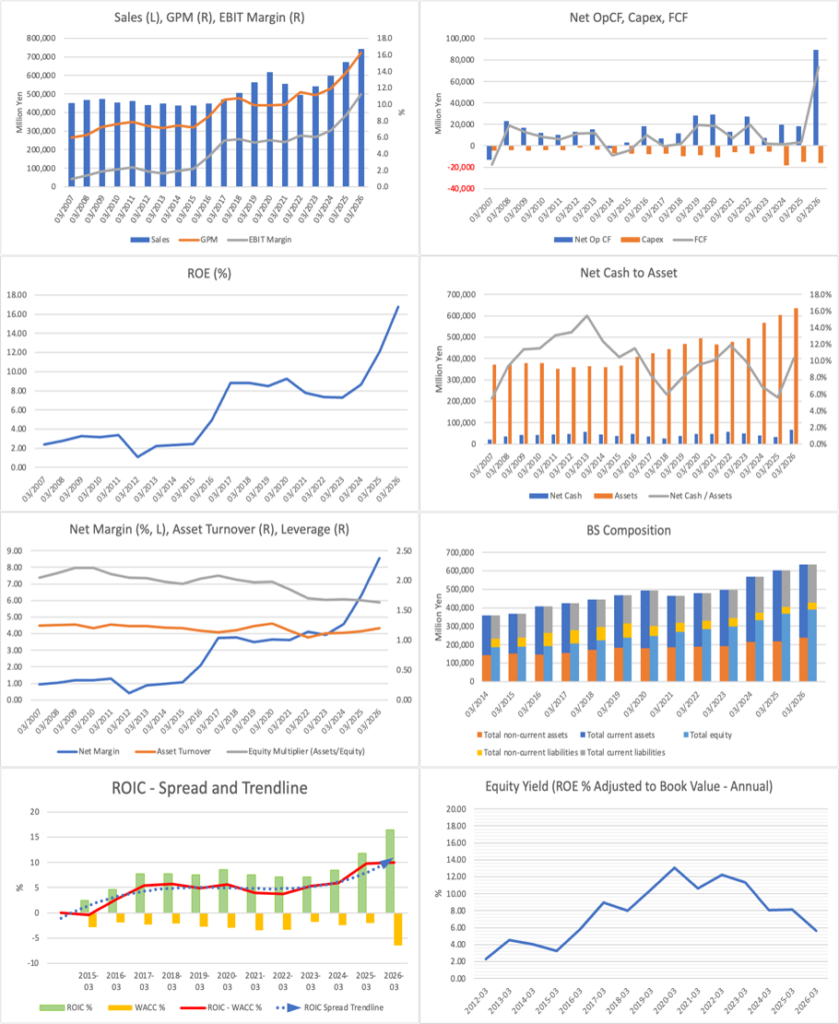
The sharp change in earnings since 2024 has been driven more by improved project profitability than by revenue growth. From FY3/2024 to FY3/2026, the operating margin rose from 6.8% to 11.2%, ROE from 8.6% to 16.8%, and ROIC from 8.4% to 16.4%. Improvements in the gross margin, selective order intake, the pass-through of higher costs, tighter construction and cost management, and an increase in high-value-added projects, including data centres and semiconductor plants, have all contributed. In FY3/2026, operating profit increased by 42.5% year on year and net profit by 49.9%. The company plans a further increase in operating profit to ¥90.0bn in FY3/2027. This can be assessed as the result not merely of higher sales volumes, but of an improved ability to allocate limited construction capacity to higher-margin projects.
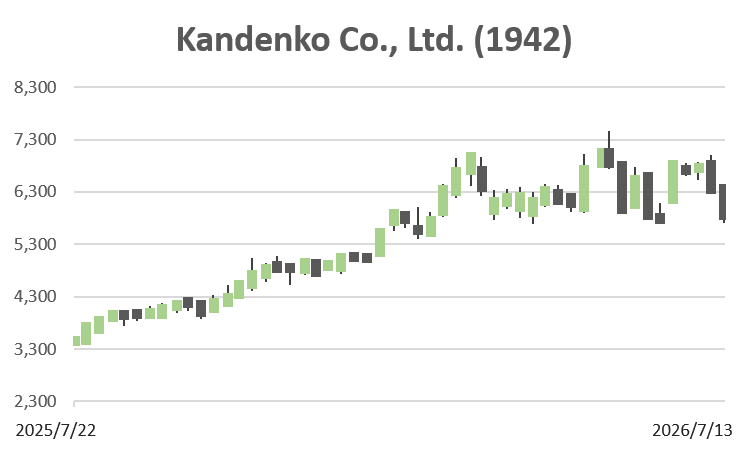
The reason the share price languished for approximately 10 years was low returns on capital and weak capital policy. ROE remained at 1–5% in the first half of the 2010s and subsequently struggled at around 7–9% through FY3/2023. The operating margin also remained at around 5–6% for an extended period, and the company’s substantial assets and stable order intake were not being converted into sufficient shareholder value. In addition, the strong capital relationship with the TEPCO Group, limited shareholder returns and the perception of Kandenko as a mature domestic contractor justified a valuation of around 1x PBR. The rise in the share price since 2024 represents not merely a correction of the previous undervaluation, but a dual re-rating in which earnings growth and multiple expansion have occurred simultaneously.
The current strong performance contains both temporary cyclical factors and a structural strengthening of the underlying business. The concentration of construction schedules for large-scale redevelopment projects and semiconductor plants, contract pricing reflecting higher material costs, and selective order intake under supply constraints could normalise as the capital expenditure cycle matures. By contrast, data-centre power demand associated with the spread of AI, the reshoring of semiconductor production capacity, the expansion of power transmission and distribution networks, renewable-energy grid connections, the renewal of ageing infrastructure, and the concentration of orders among major contractors due to engineer shortages should support medium-term demand. Recent profit growth of 40–50% is therefore unlikely to continue, but underlying margins and returns on capital should be regarded as having moved to a higher level than over the past ten years.
The issue is not whether the structural improvement exists, but how much of its value is already reflected in the current share price. At ¥6,114, the shares trade on a forecast PER of 18.7x and an actual PBR of 3.12x, substantially above Kandenko’s historical valuation. A PBR above 3x can be justified if forecast ROE of 17.2% is sustained, but it would be difficult to maintain the current valuation if ROE is normalised to 12–13%. Assuming a dividend payout ratio of 40.6% and a cost of equity of 8.0–8.5%, the long-term EPS growth rate implied by the share price is estimated at 5.8–6.3%. This is far below the EPS CAGR of 25.9% from FY3/2021 to FY3/2026, but, given that the company’s forecast EPS growth rate slows to a single-digit level in FY3/2027, the market is valuing the maintenance of a high level of earnings and moderate growth rather than the continuation of rapid growth.
Expectations for AI- and data-centre-related demand have already become an important component of the valuation expansion. Kandenko does not sell AI itself but is an ancillary infrastructure provider supplying power, air-conditioning, and communications systems, which gives it relatively high visibility in demand. However, delays to AI investment plans, power-connection constraints, rising construction costs or deterioration in customers’ investment returns could alter project start dates and profitability. Investing at the current share price, therefore, amounts to betting not only on the continuation of AI-related capital expenditure, but also on Kandenko’s ability to maintain its current high project margins.
The shareholder structure, in which Tokyo Electric Power Company Holdings owns 34.24%, provides stability to business value but has a complex effect on equity value. The relationship with the TEPCO Group supports stable orders for power transmission and distribution work, the accumulation of technical expertise and creditworthiness, and forms part of Kandenko’s competitive advantage. Conversely, the fact that TEPCO Holdings trades at around 4x PER and 0.3x PBR reflects strong market concerns about regulation, compensation liabilities, capital allocation, and governance. As long as the company retains a strong parent-company character, a discount due to potential conflicts of interest with minority shareholders and constraints on capital policy will persist. The decline in TEPCO’s ownership from the 46% range to the 34% range is positive because it improves liquidity and expands the scope for an independent capital policy. A further re-rating will depend on whether the capital relationship can be diluted further while maintaining the commercial relationship.
The investment decision should be based not on the company’s quality but on the expected return at the current price. The median fair value derived from the PBR, DCF, and ROIC approaches is ¥6,000, placing the current share price of ¥6,114 at a broadly fair value. The improvement in earnings power merits recognition, but the margin of safety is limited, and further upside depends on upward revisions to earnings forecasts, achieving ROE above 15%, and stronger shareholder returns under the next medium-term management plan. It is rational for existing shareholders to take profits and reassess the shares after confirming that the current high profitability is not a cyclical peak and that the decline in TEPCO’s ownership leads to substantive changes in capital policy.
Valuation
The median of the three approaches is ¥6,000, with the current share price broadly reflecting the earnings improvement and re-rating
PBR approach: Assuming sustainable ROE of 15–17%, a cost of equity of 8–9% and a long-term growth rate of 4–6%, the fair value range is ¥5,100–6,860, with a median of ¥5,980.
DCF approach: Assuming normalised FCF of ¥50.0–65.0bn, WACC of 7–8% and a terminal growth rate of 1.5–2.0%, the fair value range is ¥5,300–7,200, with a median of ¥6,250.
ROIC approach: Assuming normalised ROIC of 14–16%, WACC of 7–8% and a growth rate of 3–4%, the fair value range is ¥5,200–7,000, with a median of ¥6,000.
Overall assessment: Using the three approaches on an equal basis, the fair value range is ¥5,100–7,200, with a median of ¥6,000.
Market expectations: Assuming a forecast PER of 18.7x, a forecast dividend payout ratio of 40.6% and a cost of equity of 8.0–8.5%, the long-term EPS growth rate implied by the share price is 5.8–6.3%. Although this is far below the EPS CAGR of 25.9% from FY3/2021 to FY3/2026, the market already assumes that the recent rate of profit growth will normalise. The current share price does not fully reflect excessive optimism, but there is no upside to the median of the three approaches, and the margin of safety is insufficient to justify a new investment.
Shareholder Distribution
The relationship with TEPCO supports a stable business foundation, but constrains the valuation in terms of capital policy and minority shareholder interests
According to FactSet data, Tokyo Electric Power Company Holdings owns 34.24%, followed by Kandenko’s treasury shares at 3.06% and the employee shareholding association at 2.64%. Domestic and overseas institutional investors, including Sumitomo Mitsui Trust Asset Management, Amova Asset Management, Nomura Asset Management, Vanguard, Capital Research and BlackRock, also hold shares, but TEPCO’s ownership remains dominant. The presence of a stable shareholder supports long-term investment and cooperation in the power transmission and distribution business, but limits external discipline from ordinary shareholders, independence in capital allocation and the possibility of a takeover. The improvement in liquidity and expansion of the institutional shareholder base resulting from TEPCO’s reduced ownership are positive, and the treatment of future share buybacks, reductions in strategic shareholdings and additional secondary offerings will affect equity value.
Financials and Valuations
In FY3/2026, completed construction revenue was ¥742.0bn, operating profit was ¥83.1bn, and net profit attributable to owners of the parent was ¥63.5bn, with the operating margin rising to 11.2%, ROE to 16.8% and ROIC to 16.4%. The company’s FY3/2027 plan is for completed construction revenue of ¥780.0bn, operating profit of ¥90.0bn and net profit of ¥65.0bn. Standalone new orders are ¥809.0bn, and the construction backlog to be carried forward at the end of FY3/2026 was ¥673.7bn, providing high near-term earnings visibility. However, because FY3/2026 FCF was substantially above historical levels and included the effect of improved working capital, the valuation should use normalised FCF rather than perpetuating the single-year result.
Price

PBR (LTM)

PER (LTM)

ROE (LTM)

EPS (LTM)

BPS (LTM)
