2026-09-18
Home
Japanese

Omega Investment Co., Ltd.
CHUGAI RO (Company note – Basic report)

| Share price (7/8) | ¥4,020 | Dividend Yield (27/3 CE) | 4.5 % |
| 52weeks high/low | ¥5,220/3,245 | ROE(26/3) | 15.7 % |
| Avg Vol (3 month) | 37.7 thou shrs | Operating margin (26/3) | 7.71 % |
| Market Cap | ¥31.36 bn | Beta (5Y Monthly) | 0.44 |
| Enterprise Value | ¥22.13 bn | Shares Outstanding | 7.800 mn shrs |
| PER (27/3 CE) | 11.6 X | Listed market | TSE Prime section |
| PBR (26/3 act) | 0.93 X |
| Click here for the PDF version of this page |
| PDF version |
Japan’s leading manufacturer of industrial furnaces and industrial burners. Medium- to long-term business opportunities have emerged with the advent of carbon neutrality, and the Company is also taking a straightforward approach to enhancing corporate value. Positive expectations for the next Medium-Term Management Plan are rising under the new president.
Summary
◇ Overview of CHUGAI RO: Japan’s leading company in industrial furnaces under the slogan “Pioneering the future with thermal technology.” With a strong technology orientation, the Company has a track record of developing more than 100 types of industrial furnaces since its founding in 1945. It is known as a “department store of industrial furnaces.” Its strength lies in its broad expertise in industrial furnaces.
◇ Carbon neutrality requirements for industrial furnaces: The manufacturing industry accounts for approximately 30% of Japan’s CO₂ emissions, and because industrial furnaces have a particularly high weight in thermal processes represented by metal heating, responding to carbon neutrality is an important issue. There are approximately 37,000 industrial furnaces in Japan, of which 5,000–7,000 are those handled by the Company. CO₂ emissions from these Company-made industrial furnaces total 12 million tons per year (base year: FY2013), equivalent to 1% of Japan’s total emissions. To achieve carbon neutrality, it is necessary to reduce these emissions by nearly 100%, which presents an important business opportunity for the Company.
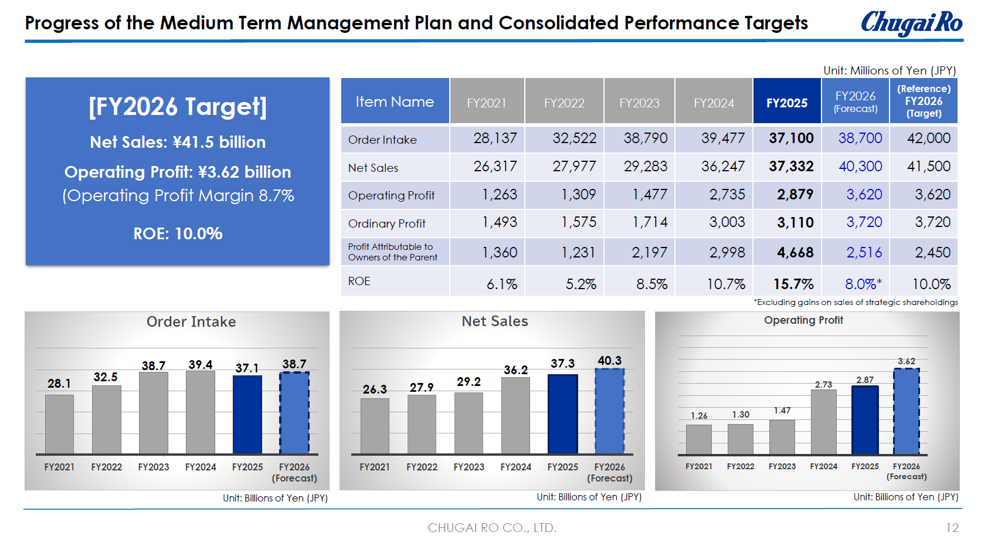
◇Medium-Term Management Plan that sees carbon neutrality as a business opportunity: Based on this background, on May 13, 2022, the Company announced the “CHUGAI RO Group Medium-Term Management Plan (FY2022–FY2026).” The plan promotes three key strategies: “The creation of new markets centered on carbon neutrality,” “Brushing up of existing products suited to needs to expand sales and increase profits,” and “The creation of rewarding workplaces.” In the final fiscal year, FY3/2027, the Company aims to achieve net sales of 41.5 billion yen, operating profit of 3.62 billion yen (operating profit margin of 8.7%), and ROE of 10.0%. Progress has generally been steady.
◇Toward achieving and sustaining a PBR of 1.0: The Company is implementing various measures based on its “Initiatives to enhance corporate value” to achieve and sustain a PBR of 1.0x. It is currently working on seven items, and most of them have been completed. The stock market has responded favorably to this management policy, and the PBR has risen to around 1.0x.
◇Business trends: Recent performance is solid. In the consolidated financial results for FY3/2026, although order intake was 37.1 billion yen (down 6% YoY), net sales were 37.3 billion yen (up 3% YoY), and operating profit and ordinary profit were 2.9 billion yen (up 5% YoY) and 3.1 billion yen (up 4% YoY), respectively. This marked the fifth consecutive year of increases in net sales and operating profit. The Company also steadily proceeded with the sale of cross-shareholdings, ROE was 15.7%, and the year-end dividend per share was 166 yen (up 16 yen YoY).
Although the FY3/2027 earnings forecast reflects uncertainty in the business environment and order intake and net sales are expected to be slightly below the Medium-Term Management Plan targets, operating profit and ordinary profit are expected to land in line with the final targets, and profit attributable to owners of parent is expected to exceed the target. The forecast is order intake of 38.7 billion yen (up 4% YoY), net sales of 40.3 billion yen (up 8% YoY), operating profit of 3.62 billion yen (up 26% YoY), ordinary profit of 3.72 billion yen (up 20% YoY), profit attributable to owners of parent of 2.52 billion yen (down 46% YoY), and dividend per share of 180 yen (up 14 yen YoY). Forecast ROE excluding the sale of cross-shareholdings is 8.0%.
◇Stock price trends and catalysts: The recent stock price (4,100 yen) has continued to rise on the progress of the current Medium-Term Management Plan, and PBR has recovered to around 1.0x. However, the stock price has recently been marking time because the FY3/2027 earnings forecast did not significantly exceed the final targets of the Medium-Term Management Plan, and order intake momentum has slowed somewhat.
The president changed in April 2026, and the Company is in the process of formulating the next Medium-Term Management Plan. Progress in earnings this fiscal year is important. However, it is more important to see how much the Company’s medium- to long-term earnings potential will increase through its areas of strength, including carbon neutrality. Attention is likely to focus on the new president’s initiatives, including whether ROE above 10% will become firmly established and whether PBR will move meaningfully above 1.0x.
Table of contents
| Summary | 1 |
| Key financial data | 2 |
| Company profile | 3 |
| History/Company’s group | 3 |
| Company’s group | 4 |
| Business overview | 5 |
| Industrial furnace market | 5 |
| Japan’s leading manufacturer of industrial furnaces and industrial burners, advocating itself as a technology-oriented company | 7 |
| Segment structure | 9 |
| Long-term performance trends | 10 |
| CHUGAI RO Group Medium-Term Management Plan (FY2022–FY2026) | 12 |
| Key strategy 1 | 16 |
| Key strategy 2 | 20 |
| Key strategy 3 | 21 |
| Financial results | 22 |
| Full-year results for FY3/2026 | 22 |
| FY3/2027 full-year forecast | 23 |
| Initiatives to enhance corporate value | 24 |
| Share price trends and catalysts | 26 |
| Financial data | 29 |
| Corporate data | 30 |
| Corporate profile/history | 30 |
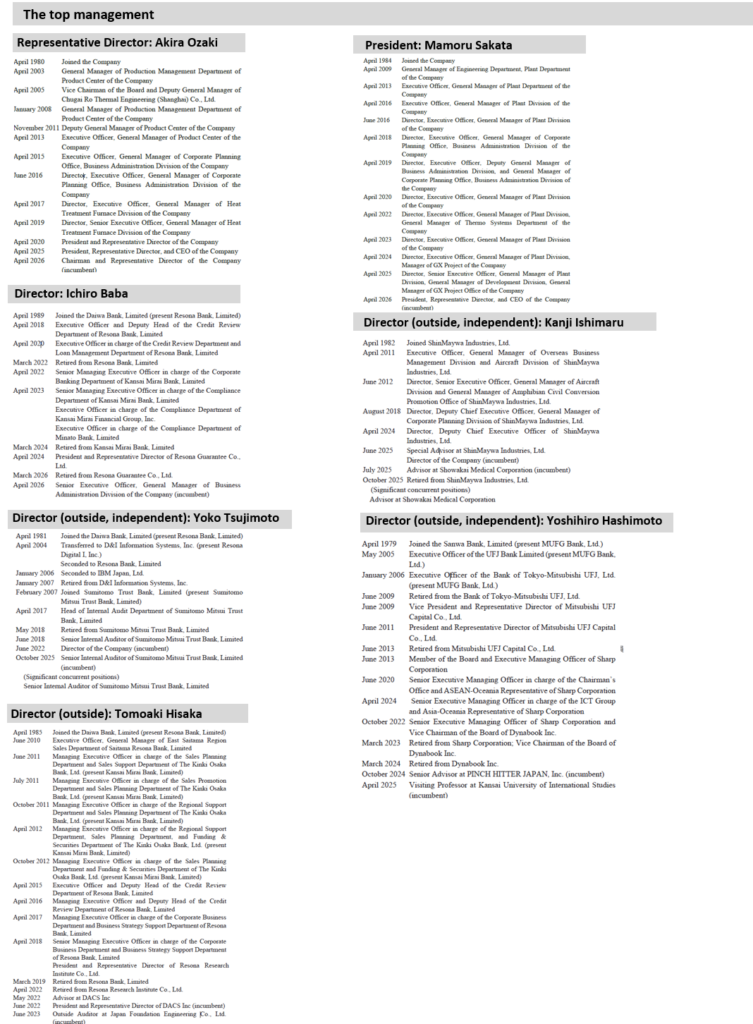
| The top management | 31 |
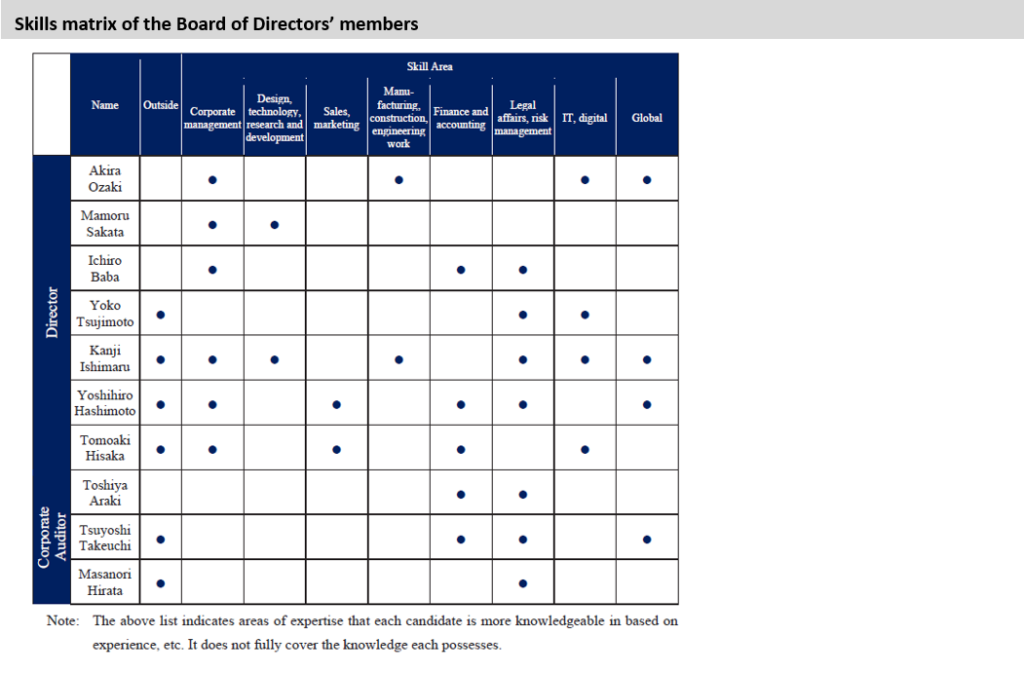
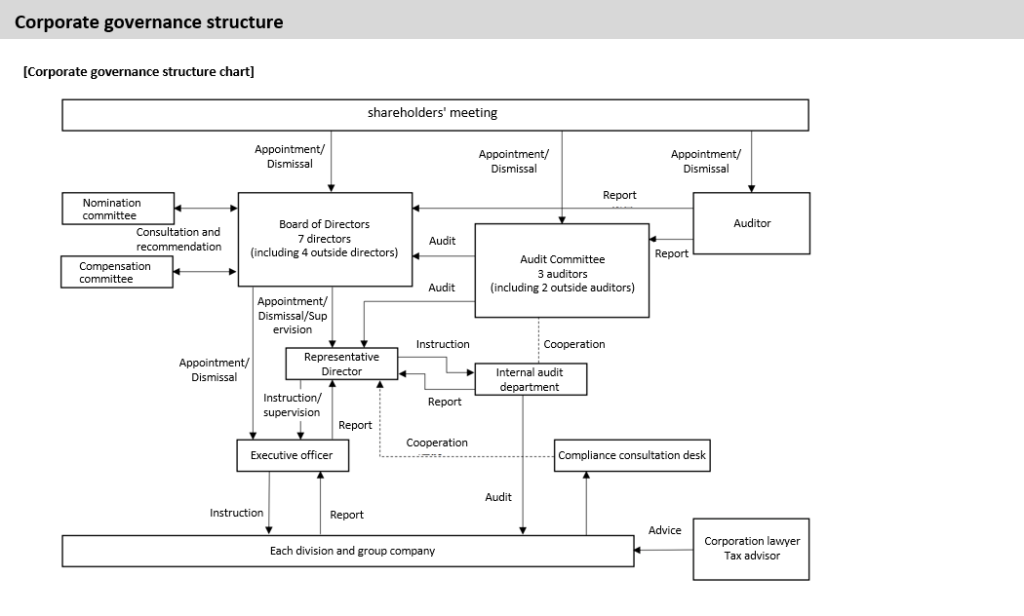
| Skills matrix of the Board of Directors’ members/Corporate governance | 32 |
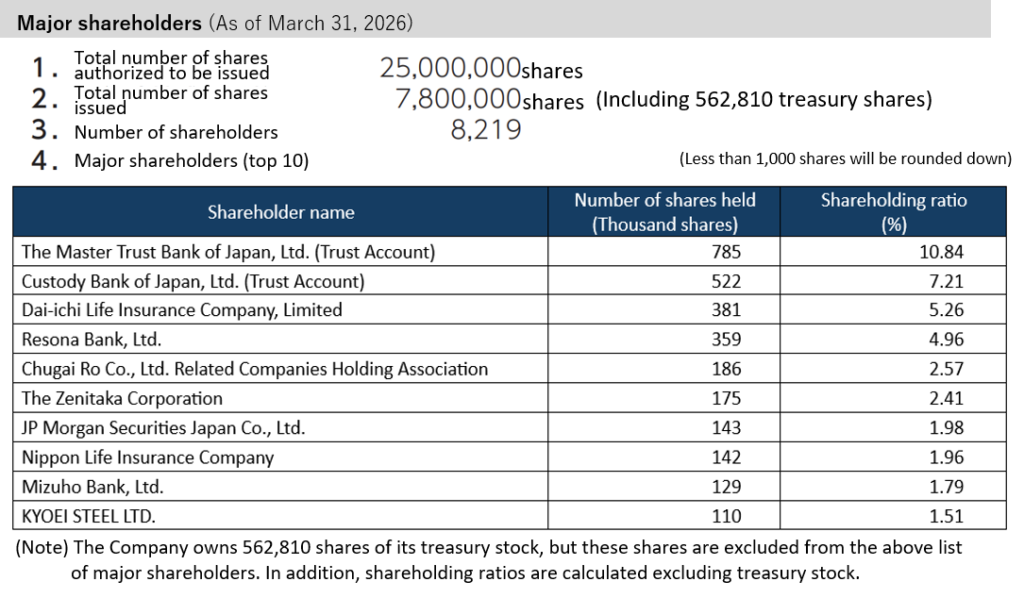
| Major shareholders/Shareholding by ownership | 33 |
Key financial data
| Unit: million yen | 2022/3 | 2023/3 | 2024/3 | 2025/3 | 2026/3 | 2027/3CE |
| Sales | 26,317 | 27,976 | 29,283 | 36,247 | 37,332 | 40,300 |
| EBIT (Operating Income) | 1,264 | 1,310 | 1,479 | 2,737 | 2,879 | 3,620 |
| Pretax Income | 1,594 | 1,699 | 3,129 | 4,222 | 6,426 | |
| Net Profit Attributable to Owner of Parent | 1,360 | 1,231 | 2,197 | 2,998 | 4,668 | 2,516 |
| Cash & Short-Term Investments | 11,130 | 7,884 | 10,061 | 4,392 | 10,821 | |
| Total assets | 38,141 | 41,178 | 48,863 | 48,736 | 51,282 | |
| Total Debt | 3,988 | 3,988 | 7,288 | 5,507 | 4,445 | |
| Net Debt | -7,142 | -3,896 | -2,773 | 1,115 | -6,376 | |
| Total liabilities | 14,928 | 17,134 | 21,092 | 20,125 | 19,798 | |
| Total Shareholders’ Equity | 23,068 | 23,860 | 27,570 | 28,329 | 31,201 | |
| Net Operating Cash Flow | 6,090 | -2,500 | -891 | -3,696 | 6,427 | |
| Capital Expenditure | 216 | 244 | 1,355 | 723 | 1,318 | |
| Net Investing Cash Flow | 510 | -63 | 550 | 654 | 2,588 | |
| Net Financing Cash Flow | -2,508 | -727 | 2,451 | -2,701 | -2,641 | |
| Free Cash Flow | 5,963 | -2,688 | -2,161 | -4,419 | 5,413 | |
| ROA (%) | 3.55 | 3.10 | 4.88 | 6.14 | 9.33 | |
| ROE (%) | 6.08 | 5.25 | 8.54 | 10.73 | 15.68 | |
| EPS (Yen) | 177.2 | 162.0 | 293.8 | 407.6 | 643.7 | 347.7 |
| BPS (Yen) | 3,005.3 | 3,146.7 | 3,709.0 | 3,859.0 | 4,311.2 | |
| Dividend per Share (Yen) | 70.00 | 70.00 | 80.00 | 150.00 | 166.00 | 180.00 |
| Shares Outstanding (Million shares) | 7.80 | 7.80 | 7.80 | 7.80 | 7.80 |
Source: Omega Investment from company materials
Company profile
CHUGAI RO CO., LTD. is Japan’s leading manufacturer of industrial furnaces and industrial burners, whose management philosophy is: “Chugai Ro creates new value through its core of thermal technology, thus contributing to society while realizing the prosperity of the company and the happiness of its employees.” With a track record of developing over 100 types of industrial furnaces, the Company is known as a “department store of industrial furnaces.” Under the slogan “Pioneering the future with thermal technology,” and based on its foundational technologies in thermal technology, engineering capabilities, and advanced technology accumulated since its founding in 1945, the Company provides industrial furnaces and related equipment to the steel, automotive, and information and communications industries. Currently, based on its Management Vision 2026, “Renovate ourselves to develop our future with the technology for carbon neutrality!”, the Company aims to contribute to society and expand corporate value through carbon-neutral technology under its Medium-Term Management Plan (FY2022–FY2026). Attention from the stock market is increasing.
History
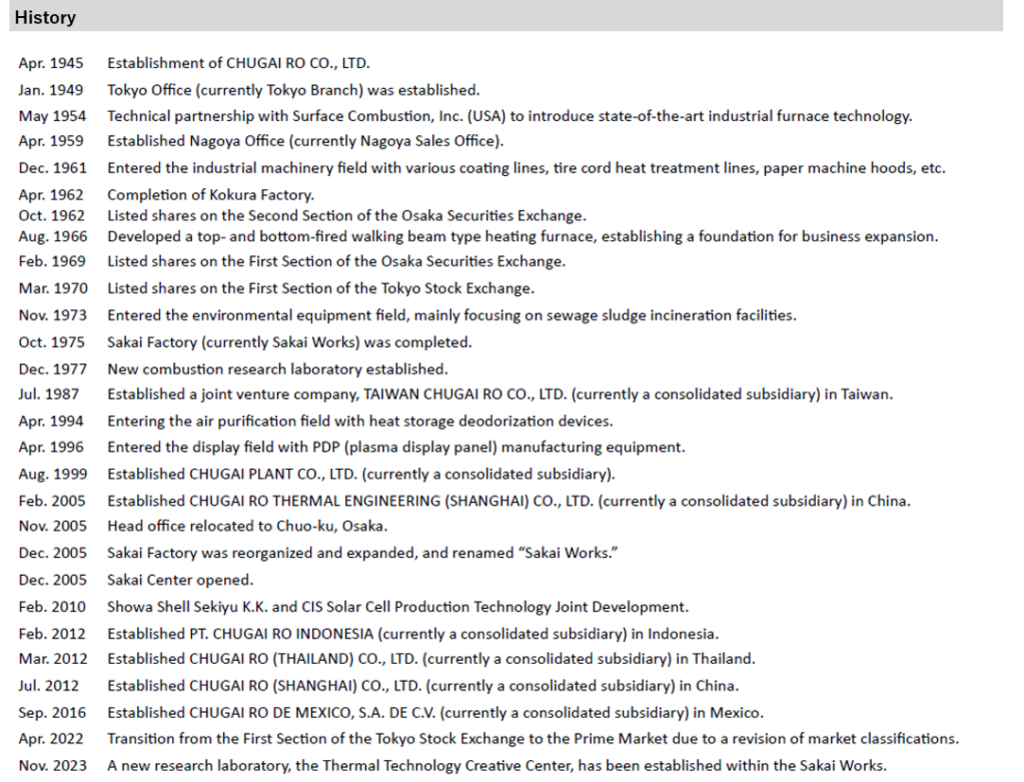
The Company was founded in 1945, and in the 1950s, it established thermal technology and popularized industrial furnaces in Japan. A turning point was its 1954 technical partnership with Surface Combustion, Inc. (USA), through which it completed Japan’s first domestically produced batch-type gas carburizing furnace and introduced the atmosphere heat treatment method to Japan on a wide scale. This enabled the mass production of metal parts with high surface strength and uniform precision, laying the foundation for the development of the automotive industry. In the following year, 1955, the Company began supplying state-of-the-art industrial furnaces to a wide range of industries, including steel, nonferrous metals, electric machinery, and glass. In 1966, it developed the top- and bottom-fired walking beam type reheating furnace, supporting the growth of the steel industry. More recently, in 2014, the Company expanded and received orders for the “HIFALCON,” a mass-production-type vacuum carburizing furnace.
Since the 1960s, the Company has expanded its business domain to include environmental response. In 1961, it began manufacturing industrial machinery, including various coating lines, tire cord heat treatment lines, and paper machine hoods. After the oil shocks of the 1970s, it developed energy-saving burners, entered the field of environmental protection in 1973 starting with sewage sludge incineration facilities, entered the information and communication field in 1988 with inline sputtering systems, the air purification field in 1994 with regenerative thermal oxidizers, the display field in 1996 with PDP (plasma display panel) manufacturing equipment, launched ultra-precision coating and drying systems for LCD and OLED in 2004, developed and received orders for solar cell manufacturing equipment in 2009, jointly developed CIS solar cell production technology with Showa Shell Sekiyu K.K. in 2010, jointly developed the world’s first general-purpose hydrogen burner for industrial use with TOYOTA MOTOR CORPORATION in 2018 (and began operation in Toyota’s production process in 2023), received orders in 2019 for precision coating systems for flexible OLED substrates, in 2020 jointly researched and developed ammonia-only combustion technology with Osaka University, and in 2022 received an order for a hydrogen combustion exhaust gas treatment system.
Overseas, the Company established bases in Taiwan in 1987, China in 2005, Indonesia and Thailand in 2012, and Mexico in 2016.
In November 2023, the Company opened a new research facility, the “Thermal Technology Creative Center”, within its Sakai Works. The aim is to focus on the development of next-generation combustion technologies, such as ammonia combustion and hydrogen combustion, as well as highly efficient energy-saving technologies, to promote the decarbonization of industrial furnaces and machinery that consume large amounts of energy in manufacturing processes.
The Company’s shares were listed on the Second Section of the Osaka Stock Exchange in 1962, then moved to the First Section of the Osaka Stock Exchange in 1969, and subsequently to the First Section of the Tokyo Stock Exchange in 1970. The shares were transferred to the Prime Market in 2022 (see also the history table on page 30).
Company’s group
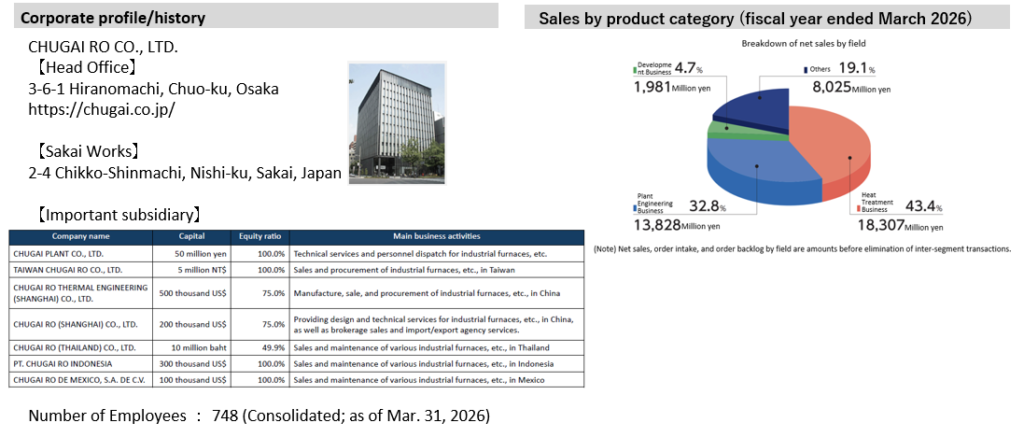
The Group consists of the Company and seven subsidiaries. It is mainly engaged in the design, manufacturing, and construction of industrial furnaces, industrial machinery, environmental equipment, and combustion equipment, as well as the manufacturing and sales of combustion devices, across three business segments: the Heat Treatment Business (primarily related to automobiles, machinery, semiconductors, chemicals, and battery manufacturing), the Plant Engineering Business (mainly associated with steel, nonferrous metals, and ceramics), and the Development Business (primarily related to decarbonization, precision coating and drying, and waste treatment and recycling). In addition, the Group conducts engineering, research, and development, as well as other services ancillary to its various businesses.
Overview of the Group and product flow
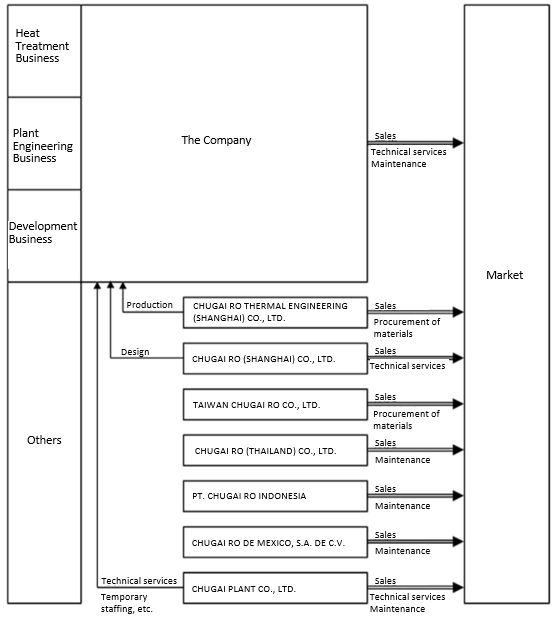
Source: Company materials
As for the Company’s business locations, its main domestic sites include the head office (Chuo-ku, Osaka), Sakai Works, Sakai Center, Kokura Factory, Tokyo Branch Office, and Nagoya Sales Office. Of these, Sakai Works is responsible for production, research, and development. Overseas, the Company has bases in Shanghai, Taiwan, Thailand, Indonesia, and Mexico. It also has partners involved in technology export in the United States and South Korea.
Sakai Works
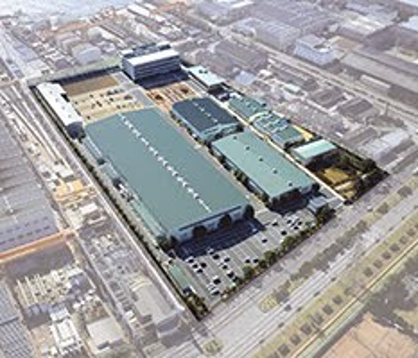
Source: Company materials
Business overview
Industrial furnace market
Industrial furnaces play a crucial role in manufacturing processes that determine the characteristics of metal parts and are widely used throughout the manufacturing industry’s supply chain, from upstream to downstream. The industries of end users are also diverse, including steel, automotive, electrical, and electronics sectors.
In terms of heat sources, there are combustion furnaces, which utilize natural gas and other fuels, and electric furnaces, which rely on electricity as their primary heat source. The former heats by burning fuel with a burner, while the latter uses electricity as the heat source. Electric furnaces are one of the promising methods for decarbonizing industrial furnaces, and demand for them is increasing, including for replacing combustion furnaces.
In addition, because combustion methods and control technologies vary by product, a key characteristic of the business is that furnace structures and other elements are custom-designed for each new project.
In Japan, it is estimated that approximately 37,000 industrial furnaces are in operation, of which an estimated 5,000 to 7,000 are the Company’s products. The size of the domestic market is estimated to be around 200 billion yen (based on a survey by the Ministry of Economy, Trade and Industry and interviews with the Company).
Industrial furnaces
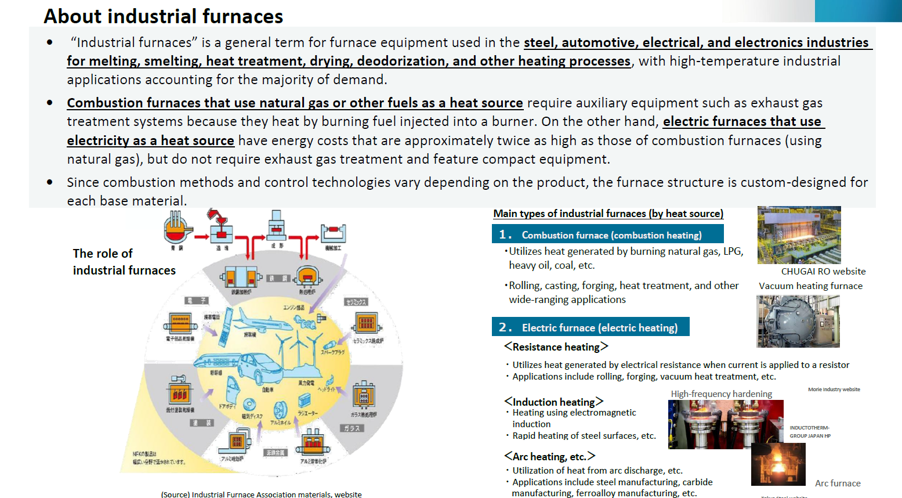
Source: Ministry of Economy, Trade and Industry, “Trends in Japan and abroad related to decarbonization of thermal processes in the manufacturing sector” (October 2, 2024, Manufacturing Industries Bureau, Casting and Forging Industry Office)https://www.meti.go.jp/shingikai/sankoshin/green_innovation/industrial_restructuring/pdf/026_03_00.pdf
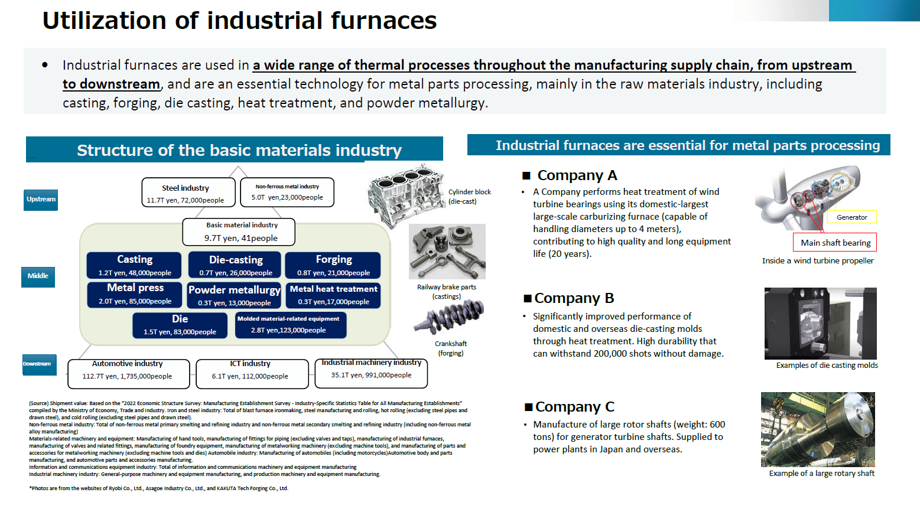
Source: Ministry of Economy, Trade and Industry, “Trends in Japan and abroad related to decarbonization of thermal processes in the manufacturing sector” (October 2, 2024, Manufacturing Industries Bureau, Casting and Forging Industry Office)https://www.meti.go.jp/shingikai/sankoshin/green_innovation/industrial_restructuring/pdf/026_03_00.pdf
Japan’s leading manufacturer of industrial furnaces and industrial burners, advocating itself as a technology-oriented company
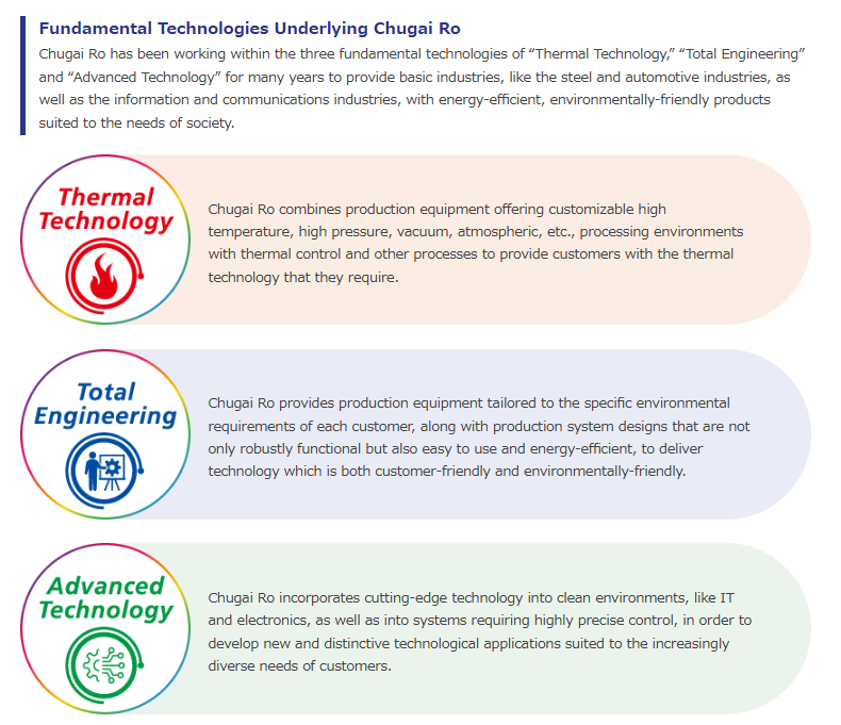
As evident in the Company’s history, it has a proven track record of supplying a diverse range of industrial furnaces to various industries. The foundational technologies cultivated in this way are “Thermal Technology,” “Total Engineering,” and “Advanced Technology.”
CHUGAI RO’s foundational technologies
Source: Company materials
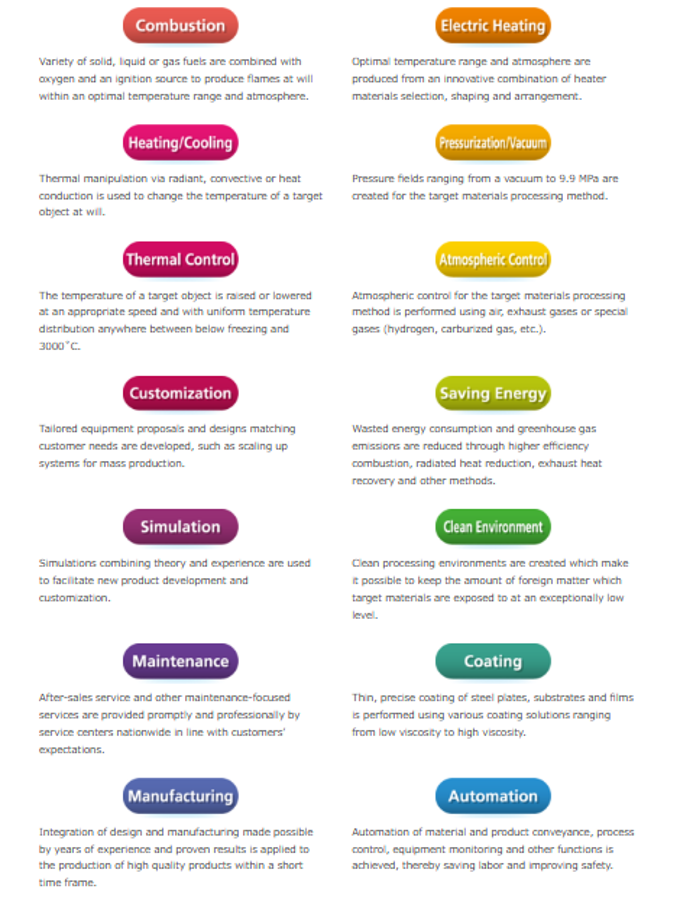
These foundational technologies have been refined into 14 core technologies.
CHUGAI RO’s core technologies
Source: Company materials
The Company’s research and development, based on the above technologies, is being carried out in three key areas: the Heat Treatment Business, the Plant Engineering Business, and the Development Business, to respond to social demands such as carbon neutrality, advanced materials, and resource circulation (zero emissions). R&D expenses for the fiscal year ended March 2026 are approximately 1.1 billion yen.
In terms of development structure, the Company established the “Thermal Technology Creative Center” within its Sakai Works in November 2023. It consists of three zones: the “Combustion Zone” for developing decarbonization and energy-saving combustion technologies using next-generation fuels (hydrogen and ammonia), the “Functional Materials Zone” for researching heat treatment technologies for advanced materials, and the “Co-Creation Space” to promote joint research and development with internal and external parties. It is also being utilized in the Green Innovation Fund project of NEDO, which is being promoted mainly by the GX Project Office.
Furthermore, as of April 1, 2025, the Company established a new Development Division Headquarters, integrating under it the previously independent Product Development Department (responsible for product development utilizing thermal technology), the Convertech Department (responsible for development and design of precision coating equipment for display panels, batteries, and semiconductors), and the GX Project Office (responsible for developing new combustion technologies using hydrogen and ammonia fuels for the decarbonization of industrial furnaces, as well as new electric heating technologies), aiming to improve development efficiency.
The Company primarily handles development and design, while manufacturing, assembly, and installation are outsourced to partner companies, resulting in a reduced capital investment burden.
Segment structure
The Company’s current segment structure is as follows.
Heat Treatment Business
Design, manufacture, construction, and sales of heat treatment furnaces for the automotive, machinery, semiconductor, and chemical industries, as well as heat treatment furnaces for batteries, substrates, catalysts, and magnetic materials. Additionally, the Company offers air purification equipment. Handled by the Company.
Plant Engineering Business
Design, manufacturing, construction, and sales of reheating furnaces and heat treatment furnaces for steel and nonferrous metals; metal strip process lines; coating lines; various types of industrial burners; and energy-saving control devices. Handled by the Company.
Development Business
Research and development related to decarbonization; design, manufacturing, construction, and sales of precision coating and drying equipment, kilns, and environmental process equipment. Handled by the Company.
Other
Operations of domestic and overseas subsidiaries.
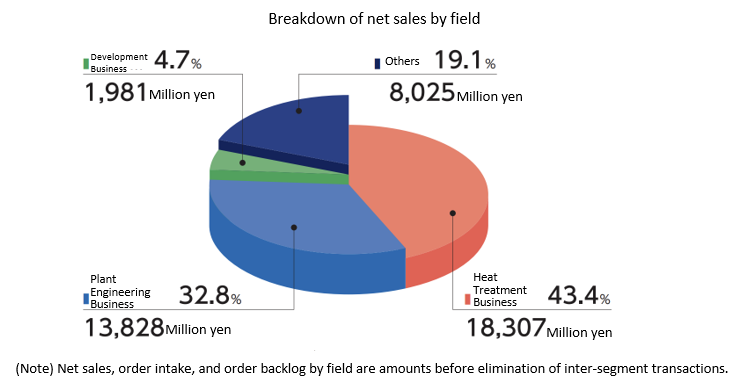
The composition ratios of net sales and other items for FY3/2026 are as follows and are well-balanced.
Breakdown of net sales (Fiscal year ended March 2026)
Source: Company materials
Long-term performance trends
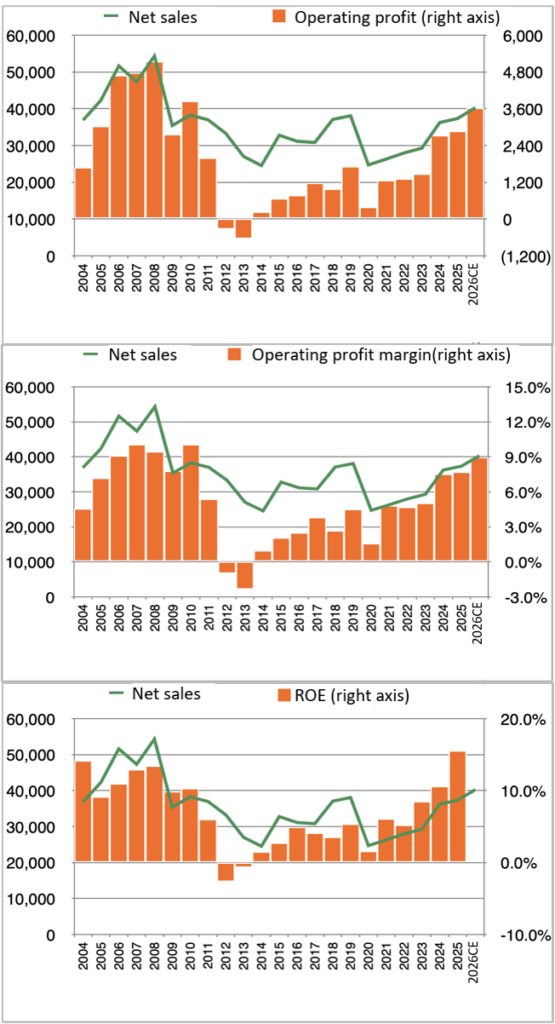
Before analyzing the Medium-Term Management Plan currently being promoted, let us review the company’s long-term performance trends. The graphs below show actual results from FY3/2025 to FY3/2026, as well as the Company’s forecast for FY3/2027.
Long-term performance trends
Source: Company materials, Factset
As these graphs show, the Company has emerged from the stagnation period of the 2010s and has recovered to a level comparable with the scale of net sales and profitability it achieved in the 2000s.
In the 2000s, new products such as precision coating systems for display and solar cell manufacturing contributed to earnings. In FY3/2009, the Company posted net sales of 54.3 billion yen and operating profit of 5.1 billion yen. During the 2000s, the peak operating profit margin was 10.1% and the peak ROE was 14.2%, demonstrating high profitability.
Subsequently, in the 2010s, performance stagnated due to factors such as a slowdown in growth in the Chinese market, the rise of local manufacturers, the shift of customer bases for precision coating systems for display manufacturing and solar cell manufacturing equipment to Asia, and intensifying competition with equipment manufacturers.
During this period, the Company actively proposed to domestic automakers and identified needs for higher strength, lighter weight, lower cost, and environmental compliance in automotive parts, while also advancing various measures to secure profitability. Through this responsiveness, performance has steadily recovered since the latter half of the 2010s.
Furthermore, in recent years, the Company has steadily linked key customers’ long-term promotion of responses to carbon neutrality to business expansion, and its earnings power has recovered to a level comparable with the 2000s.
In this way, the Company can be seen to have steadily linked new technologies to business performance when it led the market with them, and to have advanced appropriate responses even when the market environment turned into a headwind. As a “department store of industrial furnaces,” the Company’s long-term performance trends demonstrate its ability to create new value and respond flexibly to changes in the business environment.
CHUGAI RO Group Medium-Term Management Plan (FY2022–FY2026)
Perspective for viewing the CHUGAI RO Group Medium-Term Management Plan (FY2022–FY2026)
On May 13, 2022, the Company announced the “CHUGAI RO Group Medium-Term Management Plan (FY2022–FY2026).”
Practical perspectives for interpreting this Medium-Term Management Plan are as follows:
- CO₂ emissions from the approximately 37,000 industrial furnaces operating in Japan are said to amount to 150 million tons annually, accounting for about 15% of Japan’s total CO₂ emissions
- Of these, the Company’s industrial furnaces are estimated to number 5,000-7,000, with annual CO₂ emissions of 12 million tons (base year: FY2013), equivalent to 1% of Japan’s total emissions
- The decarbonization of these industrial furnaces is a significant long-term societal issue, a need of the Company’s customers, and directly linked to the reduction of the Company’s Scope 3 CO₂ emissions
- Addressing these issues is an excellent profit opportunity for the company, which seeks to “create new value” through thermal technology by leveraging thermal technology to promote the use of hydrogen and ammonia and the electrification of industrial furnaces
It should also be noted that if the Company succeeds in technological development and commercialization, this could lead to business expansion into industrial furnaces that the Company has not handled.
Next, as reference materials, materials showing Japan’s macro-level need for decarbonization are presented.
Japan’s macro-level need for decarbonization
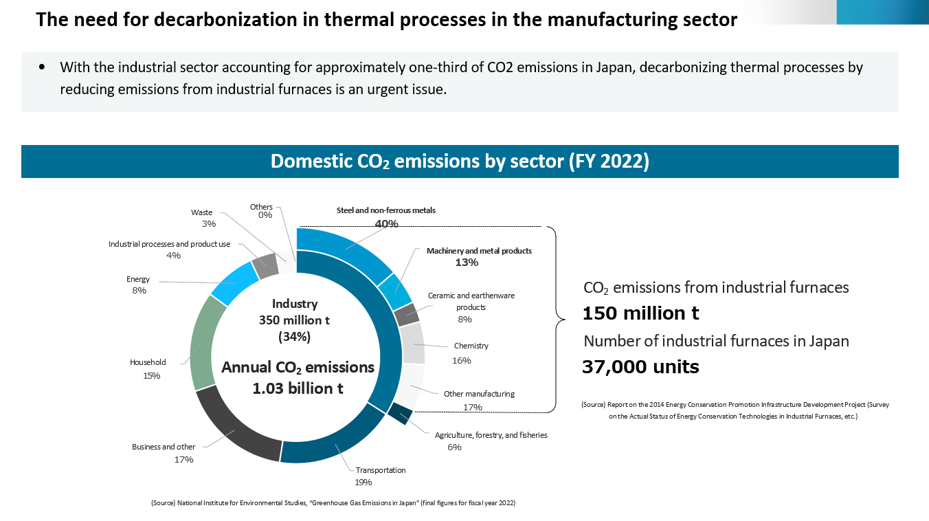
Source: Ministry of Economy, Trade and Industry, “Trends in Japan and abroad related to decarbonization of thermal processes in the manufacturing sector” (October 2, 2024, Manufacturing Industries Bureau, Casting and Forging Industry Office)https://www.meti.go.jp/shingikai/sankoshin/green_innovation/industrial_restructuring/pdf/026_03_00.pdf
Additionally, a reference material is provided regarding the direction of industrial furnace decarbonization as envisioned by the Ministry of Economy, Trade and Industry.
Direction of industrial furnace decarbonization
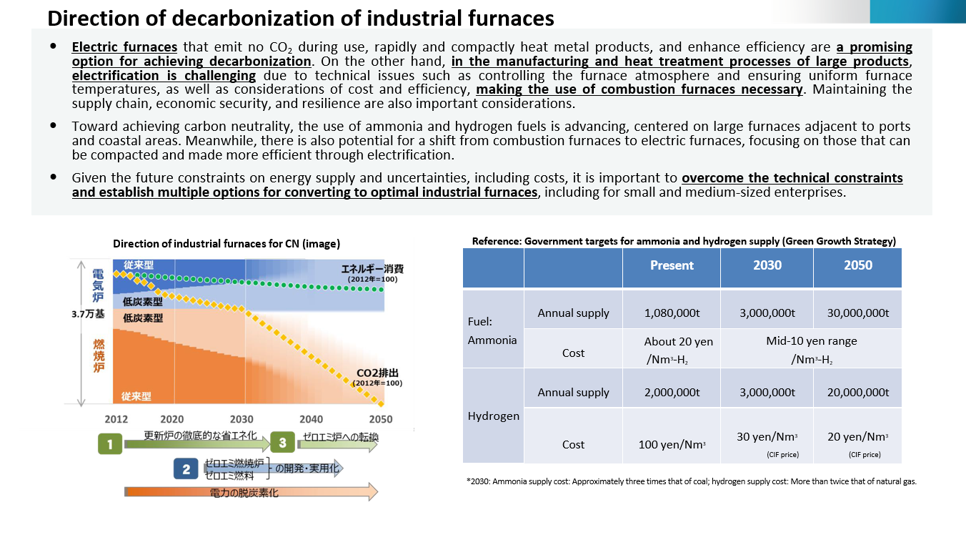
Source: Ministry of Economy, Trade and Industry, “Trends in Japan and abroad related to decarbonization of thermal processes in the manufacturing sector” (October 2, 2024, Manufacturing Industries Bureau, Casting and Forging Industry Office)https://www.meti.go.jp/shingikai/sankoshin/green_innovation/industrial_restructuring/pdf/026_03_00.pdf
A decline in customers’ enthusiasm for carbon neutrality could be a concern. Nevertheless, many of the Company’s key customers are leading companies in global industries, and it is expected that they will continue to undertake serious initiatives over the long term.
CHUGAI RO Group Medium-Term Management Plan (FY2022–FY2026)
The following reviews the key points of the “CHUGAI RO Group Medium-Term Management Plan (FY2022–FY2026)” dated May 13, 2022. In conclusion, as stated in the perspective above, the plan accurately recognizes the business environment, beginning with the megatrend of “decarbonization,” and aims to boost performance and improve capital efficiency through appropriate measures that leverage the Company’s strengths.
The following looks at the details. First, as the business environment, the Company recognizes demand for carbon neutrality, changes in the macro environment (specifically, a slowdown in domestic demand growth, the shift to EVs in the automotive industry, which is a key customer, and a decline in crude steel production), and securing skilled workers as important issues.
Recognition of the business environment that underlies the Medium-Term Management Plan (FY2022–FY2026)
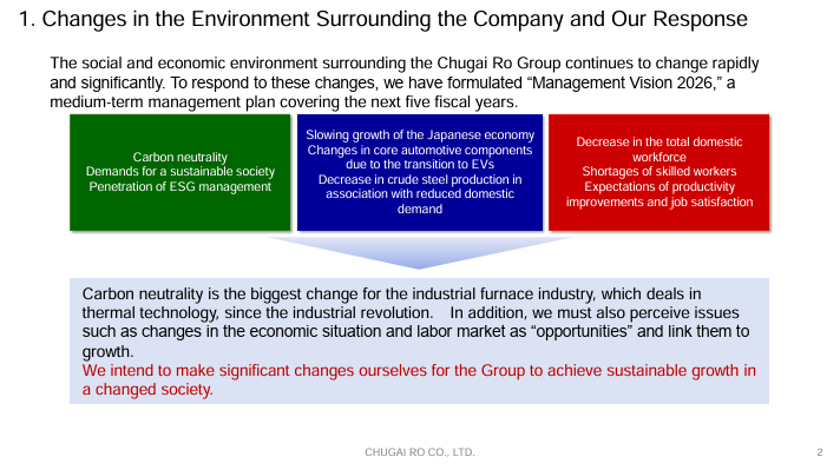
Source: Company materials
Next, based on its management philosophy, the Company has presented the following three key strategies and has unified them by setting forth Management Vision 2026. Value creation and the pursuit of added value are the themes.
Management Philosophy and Management Vision 2026
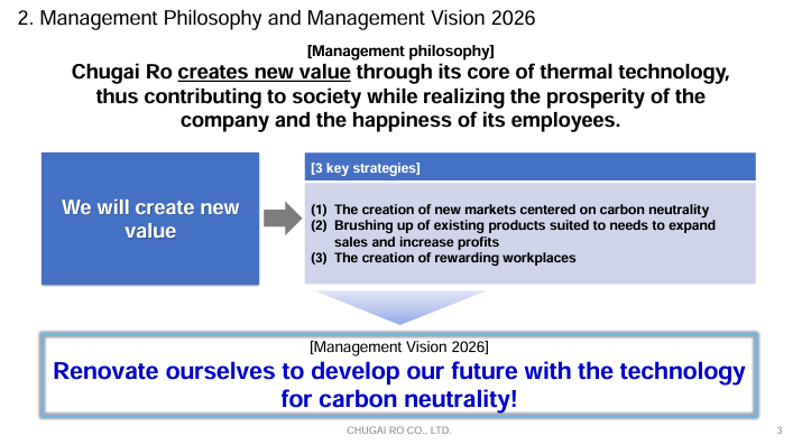
Source: Company materials
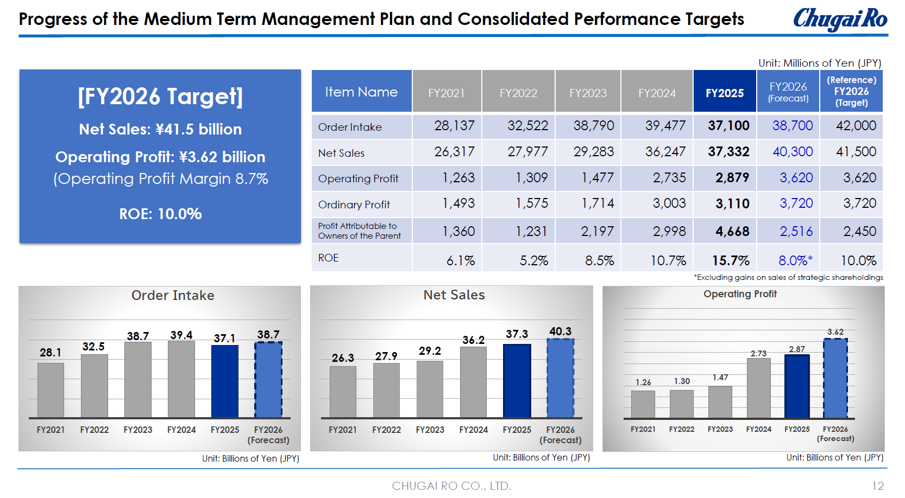
The consolidated performance targets are net sales of 41.5 billion yen, operating profit of 3.62 billion yen (operating profit margin of 8.7%), and ROE of 10.0% in FY3/2027. The trend, including actual results through FY2025 (FY3/2026), is as follows, with progress generally steady.
Consolidated performance targets
Source: Company materials
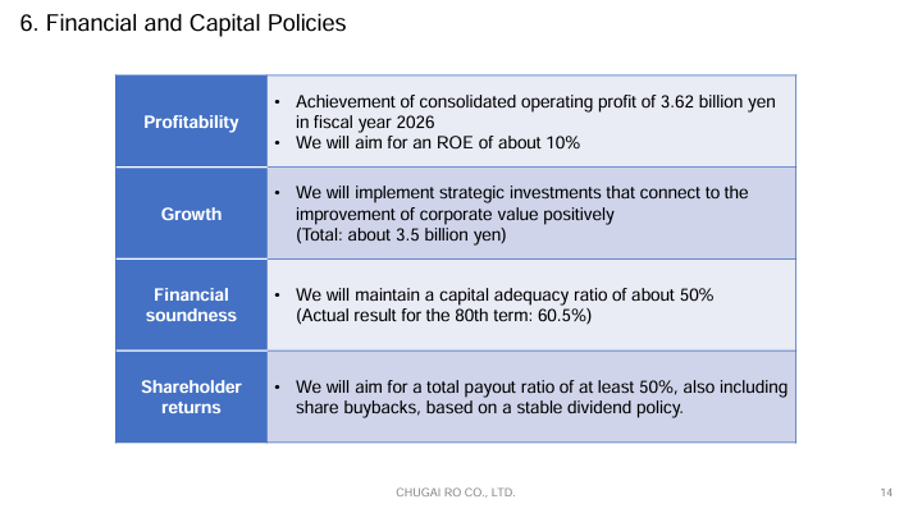
Related financial and capital policies are as follows:
Financial and capital policies
Source: Company materials
Key strategy 1: The creation of new markets centered on carbon neutrality
The details of the three key strategies mentioned above are explained below.
First are the specific measures for “The creation of new markets centered on carbon neutrality.”
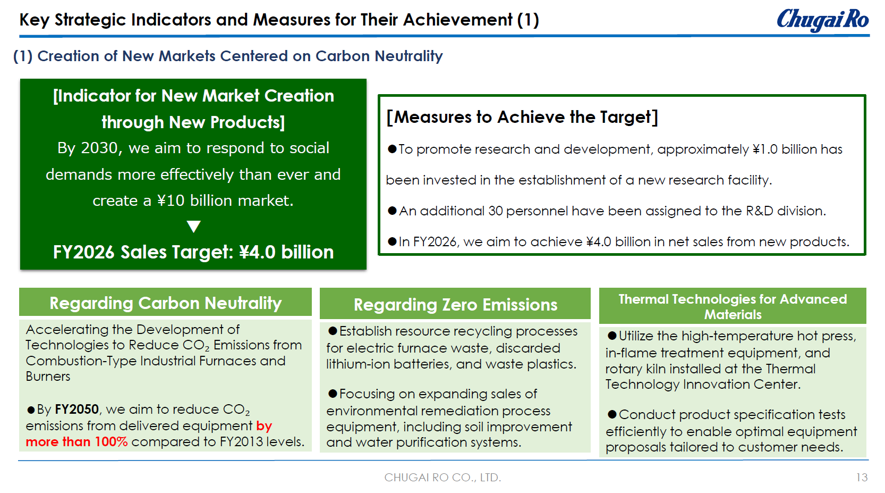
Overall picture of “The creation of new markets centered on carbon neutrality”
Source: Company materials
Note: In November 2023, the new research facility, the “Thermal Technology Creative Center,” was established within Sakai Works.
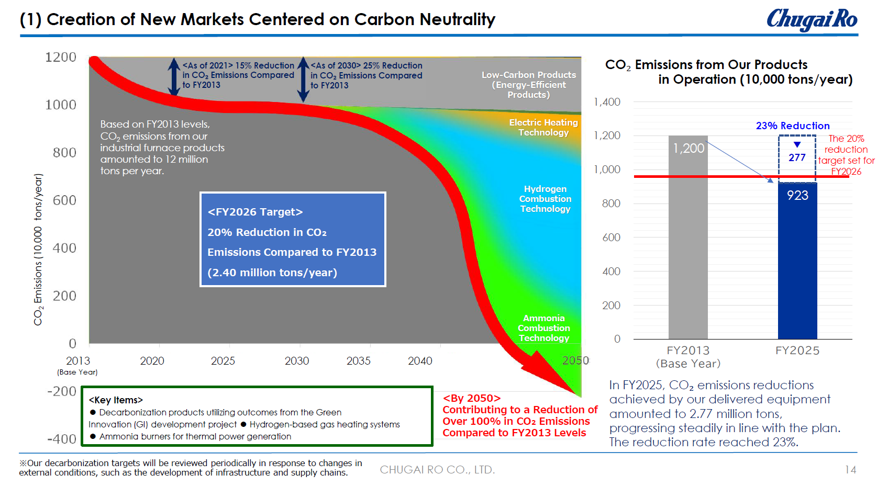
Progress on this measure is steady. First, from the perspective of reducing CO₂ emissions, the penetration of the Company’s low-carbon products (energy-saving products) has advanced, and CO₂ emissions reductions from the Company’s industrial furnace products in the FY2025 results have already met the FY2026 target.
Target: Starting from 12 million tons in FY2013 (base year)
FY2026 initial target 17% reduction
FY2026 current target 20% reduction (2.4 million tons reduced)
FY2030 target 25% reduction
FY2050 target 100%+ reduction
Result:
FY2021 result 15% reduction
FY2025 result 23% reduction (2.77 million tons reduced)
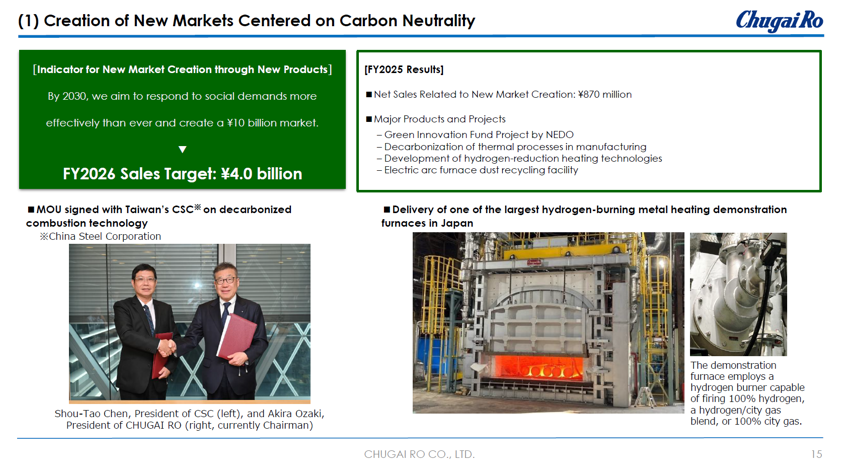
Next, progress in net sales from the creation of new markets through new products centered on carbon neutrality has also generally been steady. Based on the most recent situation, it appears highly likely that the 4.0 billion yen target will be shifted to FY2027 (FY3/2028), while the plan to reach 10.0 billion yen in FY2030 remains.
FY2024 sales result 1.0 billion yen
FY2025 sales result 870 million yen
FY2026 sales target 4.0 billion yen
FY2030 sales target 10.0 billion yen
The key points of recent results for new products are as follows:
- The Company received an order from Tokyo Steel Manufacturing Co., Ltd. for electric furnace dust recycling equipment.: This equipment enables the separation of zinc from dust and its recovery as crude zinc oxide by roasting electric furnace dust, which had previously been outsourced for treatment as industrial waste, within the Company’s own factory.
- The Company delivered one of Japan’s largest hydrogen-combustion metal-reheating demonstration furnaces to Kobe Steel, Ltd.’s Takasago Works.: This was selected by NEDO as the “Demonstration of hydrogen utilization in combustion-type industrial furnaces toward decarbonization of factories mainly consuming thermal energy.”
- The Company passed the stage gate for NEDO’s “Green Innovation Fund Project / Decarbonization of Thermal Processes in the Manufacturing Sector”: Elemental technology development, promoted since September 2023, passed NEDO’s stage-gate review in January 2026, and medium-scale demonstration development began as a subsidized project on April 1, 2026.
Achievements in new market creation
Source: Company materials
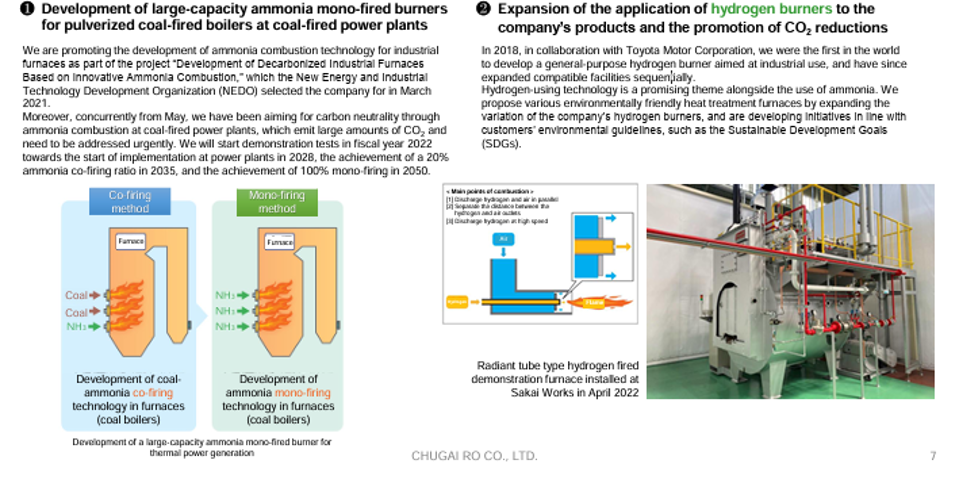
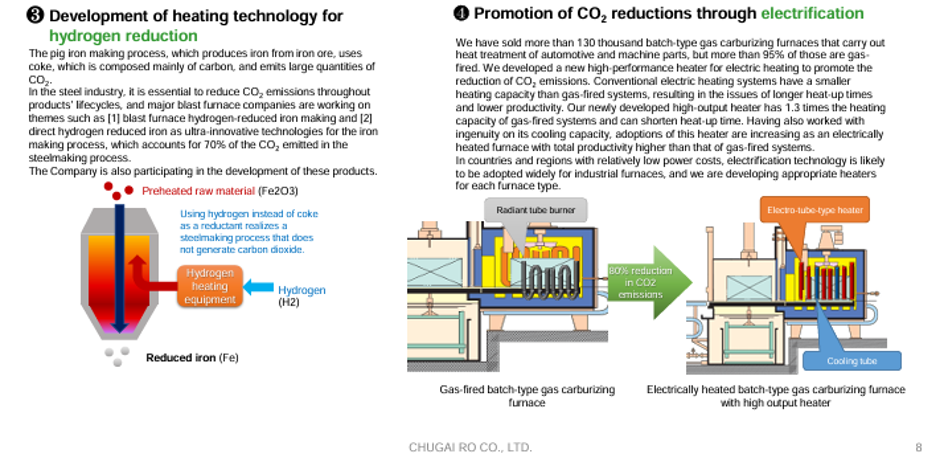
Examples of development projects
Source: Company materials
Source: Company materials
Key strategy 2: Brushing up of existing products suited to needs to expand sales and increase profits
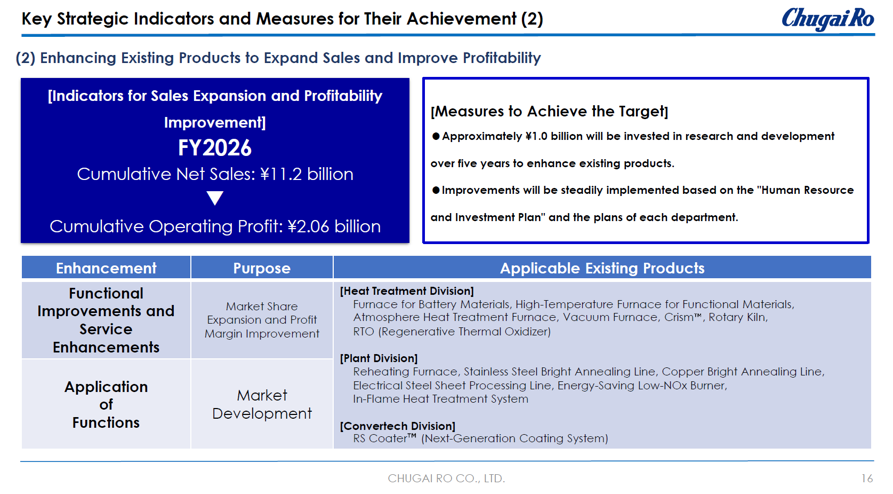
Next is “Brushing up of existing products suited to needs to expand sales and increase profits.” The measures are as follows.
Initiatives to expand sales and increase profits through brushing up on existing products
Source: Company materials
Progress is as follows and is steady.
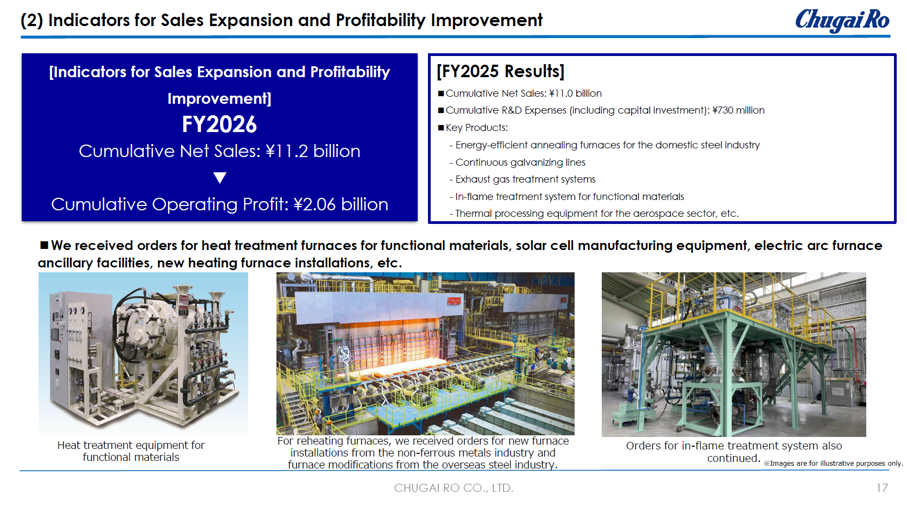
FY2024 result Net sales accumulation of 9.8 billion yen
FY2025 result Net sales accumulation of 11.0 billion yen
FY2026 target Net sales accumulation of 11.2 billion yen
Operating profit accumulation of 2.06 billion yen
Progress in expanding sales and increasing profits through brushing up on existing products
Source: Company materials
Key strategy 3: The creation of rewarding workplaces
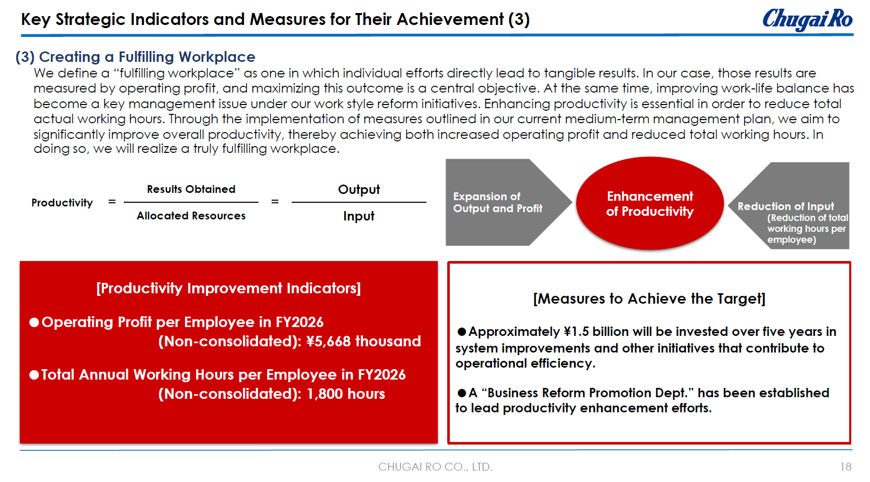
The final key strategy is “The creation of rewarding workplaces.” This is a measure to raise labor productivity by simultaneously increasing operating profit per person and reducing total actual work hours per person, thereby improving employees’ ease of work and job satisfaction.
Initiatives to create a fulfilling workplace
Source: Company materials
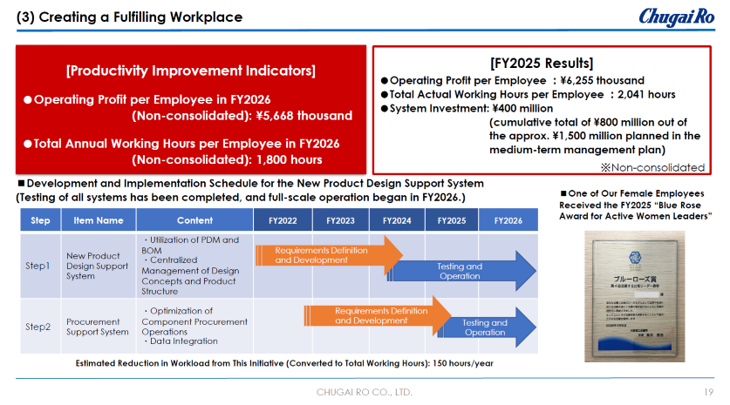
The numerical targets and progress are as follows. Operating profit per person is steady, but challenges remain in reducing total actual work hours.
Non-consolidated Operating profit per person Total actual work hours per person
FY2023 result 2,848 thousand yen 2,086 hours
FY2024 result 5,000 thousand yen 2,109 hours
FY2025 result 6,255 thousand yen 2,041 hours
FY2026 target 5,668 thousand yen 1,800 hours
Progress in creating a fulfilling workplace
Source: Company materials
Financial results
Full-year results for FY3/2026: Fifth consecutive year of increases in net sales and operating profit
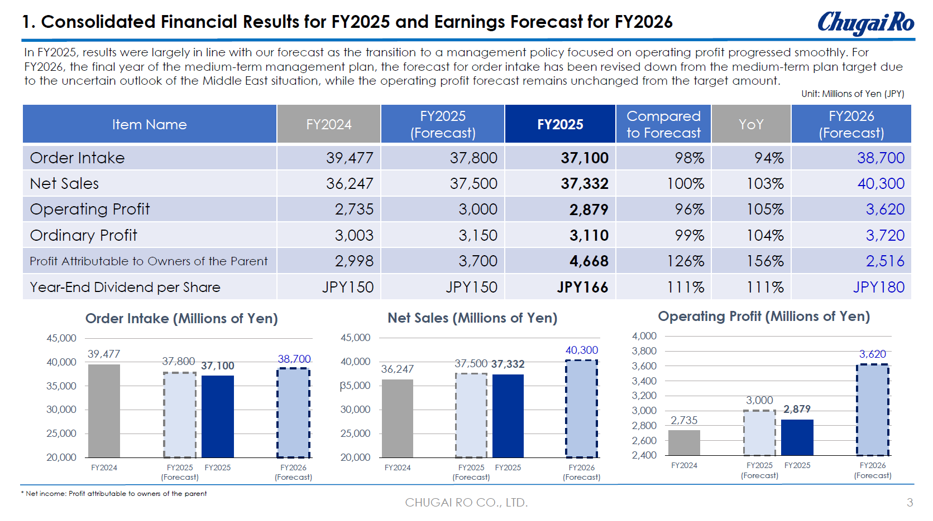
The consolidated financial results for FY3/2026 marked the fifth consecutive year of increases in net sales and operating profit. The operating profit margin was also 7.7%, the highest level in the past 15 years.
Order intake was 37.1 billion yen (down 6% YoY), 2% below the forecast. The Company secured orders for modification work on continuous annealing lines for steel in Japan, reheating furnaces for nonferrous metals, electric furnace dust recycling equipment for steel, ladle preheating equipment for electric furnaces, heat-treatment equipment related to next-generation batteries, and ovens for housing equipment components. The main reason order intake was sluggish was that customer orders slowed toward the end of the period due to heightened geopolitical risk. Order backlog was 37.7 billion yen (down 0.3% YoY).
Net sales were 37.3 billion yen (up 3% YoY), landing broadly in line with the forecast. Construction progressed steadily on projects such as production equipment for next-generation solar cells, heat-treatment equipment for electrode materials and solid electrolytes, energy-saving modification work on reheating furnaces for steel in Japan, deodorizing furnaces, stainless steel manufacturing facilities for overseas customers, and the Green Innovation Fund Project “Decarbonization of Thermal Processes in the Manufacturing Sector” of the New Energy and Industrial Technology Development Organization (NEDO), a National Research and Development Agency.
Operating profit and ordinary profit increased steadily to 2.9 billion yen (up 5% YoY) and 3.1 billion yen (up 4% YoY), respectively. Although they did not meet the Company’s forecast, the Company maintained a trend of higher sales and profits, and profitability improved. This was the result of advancing appropriate pricing and covering increases in labor, raw material, and other costs, indicating the penetration of a focus on profitability. Furthermore, the Company steadily proceeded with the sale of cross-shareholdings, and profit attributable to owners of parent was 4.7 billion yen (up 56% YoY). As a result, ROE was 15.7%. The year-end dividend per share was 166 yen (up 16 yen YoY).
Consolidated performance trends
Source: Company materials
Segment information
The segment trends are as follows. Net sales were driven by the Plant Engineering Business, increasing operating profit. The Heat Treatment Business and the Plant Engineering Business both generated earnings generally in line with expectations, but the subsidiaries in China and Mexico were weak (the Company is currently reviewing its strategy).
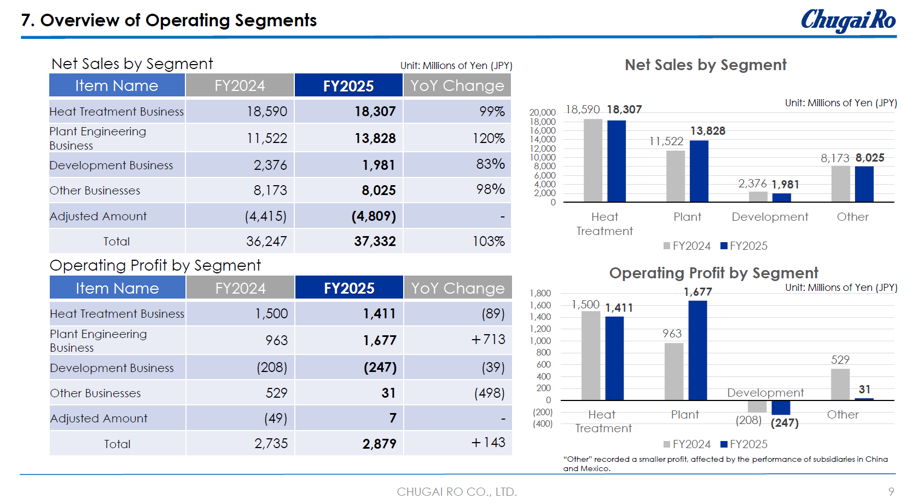
Source: Company materials
There were no major changes in the balance sheet, and the Company continues to have a high equity ratio (60.8%) and a low dependence on borrowings (8.7%). As of the end of March 2026, the Company achieved its target of reducing the cross-shareholding ratio to net assets to less than 20%. As a result, cash flow from investing was positive.
FY3/2027 full-year forecast: Final year of the Medium-Term Management Plan. Aiming for a sixth consecutive year of increases in net sales and operating profit
The Company’s forecast is order intake of 38.7 billion yen (up 4% YoY), year-end order backlog of 36.1 billion yen (down 4% YoY), net sales of 40.3 billion yen (up 8% YoY), operating profit of 3.62 billion yen (up 26% YoY), ordinary profit of 3.72 billion yen (up 20% YoY), profit attributable to owners of parent of 2.52 billion yen (down 46% YoY), and dividend per share of 180 yen (up 14 yen YoY). Forecast ROE excluding the sale of cross-shareholdings is 8.0%.
As the final year of the Medium-Term Management Plan, the Company expects net sales, operating profit, and ordinary profit to increase for the sixth consecutive year. In addition to steadily working through its order backlog, the Company plans to accumulate orders for functional-material heat-treatment equipment, solar-cell-related equipment, and combustion systems for steelmakers. On the profit side, the previous focus on profitability is expected to be maintained.
However, against the final targets of the Medium-Term Management Plan, order intake and net sales (42.0 billion yen and 41.5 billion yen, respectively) are expected to fall short of those targets. On the other hand, operating profit and ordinary profit are expected to be in line with the final targets, and profit attributable to owners of parent is expected to exceed the target (3.62 billion yen, 3.72 billion yen, and 2.45 billion yen, respectively, in the Medium-Term Management Plan). Since the plan was formulated, the business environment has changed, including tariffs and geopolitical risks. Hence, the slight downside in order intake and net sales is to some extent unavoidable. However, for profit, we would assess that the Company has established a structure to ensure the targets are achieved. The ROE target of 10.0% is likely to be missed at present, but the Company is expected to meet the 8% level expected of listed companies.
Initiatives to enhance corporate value
In addition to promoting the Medium-Term Management Plan, the Company has announced its “Initiatives to enhance corporate value”. It is implementing measures aimed at achieving and sustaining a PBR of 1.0. It is currently working on the seven items listed below, many of which have already been completed. PBR is also close to 1.0x. It can be said that the Company has entered a phase in which the stock price is firmly reflecting business expansion and improved ROE.
Initiatives to enhance corporate value and additional measures
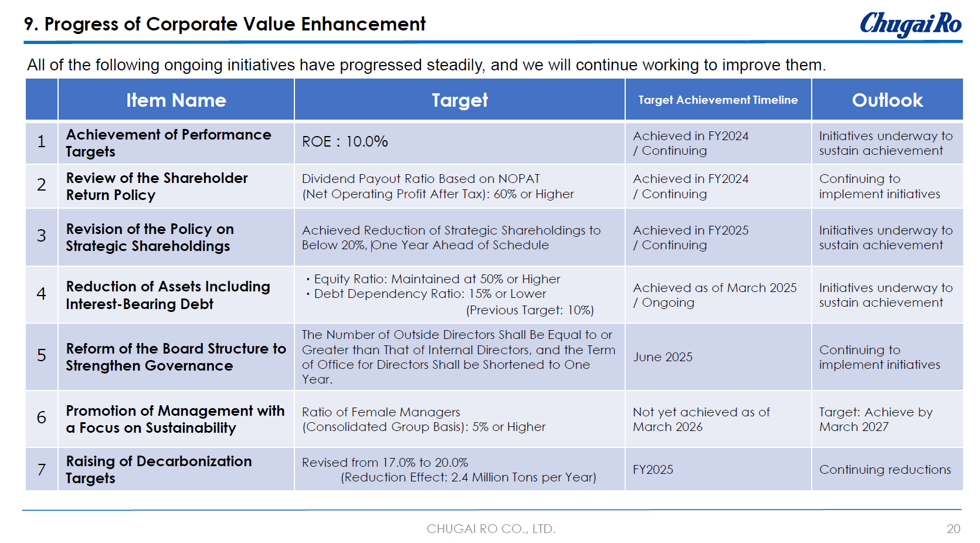
Source: Company materials
Trends in operating profit margin, ROE, and PBR
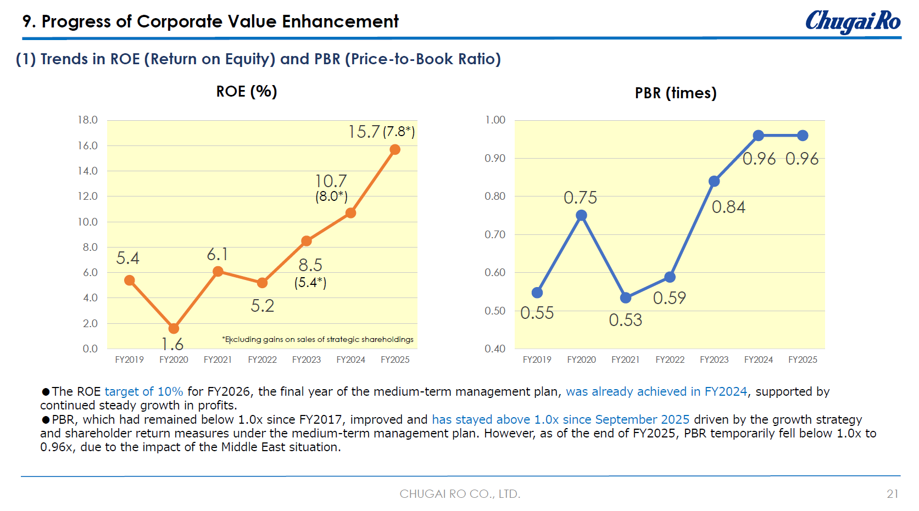
Source: Company materials
Shareholder return policy
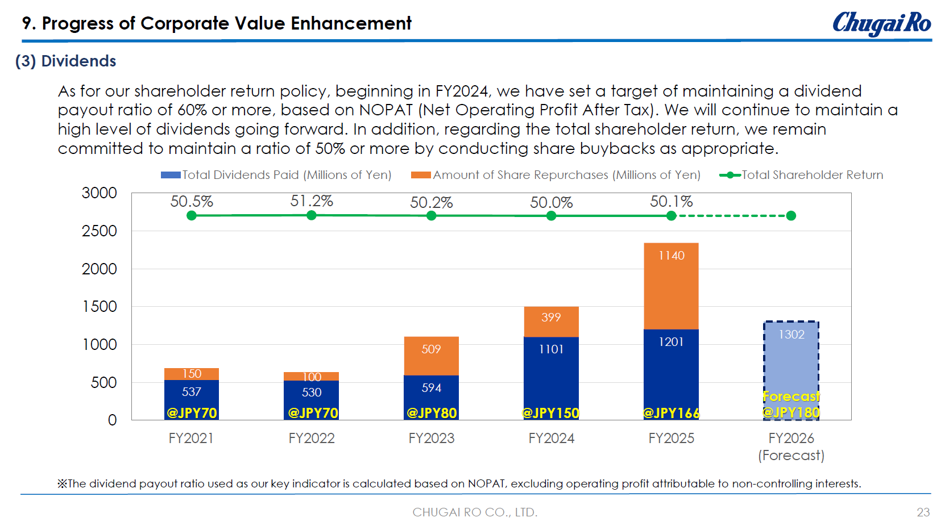
Source: Company materials
Share price trends and catalysts
Stock price trends
The Company’s stock price broke above the level around 3,000 yen, which had served as resistance since the 2010s, in 2024, and has maintained its upward trend since 2022. This should be viewed as the stock market reassessing its view of the Company in a positive direction. Specifically, the following are considered to have been evaluated:
- The Company is benefiting from the tailwind of the medium- to long-term social demand for carbon neutrality
- In response, the Company has advanced initiatives befitting a technology-oriented company in line with the Medium-Term Management Plan. It is on a trend of consecutive increases in net sales and profits.
- The Company is also advancing financial strategies, such as improving ROE, reducing cross-shareholdings, and maintaining the total shareholder return ratio, toward firmly establishing a PBR of 1.0x.
However, the stock price has been marking time recently. In particular, the following are concerns:
- Growth in order intake has slowed
- Challenges remain in improving labor productivity, and these are becoming a concern for future growth potential. It can be said that the stock market is not yet fully confident about the future upside in ROE.
Appointment of a new president
It should be noted that Mamoru Sakata was appointed as the new president, effective April 1, 2026, and is taking responsibility for advancing the formulation of the next Medium-Term Management Plan.
The key points from his remarks in the media and other sources to date can be summarized as follows:
- The Company will continue to advance responses to carbon neutrality. It will continue developing industrial furnaces and burners that use ammonia, hydrogen, and other fuels.
- New product sales will be 4.0 billion yen in FY3/2028, and the Company aims for 10.0 billion yen in FY3/2031, as in the previous plan.
- The Company will also continue brushing up existing businesses and other initiatives. Going forward, it will raise the level of the heat-treatment maintenance business.
- The Company will consider strengthening business development in North America and India.
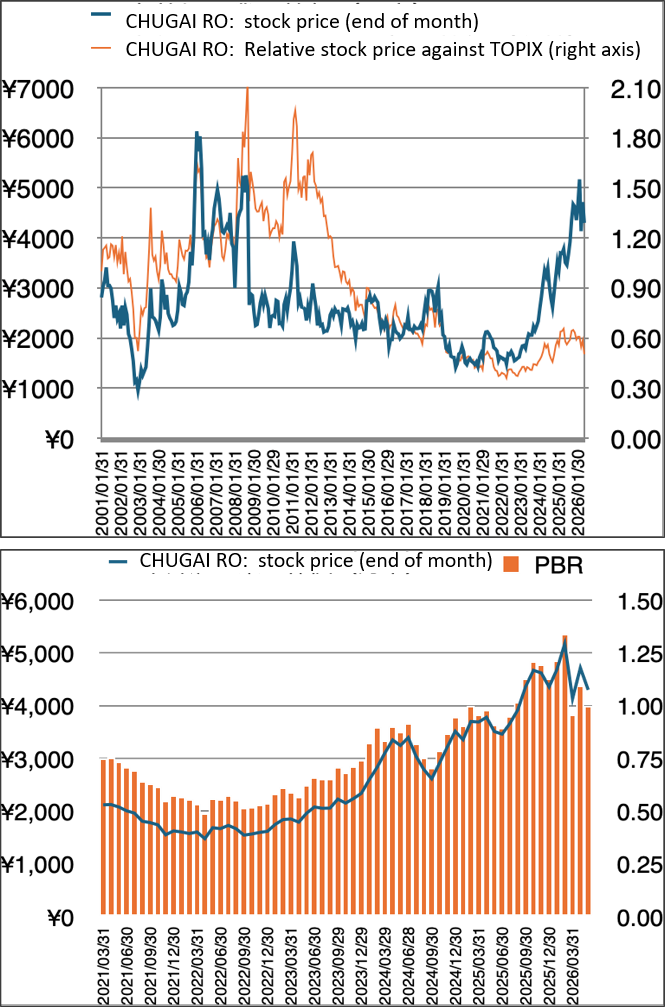
Based on the above, the key stock price catalysts to watch going forward are the following. If the new Medium-Term Management Plan shows that ROE above 10% will become firmly established, PBR has the potential to move up from around 1.0x, and we would like to continue monitoring the Company’s news flow.
- FY3/2027 earnings progress steadily
- Order intake recovers to an increasing trend
- Labor productivity improves
- Additional sales of cross-shareholdings are progressing, and the proceeds are used effectively.
- The direction of the new Medium-Term Management Plan becomes visible
- In numerical terms, a path to operating profit of 5.0 billion yen becomes visible
- In addition to carbon-neutrality-related areas and the conventional key customer areas of automotive and steel, the Company’s presence increases in areas such as production equipment for next-generation solar cells, all-solid-state batteries, and semiconductor manufacturing equipment, and earnings drivers are expanded
- A concrete strategy for overseas expansion is presented
- Recurring revenue is expanded
- A policy that goes further than before is presented regarding the reduction of the cost of capital, improvement of asset efficiency, and the approach to cash allocation
- The intellectual property strategy is promoted
- Diversity among executives and employees is promoted
As for risk factors, attention should be paid to whether enthusiasm for carbon neutrality among major customers may wane, whether relationships with suppliers may deteriorate, whether employee engagement can be maintained and improved, and whether there are any intellectual property risks.
Financial data
Source: Company materials, repost
Financial data
| Unit: million yen | 17/3 | 18/3 | 19/3 | 20/3 | 21/3 | 22/3 | 23/3 | 24/3 | 25/3 | 26/3 |
| (Income Statement) | ||||||||||
| Sales | 31,146 | 30,829 | 37,089 | 38,089 | 24,717 | 26,317 | 27,976 | 29,283 | 36,247 | 37,332 |
| Year-on-year | -5.0% | -1.0% | 20.3% | 2.7% | -35.1% | 6.5% | 6.3% | 4.7% | 23.8% | 3.0% |
| Cost of Goods Sold | 26,575 | 25,795 | 32,140 | 32,023 | 20,282 | 21,007 | 22,494 | 23,448 | 29,032 | 29,218 |
| Gross Income | 4,571 | 5,034 | 4,949 | 6,066 | 4,435 | 5,310 | 5,482 | 5,835 | 7,215 | 8,114 |
| Gross Income Margin | 14.7% | 16.3% | 13.3% | 15.9% | 17.9% | 20.2% | 19.6% | 19.9% | 19.9% | 21.7% |
| SG&A Expense | 3,797 | 3,853 | 3,962 | 4,354 | 4,046 | 4,046 | 4,172 | 4,356 | 4,478 | 5,235 |
| EBIT (Operating Income) | 774 | 1,181 | 987 | 1,712 | 389 | 1,264 | 1,310 | 1,479 | 2,737 | 2,879 |
| Year-on-year | 14.3% | 52.6% | -16.4% | 73.5% | -77.3% | 224.9% | 3.6% | 12.9% | 85.1% | 5.2% |
| Operating Income Margin | 2.5% | 3.8% | 2.7% | 4.5% | 1.6% | 4.8% | 4.7% | 5.1% | 7.6% | 7.7% |
| EBITDA | 1,112 | 1,527 | 1,378 | 2,080 | 749 | 1,676 | 1,710 | 1,953 | 3,289 | 3,422 |
| Pretax Income | 967 | 1,294 | 1,177 | 1,701 | 527 | 1,594 | 1,699 | 3,129 | 4,222 | 6,426 |
| Consolidated Net Income | 1,000 | 905 | 781 | 1,158 | 364 | 1,429 | 1,295 | 2,216 | 3,072 | 4,653 |
| Minority Interest | 21 | 40 | 26 | 37 | 35 | 69 | 64 | 19 | 74 | -14 |
| Net Income ATOP | 978 | 864 | 754 | 1,120 | 329 | 1,360 | 1,231 | 2,197 | 2,998 | 4,668 |
| Year-on-year | 79.4% | -11.7% | -12.7% | 48.5% | -70.6% | 313.4% | -9.5% | 78.5% | 36.5% | 55.7% |
| Net Income Margin | 3.1% | 2.8% | 2.0% | 2.9% | 1.3% | 5.2% | 4.4% | 7.5% | 8.3% | 12.5% |
| (Balance Sheet) | ||||||||||
| Cash & Short-Term Investments | 7,833 | 6,858 | 5,169 | 8,658 | 7,121 | 11,130 | 7,884 | 10,061 | 4,392 | 10,821 |
| Total assets | 38,502 | 41,368 | 42,731 | 46,696 | 38,577 | 38,141 | 41,178 | 48,863 | 48,736 | 51,282 |
| Total Debt | 3,988 | 4,010 | 4,995 | 9,988 | 5,988 | 3,988 | 3,988 | 7,288 | 5,507 | 4,445 |
| Net Debt | -3,845 | -2,848 | -174 | 1,330 | -1,133 | -7,142 | -3,896 | -2,773 | 1,115 | -6,376 |
| Total liabilities | 18,131 | 20,131 | 21,774 | 26,006 | 16,784 | 14,928 | 17,134 | 21,092 | 20,125 | 19,798 |
| Total Shareholders’ Equity | 20,295 | 21,138 | 20,875 | 20,589 | 21,681 | 23,068 | 23,860 | 27,570 | 28,329 | 31,201 |
| (Cash Flow) | ||||||||||
| Net Operating Cash Flow | 1,033 | 377 | -1,348 | -580 | 3,300 | 6,090 | -2,500 | -891 | -3,696 | 6,427 |
| Capital Expenditure | 145 | 512 | 380 | 305 | 449 | 216 | 244 | 1,355 | 723 | 1,318 |
| Net Investing Cash Flow | 402 | -837 | -478 | -442 | -551 | 510 | -63 | 550 | 654 | 2,588 |
| Net Financing Cash Flow | -484 | -468 | 279 | 4,510 | -4,481 | -2,508 | -727 | 2,451 | -2,701 | -2,641 |
| Free Cash Flow | 933 | 2 | -1,725 | -775 | 3,036 | 5,963 | -2,688 | -2,161 | -4,419 | 5,413 |
| (Profitability ) | ||||||||||
| ROA (%) | 2.50 | 2.17 | 1.80 | 2.51 | 0.77 | 3.55 | 3.10 | 4.88 | 6.14 | 9.33 |
| ROE (%) | 4.95 | 4.18 | 3.59 | 5.41 | 1.56 | 6.08 | 5.25 | 8.54 | 10.73 | 15.68 |
| Net Margin (%) | 3.14 | 2.81 | 2.04 | 2.94 | 1.33 | 5.17 | 4.40 | 7.50 | 8.27 | 12.50 |
| Asset Turn | 0.80 | 0.77 | 0.88 | 0.85 | 0.58 | 0.69 | 0.71 | 0.65 | 0.74 | 0.75 |
| Assets/Equity | 1.97 | 1.93 | 2.00 | 2.16 | 2.02 | 1.71 | 1.69 | 1.75 | 1.75 | 1.68 |
| (Per-share) Unit: JPY | ||||||||||
| EPS | 125.7 | 111.0 | 97.2 | 145.9 | 42.9 | 177.2 | 162.0 | 293.8 | 407.6 | 643.7 |
| BPS | 2,607.8 | 2,716.9 | 2,718.6 | 2,681.5 | 2,824.1 | 3,005.3 | 3,146.7 | 3,709.0 | 3,859.0 | 4,311.2 |
| Dividend per Share | 60.00 | 60.00 | 60.00 | 60.00 | 60.00 | 70.00 | 70.00 | 80.00 | 150.00 | 166.00 |
| Shares Outstanding (million shares) | 7.80 | 7.80 | 7.80 | 7.80 | 7.80 | 7.80 | 7.80 | 7.80 | 7.80 | 7.80 |
Corporate data
Source: Company materials
Source: Company materials
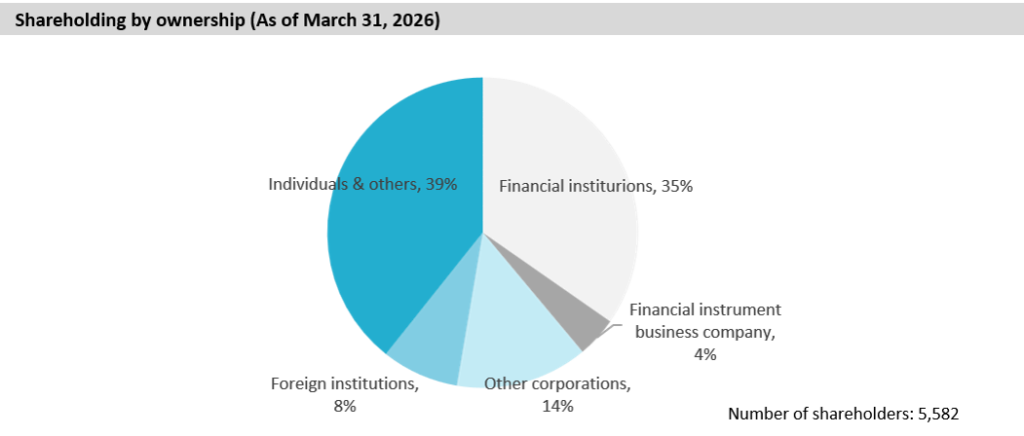
Source: Omega Investment from company materials