2026-10-13
Home
Japanese

Omega Investment Co., Ltd.
tripla (5136 : Price Discovery)
Buy
| Share Price | Forecast EPS | Forecast PER | Actual BPS |
| 2,756 yen | 129.26 yen | 21.32 x | 383.66 yen |
| Actual PBR | Forecast ROE | Forecast Dividend | Forecast Dividend Yield |
| 7.18 x | 33.69 % | 0 yen | 0.00 % |
Conclusion
BUY. tripla has entered a phase in which profit growth outpaces revenue growth, driven by GMV expansion at tripla Book, which supports direct bookings by accommodation operators, an improving usage-based fee rate, and more efficient infrastructure costs. A forecast PER of approximately 21x is attractive in light of a doubling of profits and ROE of approximately 34%. However, most of the cash reflects deposits received for accommodation payments, and we do not apply a low valuation based on mechanically deducting net cash. Our investment judgment is based on earnings power excluding settlement funds, with changes in accommodation demand, the take rate and interest income on deposits received constituting the principal risks.
Profile
An accommodation DX platform integrating direct bookings, customer management and payments
Centered on tripla Book, a booking engine for accommodation operators’ official websites, tripla offers tripla Bot, CRM and marketing automation (MA), tripla Pay and other services. Usage-based revenue linked to GMV¹ is expanding, helping accommodation operators reduce their dependence on online travel agents (OTAs) and bring customer touchpoints in-house. Book revenue in Q3 FY10/2026 was ¥670 million, up 82.6% year on year, with usage-based revenue accounting for approximately 80% and a take rate² of 1.65%. Revenue breakdown by business (operating margin): business-specific operating margins are not disclosed, as the company reports a single segment.
1. GMV (Gross Merchandise Value: gross transaction value)
The total value of accommodation bookings made through tripla’s booking system, tripla Book. For example, if a guest books a hotel room for one night at ¥20,000 using tripla Book, GMV is ¥20,000. However, this does not mean that all ¥20,000 constitutes tripla’s revenue.
2. Take rate (commission rate)
The proportion of GMV that tripla receives as usage-based revenue.
Stock Hunter’s View
Accommodation DX continues to grow rapidly. Two upward revisions in FY10/2026.
tripla provides tripla Book, which implements an accommodation booking function on accommodation operators’ own official websites. It also supports digital transformation (DX) in the accommodation industry through services including tripla Bot, which adds a multilingual chatbot to official websites; CRM and MA tools specifically designed for accommodation operators; and tripla Pay, an on-site payment function.
Although it was a relatively late entrant to the industry, launching its service in July 2019, tripla has been recognised for its excellent UI/UX (customer interface and customer experience) and ability to develop features sought by accommodation operators rapidly, and has steadily increased the number of properties using its services even during the COVID-19 pandemic. tripla Book remains a powerful driver of earnings.
Book revenue in Q3 maintained strong growth at ¥670 million (up 82.6% year on year), with usage-based revenue accounting for 80%. The take rate reached 1.65%, setting a new record for the second consecutive quarter. Strong inbound demand from independent travellers, particularly from neighbouring countries, is lifting GMV (transaction value).
Following two upward revisions during the year, the company forecasts revenue of ¥3,608 million (up 40.2% year on year) and operating profit of ¥1,029 million (up 98%) for FY10/2026. In addition, Book usage-based fees show strong seasonality in Q4, which includes August, and the revised forecast still appears to have scope for further upside.
Investor’s View
Earnings quality is improving, but deposits received are not surplus cash
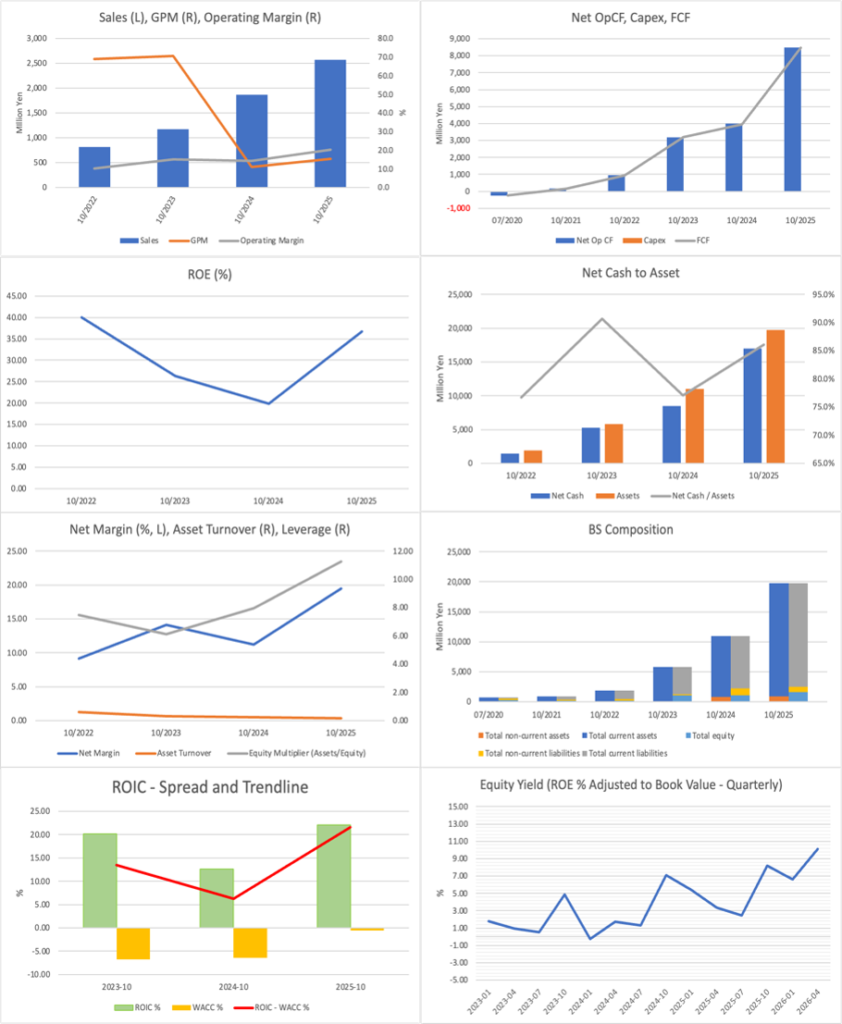
We place greater weight on margin improvement than on revenue growth. In the first nine months of FY10/2026, revenue rose 43.2% year on year to ¥2,613 million, while operating profit increased 133.7% to ¥758 million and the operating margin improved to 29.0%. The full-year company forecast is for revenue of ¥3,608 million and operating profit of ¥1,029 million, implying an operating margin of 28.5%. Trends in revenue, gross margin and operating margin indicate a transition to a phase in which greater scale translates into profit.
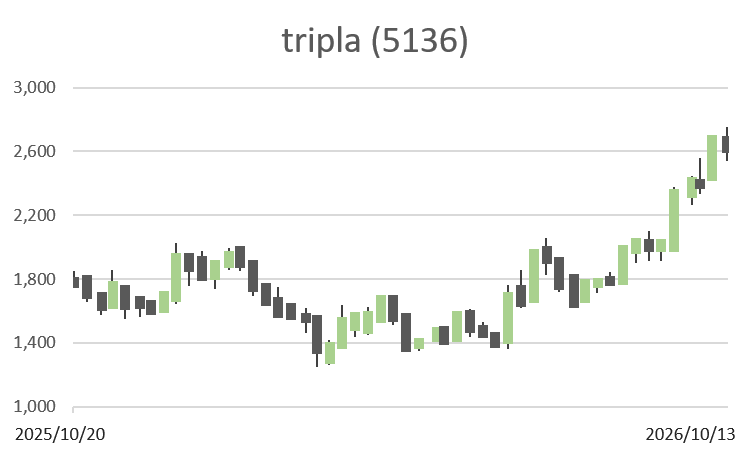
Underperformance since listing is not synonymous with business failure. After the high PER and PBR immediately following the listing priced in overly optimistic growth expectations, valuation multiples contracted. While EPS and ROE have improved, PER and PBR have fallen sharply from their early post-listing levels, and for an extended period the share price did not fully reflect earnings growth.
The rises in June and September had clear catalysts in earnings forecast revisions. Following an upward revision on 15 June, the company raised its forecast again on 14 September. The following day, 15 September, shares gapped up, opening at ¥2,208 versus the previous close of ¥2,013 and finishing at ¥2,290. In addition to GMV, the take rate, improved server cost efficiency, and interest income from increased deposits also support ordinary profit. Consequently, operating profit and financial income should be assessed separately when evaluating the sustainability of earnings.
The large cash balance on the balance sheet represents working capital for a payment platform. At the end of July 2026, cash and deposits stood at ¥25,039 million against deposits received of ¥23,074 million, reflecting a structure in which accommodation payments are held temporarily until settlement with the properties. GMV growth, a rising proportion of advance payments and settlement timing can increase both balances, but deposits received are, in principle, liabilities owed to customers and accommodation operators rather than funds available for shareholder returns. Cash less deposits received was only ¥1,965 million; subtracting borrowings of ¥846 million leaves approximately ¥1,118 million (before deducting other liabilities and required working capital).
A mechanical net-cash-adjusted PER is meaningless. Borrowings in the latest quarter comprised ¥227 million due within one year and ¥620 million in long-term borrowings, totalling ¥846 million. The difference between cash and borrowings, ¥24,193 million, exceeds market capitalisation of approximately ¥16,364 million, producing a PER × (1 − net cash/marketapitalisation) of approximately −10.2x. This is not evidence of undervaluation. Using provisional surplus cash of ¥1,118 million after deducting deposits received gives an adjusted PER of approximately 19.9x, a limited difference from the unadjusted PER.
Cash may continue to increase, but this is not equivalent to permanently generating freely available cash. If transaction value and the advance-payment ratio increase, settlement float will rise, although it could also fall because of lower accommodation demand, shorter settlement periods, or changes in payment methods. Trends in standardised operating cash flow and free cash flow, net cash to total assets and balance-sheet composition illustrate the danger of treating inflows of deposits received in the same way as ordinary free cash flow or financial security. As investors, we would like the company to disclose cash after deducting deposits received, adjusted operating cash flow and interest income on an ongoing basis.
We acknowledge the high ROE, while exercising caution in interpreting capital efficiency. Forecast EPS of ¥129.26 divided by the latest BPS of ¥383.66 gives a simplified ROE of 33.69%. ROE, ROIC, net margin, total asset turnover and financial leverage indicate improving profitability, but because settlement deposits inflate both assets and liabilities, it is inappropriate to judge financial risk solely from the equity ratio of 8.5%.
The shareholder distribution combines a long-term orientation with liquidity constraints. Major shareholders are Itaru Toriu (19.28%), Kazuhisa Takahashi (13.24%), Wojciech Jakub Podobas (4.08%), Hikari Tsushin (3.86%), and Rheos Capital Works (2.78%). Large management shareholdings align interests, while institutional investors hold 5.08% and the free float is 57.1%, leaving shares susceptible to news flow and supply-and-demand conditions. Hikari Tsushin’s stake attracts market attention, but its purpose and future trading should not be speculated upon.
Financials and Valuations
Price

PBR (LTM)

PER (LTM)

ROE (LTM)

EPS (LTM)

BPS (LTM)
